
Baseball has nine defensive positions, numbered 1 through 9 for scoring. Position 1 is the pitcher, 2 is the catcher, 3 is first base, 4 is second base, 5 is third base, 6 is shortstop, 7 is left field, 8 is center field and 9 is right field. Those numbers are a baseball scorekeeper’s shorthand for the defensive spot involved in a play—not the player’s jersey number or their place in the batting order.
The chart, field layout and sample scorebook plays below explain how all nine positions work and why a double play can appear as 6–4–3. This reference follows the positions defined by MLB’s official Baseball Basics guide, checked on October 11, 2026.
Baseball positions and numbers: the complete 1–9 chart
| No. | Position | Abbreviation | Main location and responsibility |
|---|---|---|---|
| 1 | Pitcher | P | Mound; delivers pitches and fields balls near the mound. |
| 2 | Catcher | C | Behind home plate; receives pitches, helps manage the running game and protects the plate. |
| 3 | First baseman | 1B | Near first base; receives throws for force outs and fields the right side of the infield. |
| 4 | Second baseman | 2B | Right side of second base; covers ground balls and pivot plays around second. |
| 5 | Third baseman | 3B | Near third base; reacts to hard-hit grounders and throws across the diamond. |
| 6 | Shortstop | SS | Between second and third base; fields the middle infield and often starts double plays. |
| 7 | Left fielder | LF | Left side of the outfield from the catcher’s viewpoint; tracks fly balls and throws toward the infield. |
| 8 | Center fielder | CF | Middle of the outfield; covers the largest central area and coordinates many outfield catches. |
| 9 | Right fielder | RF | Right side of the outfield from the catcher’s viewpoint; tracks deep balls and makes throws to the bases. |
Where do the nine baseball positions stand?
To picture the field, stand behind home plate looking out toward center field. The catcher (2) is nearest you, with the pitcher (1) in front on the mound. First base (3) is on your right and third base (5) is on your left. The second baseman (4) normally works to the right of second base as you look outward, while the shortstop (6) normally works to its left. The left fielder (7), center fielder (8) and right fielder (9) form the deepest defensive line.
Positions describe roles, not exact pieces of turf. Teams can shift their defenders within legal positioning requirements, vary depths by hitter and situation, and move infielders to cover a base. A player’s usual location may change from pitch to pitch. The nine-number scoring key remains the same because it names the position that made the play.
Infield positions
The infield consists of the pitcher, catcher, first baseman, second baseman, third baseman and shortstop—numbers 1 through 6. The four primary infielders (3 through 6) play around the bases, while the pitcher and catcher form the pitching and receiving battery. Ground balls, tags and short throws often involve these positions.
Outfield positions
The outfield consists of left, center and right field—numbers 7, 8 and 9. These players defend the deeper grass, catch fly balls and return hits to the infield. Center field is often associated with wide-ranging coverage; right field can require a powerful throw across to third base. Individual team choices depend on player strengths and field conditions.
Why is the shortstop number 6 instead of 5?
The scorekeeping sequence assigns 5 to the third baseman and 6 to the shortstop. It is a historical fielding numbering convention, not a straight left-to-right scan across the infield. Fans sometimes assume shortstop should be five because the shortstop stands between second and third. On every standard 1–9 fielding chart, however, the answer remains shortstop = 6 and third base = 5.
What do 6–4–3 and 5–3 mean in a baseball scorebook?
A sequence of defensive position numbers tells you which fielders handled a putout. Read the numbers in the order the ball was handled in a successful defensive play. Common examples:
| Scorebook notation | Plain-English meaning |
|---|---|
| 6–4–3 | Shortstop fields it and throws to second baseman at second, who relays to first baseman for a double play. |
| 4–6–3 | Second baseman to shortstop at second, then to first baseman: another common double play. |
| 5–3 | Third baseman fields a ground ball and throws to first baseman for the out. |
| 6–3 | Shortstop fields a ball and throws to first baseman for the out. |
| F8 or 8 | Center fielder catches a fly ball; some scorebooks prefix the position with F for flyout. |
| F7 | Left fielder catches a fly ball for an out. |
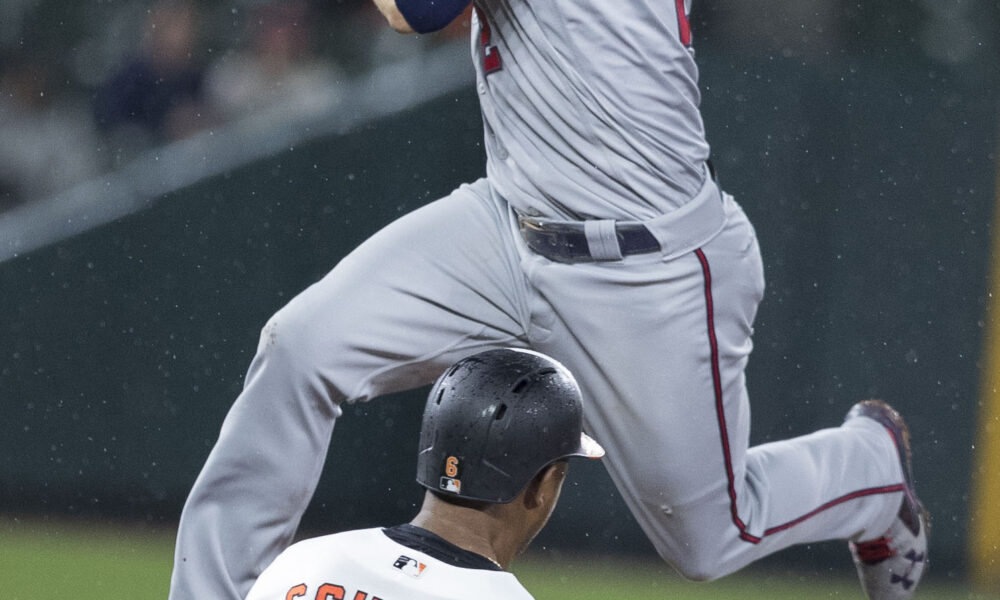
The featured photo shows second baseman Brian Dozier working around second base during a double-play attempt in a 2017 game. That visual illustrates why positions 4 and 6 frequently appear together in double-play notation. It does not mean that the exact photographed play was scored 6–4–3; the examples above are explanatory.
For a deeper explanation of how a fielder retires a runner, see our force out vs. tag out guide. Our fielder’s choice explainer covers a related scoring decision.
Baseball position numbers vs. jersey numbers vs. batting order
These three systems refer to different things, and confusing them makes scorecards hard to read:
- Fielding position number: 1 to 9, attached to the defensive role; a shortstop is 6 regardless of their uniform number.
- Jersey number: the number printed on a player’s uniform; it can be 2, 6, 42 or another permitted roster number and need not match their fielding position.
- Batting-order spot: where a hitter appears in the team’s lineup, from first through ninth. A player batting first could be the center fielder (8), while the player batting ninth could be the catcher (2).
Example: suppose a shortstop wears jersey 11 and bats third. In scorekeeping, a ground ball handled by that player still begins with the fielding number 6, not 11 and not 3.
Where does the designated hitter (DH) fit?
The designated hitter bats in place of the pitcher under the applicable rules, but DH is not a tenth on-field defensive position with a standard number 10. A team still fields nine defensive players at a time: pitcher, catcher, four infielders and three outfielders. In standard MLB lineups using a DH, one hitter does not need to play defense. The lineup’s offensive and defensive assignments therefore cannot always be mapped onto each other one-to-one.
It is useful to distinguish the DH from the pinch hitter, who enters as a batting substitution. Our pinch hitter guide explains that separate role.
What does each position need to do well?
No single position is automatically the easiest. Each has a different skill mix:
- Pitcher (1): repeatable delivery, control, situational fielding and communication.
- Catcher (2): receiving, blocking, throwing and awareness of runners.
- Corner infield (3 and 5): secure catches, quick reaction to hard-hit balls and accurate throws; first base especially demands reliable picks.
- Middle infield (4 and 6): agility, quick transfers, footwork around second and turning double plays.
- Outfield (7, 8 and 9): tracking the ball, judging its flight, coordinated coverage and strong throws.
At beginner or youth levels, rotating athletes among safe, age-appropriate positions helps them learn more than one part of the game. For competitive play, coaches also account for which player can throw accurately over the necessary distance and who can track fly balls.
How to remember baseball positions 1–9
Learn the first two as the battery: 1 pitcher, 2 catcher. Then go around the infield: 3 first base, 4 second base, 5 third base, 6 shortstop. End with the outfield arranged left to right: 7 left, 8 center, 9 right. Remember the one counterintuitive detail—shortstop is 6—rather than trying to guess the entire sequence from a drawing.
Baseball positions FAQ
What position is 6 in baseball?
Shortstop. The shortstop normally fields between second and third base and often receives or starts double-play throws.
What position is 4 in baseball?
Second baseman. In a typical 6–4–3 double play, the second baseman is the middle link receiving the shortstop’s throw before relaying to first.
What position is number 9 in baseball?
Right fielder—the defender on the right side of the outfield when looking outward from home plate.
Why are there nine baseball positions?
Each team has nine fielders when defending: the pitcher, catcher, four regular infielders and three outfielders. The DH is an offensive role, not an extra player on the field.
Does a 6–4–3 play mean players with jersey numbers 6, 4 and 3?
No. The numbers refer to positions: shortstop, second baseman, then first baseman, regardless of those players’ jersey numbers.
Are baseball and softball position numbers the same?
The common nine-position fielding notation is shared, although particular game rules, field sizes and additional formats differ. Check the rules of the league you are scoring.
Are the defensive positions fixed in place?
The role names remain fixed, but a defender’s starting spot can shift depending on the batter, game situation and current fielding rules.
Sources and image attribution
Definitions reviewed October 11, 2026 using MLB — Baseball Basics: On the Field and MLB — Positions Glossary. Also see our guide to innings, extra innings and walk-offs for the game’s broader structure.
Featured image: Keith Allison, “Second baseman Brian Dozier trying to turn double play,” 2017, Wikimedia Commons, CC BY-SA 2.0. Unmodified by AVARIXO.

Other Articles

High Jump Rules Explained: Technique, Scoring, Attempts and Ties
NBA Divisions Explained: All 30 Teams in 6 Divisions (2026–27)
