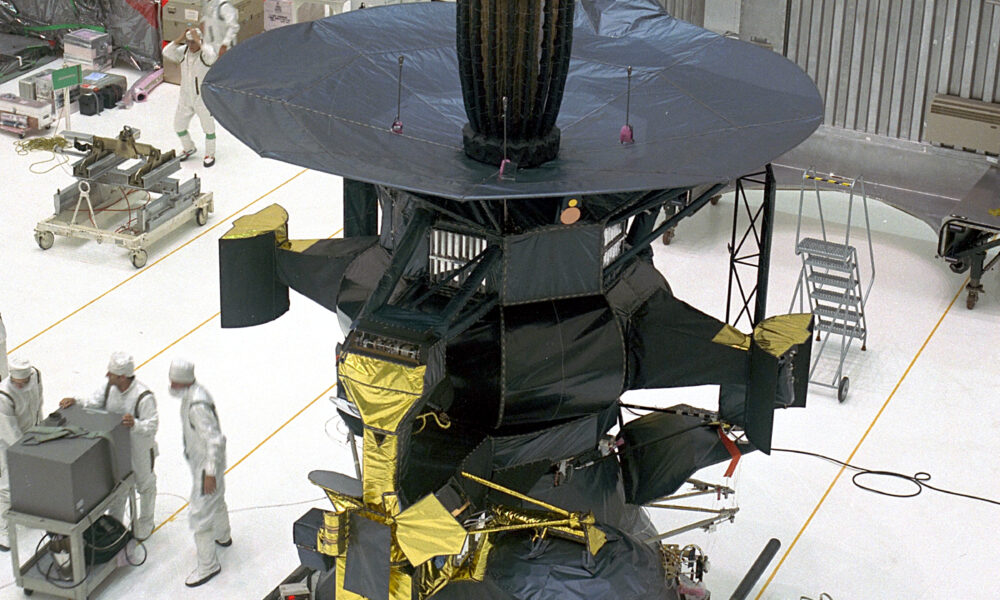

Quick answer: The Galileo spacecraft was NASA’s robotic mission to Jupiter, launched aboard Space Shuttle Atlantis on October 18, 1989. It entered Jupiter orbit on December 7, 1995, studied the giant planet and its moons for nearly eight years, and was deliberately sent into Jupiter on September 21, 2003. It consisted of a long-lived orbiter and a separate atmospheric entry probe. The photographs in this guide show the real hardware, not an artist’s impression.
Galileo spacecraft: essential mission facts
| Question | Verified answer |
|---|---|
| Who operated Galileo? | NASA; the Jet Propulsion Laboratory managed the mission. |
| What launched it? | Space Shuttle Atlantis, flight STS-34, on October 18, 1989. |
| Where did it go? | Venus and Earth gravity assists, two asteroid encounters, then Jupiter and its moons. |
| When did it enter Jupiter orbit? | December 7, 1995. |
| Was there also a Jupiter probe? | Yes. A smaller entry probe descended into Jupiter’s atmosphere and sent back data for 58 minutes. |
| What happened to the orbiter? | It was intentionally directed into Jupiter on September 21, 2003. |
| Is Galileo still operating? | No. Galileo ended in 2003; it is not an active spacecraft. |
What did the real Galileo spacecraft look like?
Galileo was not a sleek fictional spaceship. Its real flight hardware included a large folding high-gain antenna, instrument booms, protective thermal blankets, a propulsion system, scientific cameras and particle-detecting equipment. It used radioisotope power rather than depending on large solar panels for electricity so far from the Sun. This is a photograph of Galileo and its attached upper-stage booster after deployment from Atlantis on October 18, 1989.
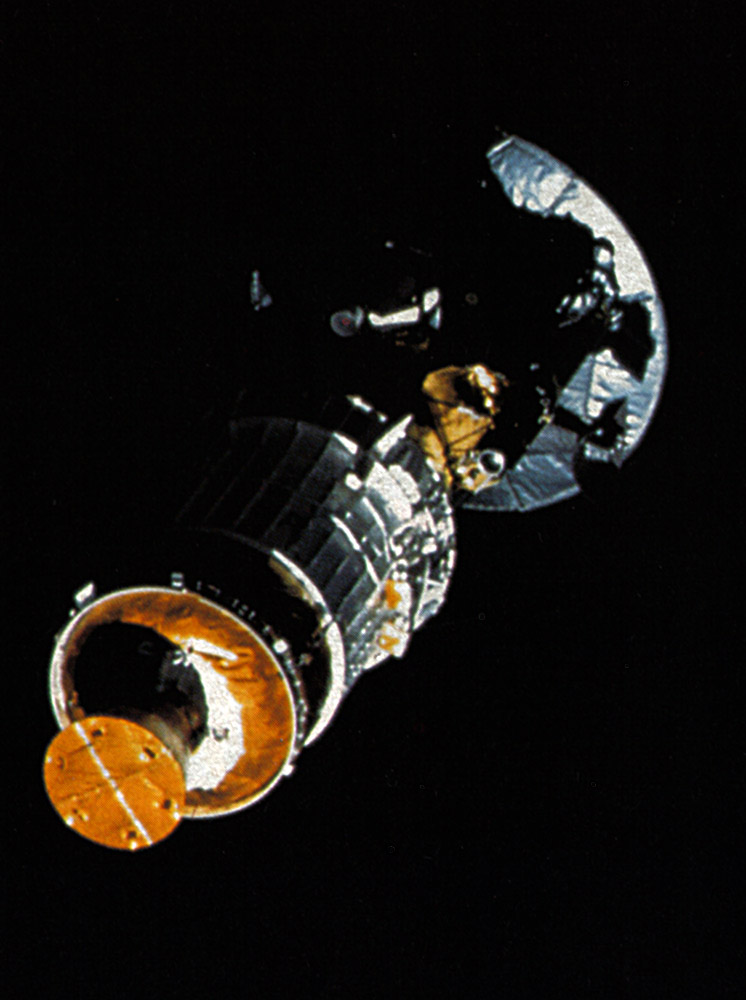
How to distinguish a real picture from artwork: a cleanroom image shows technicians, equipment and the actual spacecraft on Earth; the shuttle deployment photograph was taken in orbit. A colorful picture of Galileo flying beside Jupiter is usually an illustration—there were no external cameras following Galileo around Jupiter to take such a portrait.
Why did Galileo need six years to reach Jupiter?
Jupiter is much farther from the Sun than Earth, and Galileo did not simply point straight outward after launching. The mission used a Venus–Earth–Earth gravity-assist route: Venus in February 1990, Earth in December 1990, and Earth again in December 1992. These flybys altered the spacecraft’s trajectory and energy without requiring a proportionally enormous fuel supply. Along the way, it examined asteroid 951 Gaspra and 243 Ida, helping to establish what spacecraft close-up observations of asteroids could reveal.
Galileo mission timeline
| Date | What happened | Why it matters |
|---|---|---|
| October 18, 1989 | Launch aboard Atlantis | Begins interplanetary mission |
| 1990–1992 | Venus and two Earth flybys | Gravity assists toward Jupiter |
| 1991 | Main high-gain antenna fails to deploy fully | Forces lower-rate communications strategy |
| 1991 and 1993 | Asteroid encounters with Gaspra and Ida | Early close-up asteroid science |
| July 1995 | Atmospheric probe released | Probe begins separate Jupiter encounter |
| December 7, 1995 | Probe enters atmosphere; orbiter reaches Jupiter | First mission to orbit Jupiter |
| 1995–2003 | Orbital observations and moon flybys | Europa, Io, Ganymede and other discoveries |
| September 21, 2003 | Controlled entry into Jupiter | Ends mission while reducing contamination risk |
Why was Galileo’s antenna failure so important?
Galileo’s large high-gain antenna was supposed to open like an umbrella and return substantial volumes of science data. It failed to open completely in 1991. The spacecraft was not lost, but its original communications plan became impossible. Engineers relied on its lower-gain antenna, improved data compression, reworked communications protocols and reception using larger or combined ground antennas. NASA reports that these measures improved the effective science return compared with the very low initial capability.
This engineering story matters because Galileo’s central objective survived even though a major system did not perform as designed. A useful distinction: the antenna did not prevent Galileo from entering Jupiter orbit; it restricted how quickly the spacecraft could send observations back to Earth.
What did Galileo discover at Jupiter?
Europa: strong clues of a hidden ocean
Galileo’s views of Europa’s fractured icy surface, plus measurements of its environment, supplied important evidence consistent with a salty subsurface ocean. That did not mean Galileo drilled through the ice or directly photographed living organisms. The ocean conclusion arose from scientific interpretation of multiple observations, and Europa remains a subject of later investigations.
Ganymede: a magnetic field around a moon
Galileo measured evidence that Ganymede has its own internally generated magnetic field—an exceptional result for a moon. The finding changed the scientific picture of Jupiter’s largest satellite and helped researchers think about its internal structure.
Io: extraordinary volcanic activity
The orbiter documented continuing eruptions and volcanic features on Io. The moon’s persistent activity arises from intense tidal flexing associated with its orbit around Jupiter and gravitational interactions in the Jovian system. Galileo’s flybys provided detailed observations, but conditions near Jupiter limited how much could be transmitted and how long instruments could survive.
Comet impact and planetary environment
Galileo also viewed effects of the 1994 Shoemaker–Levy 9 comet impacts on Jupiter, studied its atmosphere and magnetosphere, and examined smaller moons and dusty rings. Its encounter science was wider than photographs alone: spectrometers, magnetometers and plasma instruments allowed measurements invisible to ordinary cameras.
Galileo orbiter vs Jupiter atmospheric probe
| Galileo orbiter | Atmospheric probe | |
|---|---|---|
| Location | Repeated orbits and flybys in Jupiter system | One-way descent through Jupiter’s atmosphere |
| Main purpose | Long-term imaging and remote/field measurements | Direct atmosphere measurements |
| Scientific operation | Years | About 58 minutes during descent |
| Fate | Controlled entry in 2003 | Lost to Jupiter’s extreme conditions in 1995 |
These were two separate vehicles within one mission. The probe was released months before arrival, while the orbiter remained in the Jovian system to receive the probe’s signal and conduct its own long-term science. The common shorthand “Galileo landed on Jupiter” is misleading: Jupiter has no conventional solid surface where the probe could land intact.
Why did NASA deliberately destroy Galileo?
By 2003, Galileo was aging and running low on the resources needed for controlled mission operations. NASA chose a trajectory that would send the orbiter into Jupiter’s atmosphere rather than leave any possibility of an eventual accidental collision with Europa or another scientifically sensitive moon. Preventing terrestrial microbes aboard a spacecraft from contaminating environments of interest to astrobiology is a major reason for planetary protection procedures.
Galileo vs Juno: are they the same mission?
No. Galileo launched in 1989 and ended in 2003. Juno is a later mission, launched in 2011, designed to study Jupiter from a very different orbit using a different suite of instruments and solar-power technology. Galileo is particularly remembered for repeated close encounters with major moons, while Juno was built to investigate Jupiter’s interior, atmosphere and magnetic environment. When reading a 2026 headline about Jupiter, check which mission supplied the original data; historic Galileo findings and present-day analysis of that archived data are not the same as a live Galileo transmission.
For a separate look at space instrumentation, see AVARIXO’s Roman Space Telescope mission guide. To understand a very different observing mission, read what Hubble’s Deep Field actually shows. Those missions observe different objects; neither is a replacement for a Jupiter orbiter.
Frequently asked questions
Did Galileo reach Jupiter in 1989?
No. It launched in October 1989 but arrived in December 1995 after gravity-assist flybys and asteroid encounters.
Is the Galileo spacecraft still in space?
Not as an operating probe. NASA deliberately ended the orbiter in Jupiter’s atmosphere on September 21, 2003.
Was Galileo the first spacecraft to explore Jupiter?
No. Earlier flyby spacecraft explored Jupiter, but Galileo was the first to enter orbit around the planet and the first to send a purpose-built probe into its atmosphere.
Did Galileo prove there is life on Europa?
No. It provided evidence supporting the possibility of a subsurface ocean, not proof of life.
Are NASA’s photographs of Galileo genuine?
Yes, the real prelaunch and STS-34 images reproduced here document the spacecraft itself. A spacecraft pictured flying near Jupiter from an outside camera viewpoint is typically an artist’s illustration.
What to remember
The story of Galileo is not only that it reached Jupiter. It is the story of a spacecraft that continued scientific exploration after a serious communications failure, revealed a dynamic system of moons, and was ultimately retired with planetary protection in mind. The mission remains historically important, but it is finished—not a source of live 2026 readings.
For independent fact-checking, the NASA Galileo mission overview, JPL mission archive and NASA’s detailed historical account provide flight dates, instrumentation and findings.