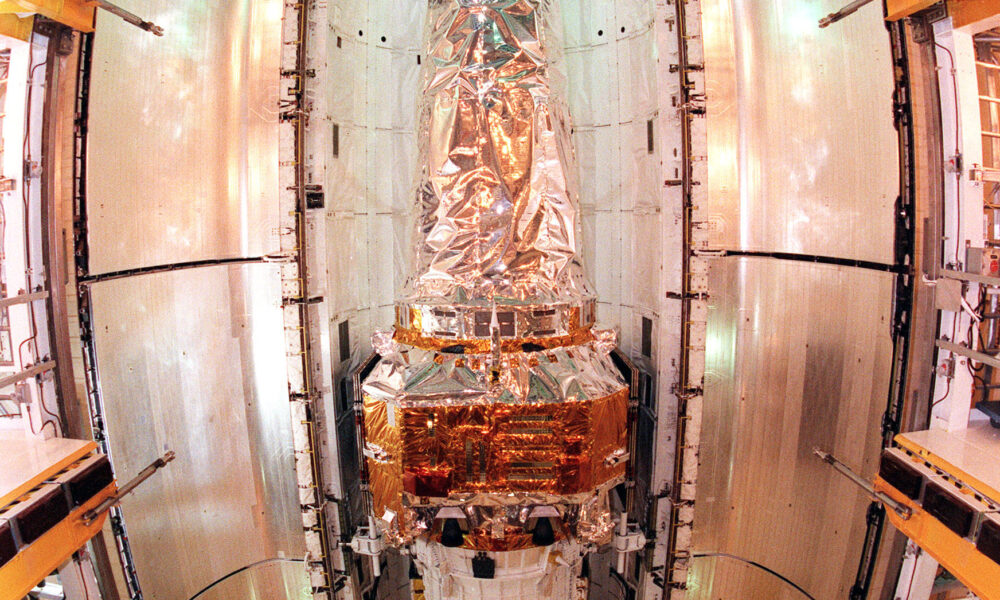

Quick answer: The Chandra space telescope—officially NASA’s Chandra X-ray Observatory—is a real orbiting observatory designed to study X-rays from exceptionally hot and energetic regions of the universe. Launched on July 23, 1999, it sees a different part of the electromagnetic spectrum from the Hubble and James Webb space telescopes. The actual hardware photographs in this guide show Chandra in shuttle-launch preparations and its mirror assembly; they are not computer-generated spacecraft illustrations.
Chandra space telescope: facts at a glance
| Question | Answer |
|---|---|
| Official name | Chandra X-ray Observatory (CXO) |
| Launch | July 23, 1999, aboard Space Shuttle Columbia (STS-93) |
| What light does it detect? | X-rays from cosmic objects and hot plasma |
| Where is it? | A highly elliptical orbit around Earth, not a telescope on the Moon |
| Why its name? | Honors physicist Subrahmanyan Chandrasekhar |
| What can it study? | Supernova remnants, black-hole environments, galaxy clusters and stars |
| Mission status in October 2026 | NASA currently labels the mission active; operational status can change |
| Who operates it? | NASA program management with science operations through the Chandra X-ray Center |
What does the real Chandra telescope look like?
The featured image is a historical photograph of the actual observatory and associated launch hardware inside Space Shuttle Columbia’s payload bay at Kennedy Space Center in 1999. The launch-day photograph documents a real flight system, not the colorful stylized pictures commonly used in news articles about X-ray astronomy.
A second authentic image below shows technicians handling Chandra’s X-ray telescope assembly before launch. Its long, carefully aligned structure helps explain one of the main engineering challenges: focusing X-rays requires optical geometry very different from an ordinary camera lens.
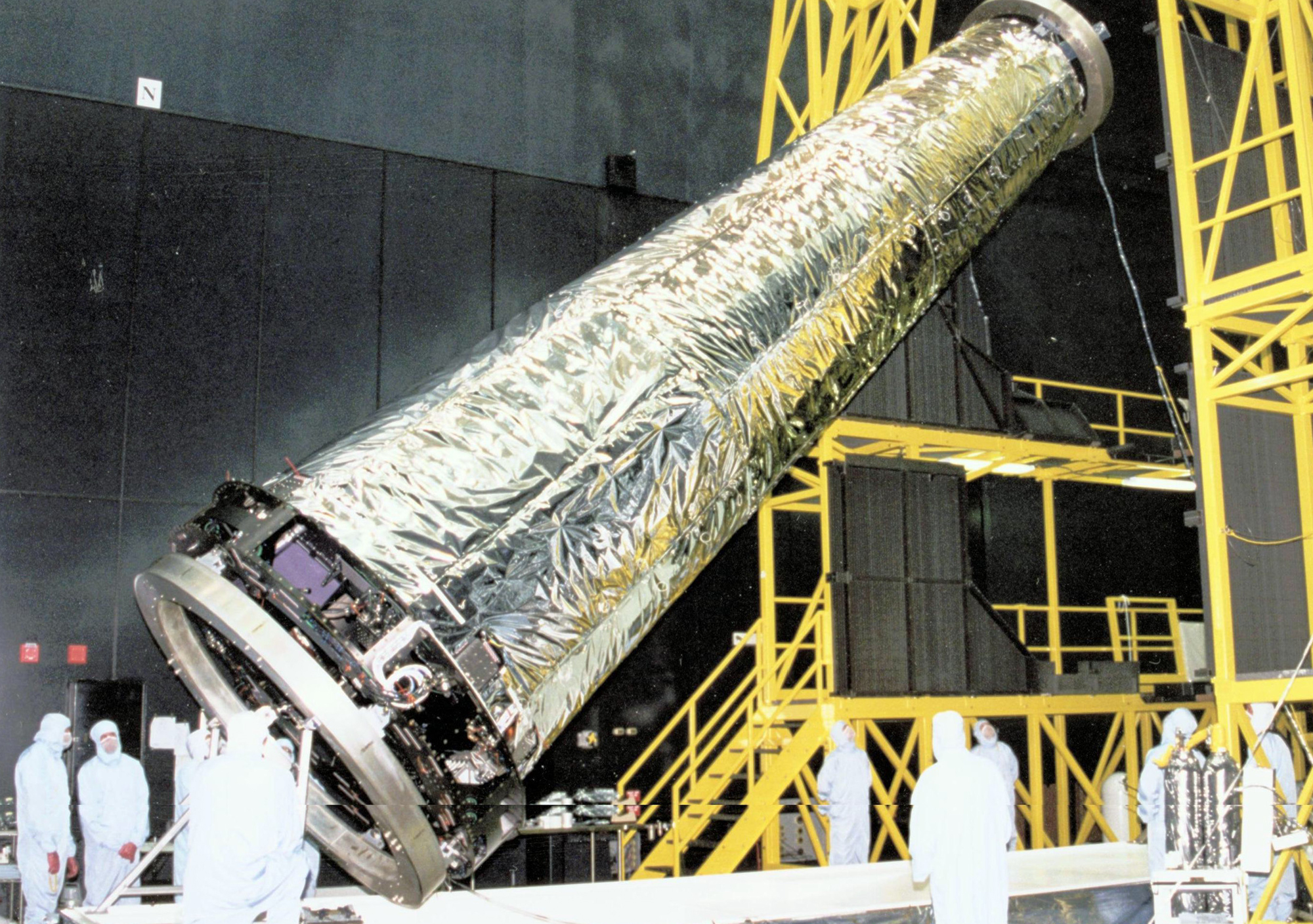
These photographs should not be confused with Chandra observations. The physical telescope itself cannot take a selfie from its distant orbit. Chandra’s science products are X-ray measurements converted into images that help scientists investigate otherwise invisible high-energy processes.
How does Chandra see X-rays?
1. X-rays come from extremely energetic processes
Visible light tells us about stars, dust and gas that emit or reflect wavelengths our eyes can detect. X-rays reveal far more energetic phenomena: material close to an accreting black hole, million-degree gas between galaxies, shock-heated matter in a supernova remnant, and powerful magnetic activity around some stars. Many of these targets are studied across multiple wavelengths, not just with Chandra.
2. Ordinary straight-on mirrors do not focus cosmic X-rays
A bathroom mirror reflects visible light readily. At X-ray wavelengths, most photons would instead pass into or be absorbed by a surface if they arrived too close to perpendicular. Chandra uses a set of carefully shaped, nested mirrors that redirect X-rays at very shallow (grazing) angles. Imagine skimming a stone along a pond rather than throwing it straight down.
The mirrors funnel incoming X-rays toward scientific instruments, where the photons are measured. The alignment and smoothness of the mirror surfaces are crucial to recording fine details of the sky.
3. Detectors measure photons; software builds the image
Instead of creating an ordinary RGB photograph in a single exposure, Chandra detectors record the positions and energies of incoming X-ray events. Scientists assemble maps of those measurements. Colors in many published Chandra images represent assigned X-ray energy bands or are combined with visible- or infrared-light observations to clarify distinct structures. That scientific process is different from taking a regular color photograph.
4. Scientists compare evidence from other telescopes
Hubble, Webb, radio arrays and ground-based optical telescopes can observe the same regions in different wavelengths. For example, Webb may highlight cool dust or embedded young stars in the infrared while Chandra records much hotter X-ray-emitting gas. The combined view is valuable, but it should not be described as a single camera shot.
What makes Chandra different from Hubble and Webb?
| Telescope | Main wavelengths in this comparison | Especially useful for |
|---|---|---|
| Chandra | X-ray | Hot gas, shock waves, high-energy particles and black-hole surroundings |
| Hubble | Ultraviolet, visible and some near-infrared | Stars and galaxies viewed in light near what human eyes see |
| James Webb | Near- and mid-infrared | Cooler dust, distant galaxies and faint infrared signals |
There is no universal winner. A galaxy cluster can appear ordinary in visible light but show enormous reservoirs of hot X-ray-emitting gas in Chandra data. Conversely, Chandra cannot replace Webb when the question specifically requires infrared spectra or dust-penetrating imagery. Each observatory samples a different physical process.
Why was Chandra launched by a space shuttle?
Earth’s atmosphere absorbs the vast majority of the cosmic X-rays Chandra was built to study. An X-ray observatory therefore needs to operate above the atmosphere. Chandra launched on Space Shuttle Columbia during mission STS-93 in July 1999. The astronauts deployed the telescope and its Inertial Upper Stage, which helped send it toward a high-altitude orbit.
Chandra did not sit permanently inside the shuttle, and it was not repaired by astronauts like Hubble. After deployment it became an independent robotic observatory. Its elongated orbit keeps it away from Earth’s radiation environment for substantial observing periods while bringing it back closer to Earth at other points in its orbit.
Five kinds of discoveries Chandra helps make
Black holes and the gas around them
Chandra cannot photograph a black hole’s event horizon as a normal silhouette through visible light. Instead, it detects energetic X-rays from hot matter in extreme gravitational environments and from surrounding structures. Those signals help astronomers map how matter behaves and how black-hole activity affects nearby gas.
Supernova remnants
After a massive star explodes, expanding shock waves can heat surrounding material to temperatures that emit X-rays. Chandra maps that hot material, exposing complicated structures that may be invisible in ordinary optical photos. Researchers can compare X-ray structure with optical or infrared observations to study how the blast evolves.
Galaxy clusters
Clusters contain numerous galaxies embedded in enormous quantities of thin but extremely hot gas. That gas shines in X-rays. Chandra’s observations help researchers map where the gas is concentrated and how it has been disturbed by collisions and by energetic activity from galaxies within the cluster.
Young and mature stars
Some stars release X-rays through hot plasma and magnetic activity. Chandra can reveal high-energy processes in star-forming regions, helping scientists distinguish stellar activity from surrounding dust and gas that may obscure other wavelengths.
Combined views of the same object
One of Chandra’s strengths is working alongside other observatories. X-ray, optical and infrared measurements can trace different temperature regimes within a nebula. A multiwavelength composite can be scientifically informative, provided the image labels identify the contributing instruments and explain how colors were assigned.
Are Chandra’s colorful images real or fake?
The X-ray measurements are real; the colors are often assigned for interpretation. Human eyes do not see X-rays. Instrument teams encode measured photon energies or intensities into display colors to make structures distinguishable. Some images additionally incorporate data from other observatories. The resulting image is a visualization of real observations—not a literal visible-light snapshot, and not necessarily AI-generated art.
A reliable description identifies whether an image is: (1) a photograph of the Chandra hardware; (2) a Chandra X-ray data image; (3) a multiwavelength data composite; or (4) an artist’s concept. That distinction matters when readers see dramatic false-color images of black holes and mistake the colors for something an astronaut could view through a window.
Is Chandra still working in 2026?
As checked on October 15, 2026, NASA’s official Chandra mission page labels it an active mission. The mission launched in 1999 and has operated for decades beyond the era in which most comparable technology was originally developed. A mission’s public status, schedules and operations can change; for the latest state consult NASA and the Chandra X-ray Center rather than assuming that every older article is current. Budget discussions, instrument maintenance and operational decisions should not be confused with an official announcement that the telescope has shut down.
Frequently asked questions
Is the Chandra space telescope a NASA mission?
Yes. Chandra is a NASA observatory; NASA manages the mission with scientific operations through the Chandra X-ray Center.
Where is the Chandra telescope located?
It orbits Earth in a highly elliptical orbit. It is neither on the International Space Station nor on the lunar surface.
What is the difference between Chandra and an ordinary telescope?
Chandra measures high-energy X-rays using grazing-incidence mirrors and specialized detectors. Ordinary backyard telescopes generally collect visible light and cannot directly detect cosmic X-rays through Earth’s atmosphere.
What does a Chandra image show?
It shows measured X-ray emission, generally rendered using display colors or combined with measurements from other telescopes. It is not an ordinary color photograph of the object.
Who was Chandra named after?
It honors Subrahmanyan Chandrasekhar, whose major scientific contributions included work on stellar structure and evolution.
How does Chandra compare to the James Webb Space Telescope?
Chandra studies X-rays and especially energetic phenomena; Webb observes infrared wavelengths. Their results are complementary rather than interchangeable.
Primary sources and related reading
For changing mission status and technical records, start with NASA’s Chandra mission page, NASA’s retrospective on Chandra engineering and the Chandra X-ray Center’s public image-use policy. For another example of why the hardware and science images must be clearly distinguished, read AVARIXO’s Artemis II science data explainer.

Other Articles

Cricket Darts Rules: Marks, Scoring, Bullseye and Worked Examples