
What is chess notation?
Chess notation is a compact way to record moves so players can replay, analyze and discuss a game. The most widely used system for standard chess is algebraic notation. It identifies the destination square of each move and adds a piece letter, capture symbol or other marker when necessary.
For example, e4 means a pawn moved to e4, Nf3 means a knight moved to f3, and Qxd5 means a queen captured something on d5. You do not need to memorize hundreds of moves to learn the system; begin with board coordinates and six basic symbols.
How chessboard coordinates work
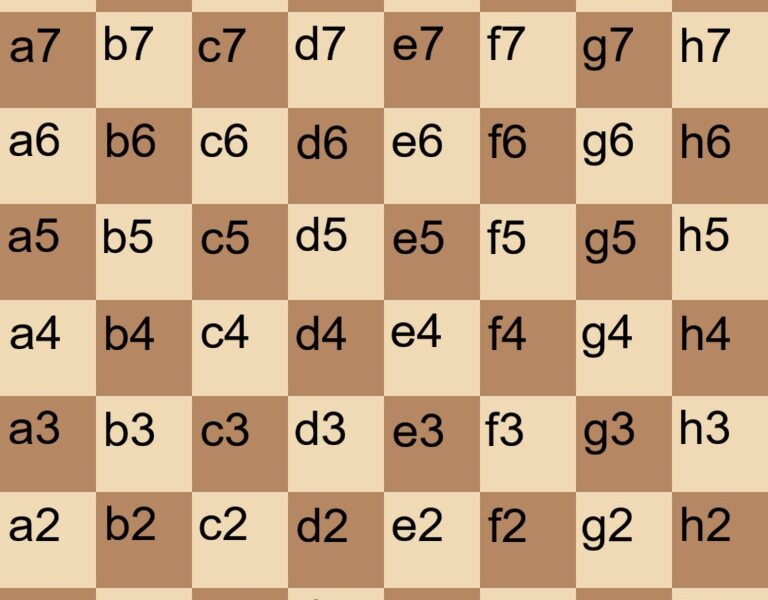
Every square has a letter and a number. Files (vertical columns from White’s viewpoint) are labeled a through h. Ranks (horizontal rows) are numbered 1 through 8, with White’s home rank at 1 and Black’s at 8. A square such as e4 is where file e and rank 4 meet.

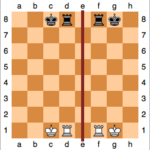
When a game is set up correctly, White’s queen begins on d1, White’s king on e1, Black’s queen on d8 and Black’s king on e8. The coordinates do not rotate when Black moves; the same square is always called e4 regardless of which player is looking at the board.
Chess piece letters and pawn moves
| Piece | English notation letter | Example |
|---|---|---|
| King | K | Ke2 |
| Queen | Q | Qh5 |
| Rook | R | Ra1 |
| Bishop | B | Bc4 |
| Knight | N | Nf3 |
| Pawn | No letter | e4 |
The knight uses N because K is reserved for the king. A pawn move is written with its destination square only, so e4 normally means a pawn moved to e4. This is why a game can begin with the familiar notation 1. e4 e5 2. Nf3 Nc6.
How to write captures with x
The letter x means a capture. A rook capturing on d5 is Rxd5. A knight capturing on e4 is Nxe4. Pawn captures include the pawn’s starting file: exd5 means a pawn from the e-file captured on d5.
Do not write a pawn letter P in ordinary algebraic notation. Also, the destination square is the square the capturing piece occupies after the move, except that en passant is a special pawn capture in which the captured pawn is removed from an adjacent square. Our en passant guide explains that exception.
Checks, checkmates and promotion symbols
| Symbol | Meaning | Example |
|---|---|---|
| + | Check | Qh5+ |
| # | Checkmate | Qxf7# |
| =Q | Pawn promotes to queen | e8=Q |
| O-O | Kingside castling | O-O |
| O-O-O | Queenside castling | O-O-O |
The plus sign describes an attack on the king that the opponent must answer. The hash sign marks checkmate. Promotion is written with an equals sign followed by the new piece, such as e8=N when a pawn promotes to a knight. Castling uses the letter O rather than the number zero. For details about castling legality, see our castling guide.
How to record a game move by move
White’s first move is written after 1. and Black’s reply follows on the same move number. A short sample opening is:
1. e4 e5
2. Nf3 Nc6
3. Bc4 Bc5
4. c3 Nf6
Read the first line as: White advances the e-pawn to e4, then Black advances the e-pawn to e5. On move two, White develops the knight to f3, and Black develops a knight to c6. Each move’s legality depends on the actual position; the notation does not replace the board.
Game scores often show a result at the end: 1-0 for a White win, 0-1 for a Black win and ½-½ for a draw. These are results, not moves.
What if two identical pieces can move to the same square?
Sometimes two knights, rooks or other identical pieces could legally move to the same destination. Algebraic notation adds just enough of the starting square to make the move unambiguous. For example, if two knights can reach d2, Nbd2 identifies the knight from the b-file. If they share a file, a rank may be used instead, such as R1e2.
This is called disambiguation. It is not necessary to include the starting square on every move. The extra character is used only when the ordinary piece letter plus destination would describe more than one legal move.
How to read annotations and move quality symbols
Books and analysis tools may add commentary markers: ! for a good move, ? for a mistake, !! for an especially strong move and ?? for a serious blunder. These are annotations made by an author or engine, not part of the move’s basic legal description.
Computer analysis can assign different evaluations to the same move in different positions. A move annotated as brilliant in one source is not automatically best according to every engine or time control.
SAN, LAN and PGN: what is the difference?
| Term | Meaning | Typical use |
|---|---|---|
| SAN | Standard Algebraic Notation | Human-readable game scores such as Nf3 |
| LAN | Long Algebraic Notation | Includes starting and destination squares |
| PGN | Portable Game Notation | Text format for full games with headers and moves |
A PGN file can include metadata such as player names, date, event and result, followed by the game’s moves in notation. Chess sites use PGN to share and replay games. SAN is the familiar compact form used inside many PGN files.
How to practice reading chess notation
- Set up a board and identify a1, e4, d5 and h8 without moving pieces.
- Move a pawn to e4 and say the move aloud as “e4.”
- Move a knight to f3 and write “Nf3.”
- Practice a capture and add x, such as exd5 in a legal position.
- Set up castling and write O-O or O-O-O.
- Replay a four-move opening from a written score and check the board after every move.
Learning notation is easier when you switch between the written score and a real or digital board. A few minutes of daily practice will make coordinates feel natural.
Common mistakes
- Using K for knight: K means king; N means knight.
- Writing P before a pawn move: Pawns normally have no piece letter.
- Confusing O with 0 in castling: Standard notation uses the letter O.
- Assuming x names the captured piece: It marks the capture; the destination identifies the square.
- Ignoring disambiguation: If two same-type pieces can reach one square, add the necessary starting file or rank.
- Mixing board orientation: Square names stay fixed regardless of whose turn it is.
Frequently asked questions
What does N mean in chess notation?
N stands for knight. K is already used for the king.
What does x mean in chess moves?
It indicates a capture, such as Bxf7 for a bishop capturing on f7.
What does + mean after a move?
It means the move gives check to the opposing king.
What does O-O mean?
It is kingside castling. O-O-O means queenside castling.
Is chess notation the same in every language?
Board coordinates are consistent, but piece letters may differ in localized notation. English-language SAN uses K, Q, R, B and N.
Official reference and next steps
FIDE describes algebraic notation in Appendix C of the Laws of Chess. If you are new to the rules behind the symbols, start with stalemate, en passant and castling. These three topics cover situations that can make a recorded move look surprising at first.

Other Articles

Castling in Chess: Kingside vs. Queenside Rules and Examples