
Caro-Kann Defense in Chess — a practical guide to the opening’s moves, strategy and common mistakes.
What is the Caro-Kann Defense?
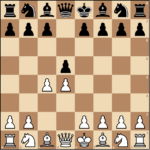
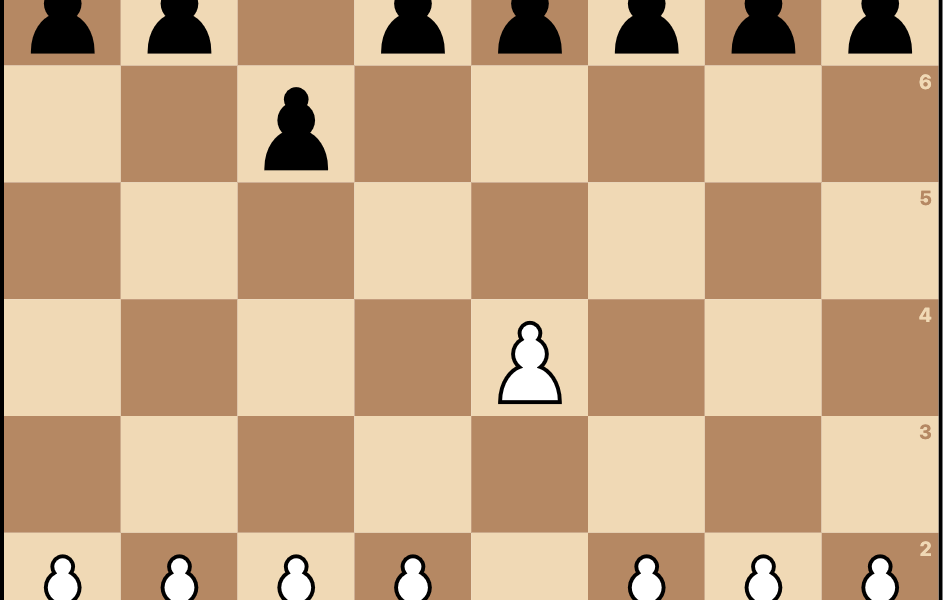
The Caro-Kann Defense is a chess opening for Black beginning 1. e4 c6. Black usually follows with 2…d5, challenging White’s central pawn with the support of the c-pawn. Unlike the French Defense, the Caro-Kann often allows Black’s light-squared bishop to develop outside the pawn chain before …e6 is played.
The opening is known for a resilient pawn structure and practical counterplay. That does not mean every Caro-Kann position is quiet: some lines feature opposite-side castling, sharp attacks and early tactical decisions.
The first moves and a common setup
1. e4 c6
2. d4 d5
3. Nc3 dxe4
4. Nxe4 Bf5
White occupies the center with e4 and d4. Black prepares …d5, then may exchange on e4 and develop the bishop to f5. This is one common Classical Variation route, not a mandatory move sequence. Black also has the option of …Nd7 or …Nf6 in appropriate lines.
The point of …c6 is not to attack a piece immediately; it supports the central pawn break …d5. Beginners should learn why that break matters rather than memorize a long list of responses.
Four main Caro-Kann variations
| White’s choice | Variation | Core idea |
|---|---|---|
| 3. e5 | Advance Variation | White claims space; Black challenges the pawn chain |
| 3. Nc3 or 3. Nd2 | Classical families | White develops while keeping central tension |
| 3. exd5 cxd5 | Exchange Variation | Symmetrical central pawn exchange, often followed by piece play |
| 3. f3 | Fantasy Variation | White reinforces e4 but creates new tactical questions |
These branches are strategically different. Black should not automatically play the same bishop move or pawn break in every variation.
The Advance Variation: 3. e5
After 1. e4 c6 2. d4 d5 3. e5, White gains space and restricts some of Black’s pieces. Black can develop the light-squared bishop with …Bf5 before placing the e-pawn on e6, and may later challenge White’s center with …c5.
White often aims to support the advanced e5 pawn and develop an initiative. Black’s job is to avoid being squeezed: exchange a piece when appropriate, complete development and attack the base of the pawn chain rather than pushing pawns without a plan.
The Classical and Exchange variations
In Classical setups, White often recaptures on e4 with a knight and Black chooses how to develop the light-squared bishop. Positions can be balanced but require attention to the center and kingside development. The Exchange Variation simplifies the pawn structure early with 3. exd5 cxd5, but it is not an automatic draw. Both sides still have plans involving the minority attack, open files and piece activity.
A practical training method is to play a few games in each structure and compare which squares are strong for knights and bishops. Understanding pawn breaks makes your repertoire more reliable than remembering an exact ten-move sequence.
Black’s opening plan
- Support the central challenge with …c6 and …d5.
- Develop the light-squared bishop before …e6 when the position permits.
- Choose a suitable setup for the knights, usually involving …Nd7 or …Nf6.
- Castle when the king’s route is clear and safe.
- Watch White’s space advantage in the Advance Variation and prepare the correct pawn break.
- Do not force a central exchange if it simply improves White’s pieces.
The move order matters: a move that is good in the Classical Variation may be premature against the Fantasy Variation.
White’s ideas against the Caro-Kann
White can choose between keeping more central space with 3. e5, maintaining tension with 3. Nc3, exchanging early with 3. exd5 or trying a more ambitious setup. The right choice depends on how much theory you want to study and what middlegame structures you prefer.
Do not assume Black’s compact position means you can attack without development. Black’s pawn structure can absorb pressure, and premature sacrifices may simply lose material. Aim to develop smoothly, watch for …c5 and assess the bishop pair and central files.
Caro-Kann versus French Defense
Both openings challenge 1. e4 with a supported …d5 advance. The Caro-Kann uses …c6 to prepare …d5, while the French uses …e6. In many French positions, the c8 bishop is restricted by the e6 pawn; in the Caro-Kann it often has an earlier route outside the pawn chain.
The tradeoff is that Black spends a tempo on …c6 and may need to work carefully to activate the c-pawn later. For a fuller comparison, see our French Defense guide.
Common beginner mistakes
- Playing …e6 before deciding what to do with the bishop: It can become trapped behind the pawn chain.
- Ignoring the e4 pawn: The central tension is the reason for the opening.
- Assuming all variations are slow: Some are sharp and require concrete calculation.
- Moving the queen repeatedly: White can gain development by attacking it.
- Memorizing moves without understanding …c5: The later pawn break often defines Black’s middlegame counterplay.
Caro-Kann FAQs
Is the Caro-Kann good for beginners?
Yes. It teaches solid development, central pawn breaks and structural planning, although beginners still need to learn the major third-move options.
What are the first moves?
1. e4 c6, commonly followed by 2. d4 d5.
Is the Caro-Kann only for Black?
The name describes Black’s defense to White’s first move. White needs to understand how to respond to it too.
Is the Caro-Kann always defensive?
No. It often begins solidly but can generate active piece play and tactical counterattacks.
Takeaway
Remember the opening’s purpose: 1…c6 supports …d5, and Black often develops the light-squared bishop actively before closing the pawn chain. Start with one reply to the Advance, Classical and Exchange variations, then review real games to see how the plans work. If the symbols are unfamiliar, read our chess notation tutorial.