What is the French Defense?
The French Defense is a chess opening for Black that starts 1. e4 e6, usually followed by 2. d4 d5. Rather than immediately placing a pawn on e5, Black prepares to challenge White’s central e4 pawn with …d5. The result often features a solid pawn structure and strategic battles over central squares.
It is an established response to 1. e4 at every playing level. The French can produce slow maneuvering games or sharp attacks, depending on White’s third move and Black’s chosen variation.
French Defense opening moves
1. e4 e6
2. d4 d5
White occupies the center with e4 and d4. Black’s …e6 supports the d5 pawn advance and builds a central counterweight. After the first two moves, White has several major choices: 3. Nc3, 3. Nd2, 3. e5 or 3. exd5. Each changes the pawn structure and the type of game that follows.
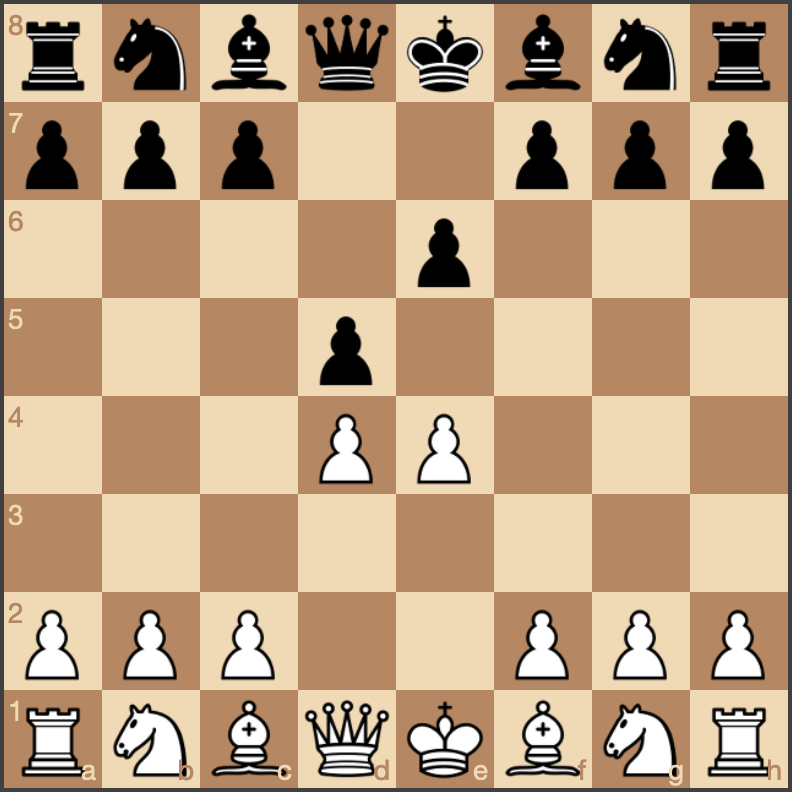
Four common French Defense variations
| White move | Variation | Typical idea |
|---|---|---|
| 3. Nc3 | Classical / Winawer choices | White develops a knight and keeps tension in the center |
| 3. Nd2 | Tarrasch Variation | White supports e4 while avoiding some pin ideas |
| 3. e5 | Advance Variation | White gains space and creates a central pawn chain |
| 3. exd5 | Exchange Variation | Central pawn tension is resolved early |
These are opening families, not complete forced lines. The moves after White’s choice determine whether Black should challenge the center with …c5, develop with …Nf6, exchange on e4 or use a different plan.
The Advance Variation: a useful pawn-chain lesson
After 1. e4 e6 2. d4 d5 3. e5, White has advanced the e-pawn to gain space. Black often counters with …c5, pressuring the base of White’s pawn chain on d4. White may respond with c3 to support that pawn.
This is a fundamental French Defense concept: Black does not need to attack the head of the pawn chain directly. Pressure on d4 can undermine White’s central structure, while White tries to use the extra space to develop pieces and launch play on the kingside.
The Winawer and Classical setups
After 3. Nc3, Black can choose 3…Bb4, known as the Winawer Variation, pinning the knight to White’s king and increasing pressure on the center. Another major choice is 3…Nf6, entering Classical French Defense structures.
The Winawer can lead to doubled pawns and unbalanced play. The Classical tends to emphasize central tension and development, although it can also become tactical. Beginners should understand the strategic difference before memorizing long forcing lines.
The French Defense’s light-squared bishop problem
One recurring challenge for Black is the bishop that starts on c8. The pawn on e6 can restrict its diagonal, making it harder to develop actively. This does not mean the bishop is permanently bad. Black may exchange it at the right moment, reroute it or prepare pawn breaks that open useful lines.
Beginners often develop every other piece and then discover that the c8 bishop has no good square. Plan for it early: evaluate …b6 and …Ba6, …Bd7, or other development schemes according to the position. Avoid blindly pushing pawns just to free the bishop if doing so weakens the king or center.
Black’s main strategic ideas
- Challenge White’s center. The …d5 advance and often …c5 create counterpressure against d4 and e4.
- Develop with purpose. Knights and bishops should support central play rather than chase irrelevant pawns.
- Watch the pawn-chain base. In the Advance Variation, d4 is often a natural target.
- Find a plan for the c8 bishop. Its development is a recurring strategic decision.
- Time central breaks carefully. Moves such as …f6 can challenge e5 in suitable positions, but may weaken the king if rushed.
White’s plans against the French
White often enjoys more space, especially in the Advance Variation, but must defend the center against Black’s pawn breaks. Development and piece coordination matter more than simply holding every pawn. In many French structures, White aims to maintain the e5 pawn, support d4 and use the extra space for kingside play.
White should not underestimate …c5. If Black can exchange or pressure d4 effectively, White’s central advantage may disappear. The Exchange Variation offers a simpler structure, while 3. Nc3 and 3. Nd2 allow more complex strategic battles.
French Defense versus the Caro-Kann
The French begins 1. e4 e6 and usually prepares …d5 with the e-pawn supporting it. The Caro-Kann begins 1. e4 c6, preparing …d5 with the c-pawn. Both challenge White’s center, but they produce different pawn structures and development problems.
One practical distinction is the light-squared bishop: the French often locks it behind the e6 pawn, while the Caro-Kann frequently allows Black to develop it before playing …e6. Neither is automatically superior; both are established openings with different tradeoffs.
Mistakes to avoid
- Ignoring the c8 bishop: Plan how to activate or exchange it.
- Playing …c5 without calculation: It is thematic, but the exact timing matters.
- Moving too many pawns before developing: A solid structure still needs active pieces.
- Assuming every French position is closed: The Exchange Variation and some Classical lines can open quickly.
- Attacking e5 without checking king safety: The …f6 break can create weaknesses if mistimed.
- Copying moves from different variations: Learn the pawn structure first.
How beginners can learn the French Defense
Begin by practicing the position after 1. e4 e6 2. d4 d5. For each of White’s four common third moves, learn one straightforward response and the reason behind it. Play games at a slower time control and review how the d4 and e5 squares changed.
Study pawn structures rather than isolated opening traps. Once you understand why Black plays …d5 and …c5, you can recognize useful plans even when your opponent chooses an unusual move order. If the notation is unfamiliar, see our chess notation guide.
Frequently asked questions
Is the French Defense good for beginners?
Yes. It teaches pawn chains, central breaks and long-term piece planning, although the c8 bishop requires attention.
What are the first moves of the French Defense?
1. e4 e6, usually followed by 2. d4 d5.
Is the French Defense passive?
Not necessarily. Black accepts some space constraints but actively challenges the center with pawn breaks.
What is the Advance French?
It begins 1. e4 e6 2. d4 d5 3. e5, creating a pawn chain and a space advantage for White.
What is the Winawer Variation?
After 1. e4 e6 2. d4 d5 3. Nc3, Black plays 3…Bb4.
Takeaway
The French Defense offers Black a sturdy answer to 1. e4 built around …e6 and …d5. Its main lessons are to challenge the center at the right time, understand pawn chains and make a practical plan for the light-squared bishop. Learn one variation at a time and use your games to test the ideas. Standard chess move rules are defined in the FIDE Laws of Chess.