Annular Eclipse Explained: Real 2023 Ring-of-Fire Photo, Why It Happens and Eye Safety

Quick answer: An annular solar eclipse happens when the Moon passes directly in front of the Sun but appears slightly too small to cover its bright disk completely. A glowing edge of the Sun remains visible around the Moon, producing the famous ring of fire. Unlike a total eclipse, an annular eclipse has no safe naked-eye viewing phase: you must use appropriate solar-viewing protection throughout. The United States experienced a major annular eclipse on October 14, 2023, with the path running from Oregon toward Texas before continuing into Central and South America.
Annular solar eclipse: key facts
| Question | Answer |
|---|---|
| Also known as | Ring-of-fire solar eclipse |
| What blocks the Sun? | The Moon passing in front of the Sun |
| Why a ring remains | The Moon appears slightly smaller than the solar disk |
| Can viewers remove eclipse glasses? | No, not at any point during annularity |
| October 2023 U.S. path | Oregon, through Nevada, Utah, New Mexico and Texas, grazing additional states |
| Longest annularity in October 2023 | Approximately five minutes and 18 seconds at maximum duration worldwide |
| Direct viewing | Use ISO 12312-2 solar-viewing glasses or safe indirect projection |
NASA’s 2023 annular-eclipse path record and eclipse geometry calculation supply historical values. Your own location would have had a shorter interval unless it lay near the maximum point.
Why does the Moon look smaller during an annular eclipse?
The Moon does not orbit Earth in a perfect circle. Its distance from Earth varies between relatively near and far points along an elliptical orbit. When an alignment occurs with the Moon far enough away, the Moon’s apparent size is insufficient to hide the full visible Sun, even when they line up closely. This leaves a bright ring, or annulus, instead of allowing observers to see the corona around a black disk during totality.
Not every solar eclipse at lunar apogee is annular for every observing location. The alignment between Sun, Moon and viewer must also place the observer in the central eclipse track. Outside that track, the same astronomical event can look like a partial eclipse.
How is annular different from total and partial eclipses?
| Type | Appearance | Eye safety |
|---|---|---|
| Annular | Dark Moon surrounded by bright solar ring | Solar filter at all times |
| Total | Entire solar face disappears at maximum | Solar filter before and after totality; removal only during full coverage |
| Partial | Moon covers only part of the solar disk | Solar filter at all times |
NASA emphasizes that a thin remaining ring is still dangerously bright: official solar eclipse viewing safety guidance applies even when most of the Sun appears blocked.
Where was the October 14, 2023 ring of fire visible?
The annular path entered the United States in Oregon, crossed parts of the West and Southwest, and left in Texas. It continued into Mexico and Central America and across parts of South America. Locations such as Albuquerque, New Mexico, were inside the path, while many more U.S. communities experienced a partial eclipse. Weather and exact position mattered for whether the annulus was visible.
What were the local times?
NASA lists annularity in Albuquerque beginning around 10:34 a.m. MDT on October 14, with maximum around 10:35 a.m. Local times differ by state and time zone; a chart giving one U.S. “ring of fire time” is therefore misleading. A central-path maximum anywhere on Earth cannot be substituted for a specific city.
What does a genuine annular eclipse photograph show?
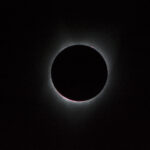
In an authentic photograph taken through a suitable filter, the Sun becomes a relatively dark or colored disk with a dark circular Moon over its center, leaving a slim bright band along its edge. The photograph used here is from the actual October 14, 2023 annular eclipse, contributed by the original photographer under CC0, not computer-generated art or an image from the 2024 total eclipse.
Real solar photographs can look orange or gold because of filtering, camera settings or processing; those colors should not be interpreted as a direct measure of the Sun’s surface temperature. A filter does not make the eclipse safe to watch through an unprotected telescope or unfiltered binoculars.
Why don’t annular eclipses occur every new Moon?
Solar eclipses require a new Moon, but the Moon’s orbit is tilted by about five degrees relative to Earth’s orbit around the Sun. Most months, the Moon passes above or below the precise Sun–Earth alignment. Only when the Moon crosses near an orbital node during the correct phase can its shadow or antishadow reach Earth.
How to view an annular eclipse safely
- Use solar eclipse glasses or viewers from a reliable supplier compliant with ISO 12312-2.
- Check for scratched, torn or otherwise damaged filters and discard them if compromised.
- Never look through binoculars, telescopes or cameras without dedicated solar filters secured on the front of the optics.
- For indirect viewing, construct a pinhole projector and observe the light pattern on a screen, not through the pinhole.
- Supervise children and follow local eye-care and emergency advice if visual symptoms appear.
Ordinary sunglasses do not provide adequate protection even if they seem very dark. An annular eclipse never enters the fully covered phase during which naked-eye viewing is temporarily acceptable in a total eclipse.
Can an annular eclipse affect wildlife?
A temporary drop in daylight can influence insects, birds and other animals; the degree of change depends on how much sunlight remains, weather and location. Researchers have recorded behavioral responses during various eclipses, but claiming all animals go to sleep during annularity overstates the evidence. Annularity leaves more direct sunlight than totality.
Why is the 2023 ring of fire distinct from 2024 totality?
The October 2023 annular eclipse and April 8, 2024 total eclipse involved different orbital geometry and routes. In October 2023, the Moon looked too small to fully cover the Sun; in April 2024, the Sun’s bright disk was entirely hidden for viewers inside the narrow path. Even if both photos contain a central dark Moon, the thin illuminated solar ring is the distinctive feature of an annular event.
Frequently asked questions
What does annular mean?
It comes from a Latin root meaning ring-shaped, referring to the bright ring of Sun visible around the Moon.
Can you look at a ring-of-fire eclipse without glasses?
No. Some bright solar surface always remains visible and direct viewing without proper protection risks permanent eye injury.
What is the difference between annular and partial eclipses?
An annular eclipse is a central alignment with a bright circular ring. A partial eclipse leaves an uneven crescent because the observer is outside the central alignment.
Was the 2023 solar eclipse total?
No. On October 14, 2023 it was annular along the central path.
Does an annular eclipse show the solar corona?
The remaining bright photosphere generally overwhelms the faint corona, unlike the fully covered interval of a total eclipse.
Editorial review October 2026. Official references: NASA 2023 path and timings, NASA eclipse safety, NASA eclipse geometry.