
An AI text detector estimates whether a passage resembles writing produced by a language model. It cannot reliably prove who wrote the text. If you paste an essay, email or article into a checker and see “95% AI,” treat that as the tool’s model-specific score—not as a 95% probability that a person cheated or that the passage was generated by ChatGPT. The meaning of a percentage varies across tools, and false positives and missed AI writing remain possible.
This guide explains how AI writing detection works, what a result can and cannot tell you, how to compare two tools without misinterpreting their scores, and how to respond fairly when human writing is incorrectly flagged.
What is an AI text detector?
An AI text detector is a classifier that tries to distinguish human-written text from text generated by AI. It typically uses statistical signals learned from labeled examples. Different products may report a classification, highlighted passages, a confidence indicator, or an overall percentage.
That is different from plagiarism checking, which looks for matching or similar text in existing sources. AI writing can be original yet machine-generated; human writing can contain copied passages. A plagiarism similarity score and an AI detection score answer different questions and should not be compared as though they were interchangeable.
How do AI text detectors work?
Detector designs vary, but they usually rely on one or more approaches:
- Trained classifiers: A model learns patterns that separate examples labeled as human-written and AI-generated. Performance depends on the training set and how similar new text is to it.
- Statistical text patterns: Some detectors examine word predictability, sentence structure and other language signals. These are correlations, not a signature that uniquely identifies an author.
- Passage-level analysis: A tool may split a document into smaller units and assign labels to particular sentences or sections, then aggregate those results.
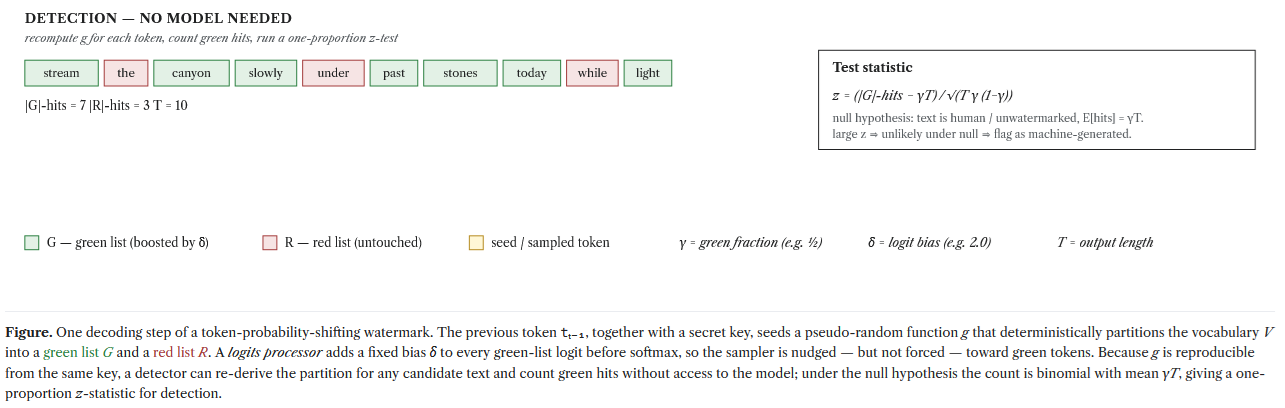
- Provenance checks: When a trusted technical record or watermark is available, verification may look for that signal instead of guessing from writing style. Such signals are not available for all text or all models.
Independent research is important because a model that performs well on samples from a familiar generator may perform worse on unfamiliar models, subject areas or edited text. A 2026 research benchmark on detector robustness highlights difficulties with generalizing across domains and model families; the authors’ test conditions should be considered before applying the findings to a particular classroom or newsroom.
How to check text with an AI detector
- Choose a reputable tool. Review its privacy policy, whether submitted text is retained, how it explains scores and what types of writing it was evaluated on.
- Use a representative sample. Very short snippets, lists, formulas, translated fragments or heavily templated material may not give the same quality of signal as a substantial passage of prose.
- Paste or upload only what you are permitted to share. Do not upload confidential school records, employment documents, unpublished manuscripts or private client data to an unfamiliar service.
- Read the tool’s own definition of its output. Check whether the figure represents text flagged, a confidence metric, or a different measure. Do not translate it automatically into “chance of cheating.”
- Inspect any highlighted section. Look for formulaic phrases, repeated wording, unusual shifts in style and ordinary reasons that a passage might have been classified incorrectly.
- Use context before taking action. Prior drafts, version history, citations, a writing conversation and the writer’s ability to explain their work can be more informative than a detection percentage alone.
Do not assume a result becomes conclusive because a second site agrees. Tools may share similar training biases or respond to the same stylistic features. Agreement between two automated classifiers is supporting context at best.
What does “90% AI” or “100% AI” mean?
There is no universal interpretation. Some products use a confidence-style indicator; others report the portion of qualifying text a system has classified. Without knowing the scoring method and calibration, a 90% displayed score is not equivalent to saying there is a 90% probability that a particular person used AI. Even a high score is a classification rather than direct evidence of authorship.
| Result you might see | What it could mean | What it does not prove |
|---|---|---|
| “Likely AI-generated” | Detector found patterns associated with its AI examples | That a specific model or person wrote the passage |
| “Mostly human-written” | Detector found fewer of the patterns it flags | That no AI assistance was involved |
| High numeric score | Tool’s own threshold or aggregate classification measure | An independently calibrated probability of cheating |
| Highlighted sentences | Passages the tool finds more suspicious | That each highlighted sentence came from AI |
| Two detectors disagree | Different models, thresholds or input processing | That either product must be correct |
Always use the product’s official scoring documentation if you need to interpret an actual report. For example, Turnitin’s AI-writing guidance explicitly warns against relying on the score as the sole basis for adverse action against a student.
Why human writing gets flagged as AI
False positives happen when a classifier labels human-authored material as machine-generated. Common risk factors can include formulaic writing, repeated sentence patterns, conventional introductions, short or constrained responses, or material that differs from the detector’s training examples. These are possible explanations, not a reliable diagnostic test for an individual flagged paragraph.
OpenAI’s guidance for educators says detectors it studied were not reliable enough for consequential judgments and describes false positives on entirely human-written material. Its guidance also stresses that asking ChatGPT whether it wrote a passage is not a valid authorship test.
What to do if an essay you wrote is marked as AI
- Preserve the original files. Keep dated drafts, notes, reference lists and document version history.
- Request the precise policy. Ask how the institution uses AI reports and what evidence is considered beyond the numerical score.
- Explain your process. If appropriate, walk through how you selected sources, outlined the argument and revised specific paragraphs.
- Avoid changing valid writing just to chase a detector. Rewording clear sentences to satisfy a score can reduce accuracy and may not change the classifier reliably.
- Follow the appeals process. If a serious decision is at stake, request human review under the applicable academic or workplace procedure.
Can AI-generated writing evade detection?
Yes. A detector may miss generated content, especially if text is edited, translated or produced by a model that differs from the detector’s training data. This is called a false negative. Conversely, human-written text may be wrongly flagged. Neither problem can be solved by assuming one tool always works.
Be cautious about websites promising a guaranteed “undetectable AI” result. Claims of universal evasion or universal detection should be backed by independently reproducible tests using current models, varied writing genres and human controls. A screenshot showing one favorable score is not sufficient evidence.
How AI detectors differ from AI watermarks and provenance
Style-based classifiers infer an origin from patterns in text. A technical provenance system instead checks for a signal attached or embedded when a file was generated. The latter may offer stronger evidence when a signal is present and verifiable, but coverage depends on the creator, export path, model and supported medium.
Do not confuse checking a text passage with checking the provenance of images or audio. For example, our guide to Google SynthID detection discusses media-specific signals, while our explainer on AI text watermarking addresses a separate approach. OpenAI’s provenance guidance explains that access and coverage differ by file type and verification mechanism.
How to evaluate an AI checker before trusting it
| Question to ask | Why it matters |
|---|---|
| Was it tested on human controls? | Detects false accusations, not only missed AI content |
| Were multiple AI model families included? | A single-generator benchmark may not generalize |
| Were different genres and writing abilities tested? | Classifiers can react differently to essays, news, code and concise prose |
| Is the scoring definition public? | Users need to know what a percentage represents |
| Does the company disclose retention and training policies? | Unpublished text and student information may be sensitive |
| Is an independent evaluation available? | Vendor advertising is not the same as neutral validation |
| Are model and evaluation dates current? | Generative models and detectors both change rapidly |
Published accuracy claims from different companies are not directly comparable unless they use the same dataset, scoring rule and test conditions. A reported “99% accuracy” can conceal important differences in the false-positive rate, the prevalence of AI text in the test data and how borderline cases were treated.
Can teachers, editors or employers use AI detector results?
They can consider a detector as one piece of information, subject to relevant policy and privacy rules. But a high-stakes accusation should rest on much more than a tool’s label. Good practice includes a documented process, a chance for the writer to explain their work, clear disclosure requirements and consistent treatment across similar cases.
In a newsroom, an editor may instead concentrate on verifiable accuracy, quotations, source links, missing citations and whether a writer complied with its disclosure policy. Those checks address actual editorial quality regardless of whether AI helped draft the text.
Frequently asked questions
Can an AI detector prove that ChatGPT wrote a paragraph?
No. A text-only detector generally produces a probabilistic or categorical inference, not a verified record linking a paragraph to a specific ChatGPT account or model.
Is a high AI score proof of cheating?
No. The meaning and reliability of scores vary, and false positives occur. Follow the institution’s evidence and review policies rather than treating the number as a verdict.
Why do two AI detectors give different scores?
They may use different classifiers, thresholds, training sets and aggregation methods. Scores also may represent different measures, so comparing raw percentages can mislead.
Can a short paragraph be checked accurately?
Accuracy can be limited on short, highly formatted or atypical text. Consult the individual detector’s minimum-length rules and validation data; do not assume a short passage supports a definitive conclusion.
Does a plagiarism checker detect AI?
Not necessarily. Plagiarism detection compares text with known sources, while AI detection estimates whether writing resembles generated content. Some products offer both features, but they remain distinct tests.
Is it safe to paste private writing into free AI checkers?
Only if the service’s privacy practices meet your needs and you have permission to submit the text. For confidential manuscripts, student work or workplace data, avoid unknown services and use an approved process.
Bottom line
AI text detectors can be useful screening tools, but their scores are not proof of authorship. Before acting on a result, inspect how the product defines its score, account for false positives and false negatives, protect private documents, and look for independent evidence. For any decision affecting someone’s reputation, grade or job, use human review and transparent procedures. The safest conclusion from a detector alone is that more context may be needed.

Other Articles

Nintendo Switch 2 Guide: Specs, Games, Storage and Setup Mistakes