
Quick answer (reviewed October 17, 2026): The main difference between a solar and lunar eclipse is which object blocks sunlight and where the shadow falls. During a solar eclipse, the Moon moves between Earth and the Sun and its shadow falls on Earth. This can only happen at a new moon. During a lunar eclipse, Earth moves between the Sun and Moon so Earth’s shadow falls on the Moon. It can only happen at a full moon. A solar eclipse requires proper solar eye protection except for the brief completely covered phase of a total solar eclipse; a lunar eclipse is safe to watch with your bare eyes.
The two phenomena are often described together, but they are not interchangeable: one briefly changes what people in a relatively narrow daytime path can see of the Sun, while the other darkens or reddens the Moon across much of Earth’s night side. This guide uses NASA’s eclipse types guide, its eclipse science overview, actual NASA eclipse photographs and official safety advice to compare them precisely.
Solar eclipse vs lunar eclipse: the main differences
| Question | Solar eclipse | Lunar eclipse |
|---|---|---|
| What blocks sunlight? | Moon blocks our view of the Sun | Earth blocks direct sunlight from reaching the Moon |
| Alignment | Sun–Moon–Earth | Sun–Earth–Moon |
| Moon phase | New moon | Full moon |
| Shadow falls on | Earth’s surface | The Moon’s surface |
| Time normally observed | Daytime | At night when the Moon is above the horizon |
| Where visible? | Limited geographical area, especially for totality | Potentially much of Earth’s night-facing hemisphere |
| Typical full-phase duration | Minutes at one observing location | Can last more than an hour |
| Eye protection needed? | Yes, except during complete totality in a total eclipse | No special eye protection needed |
| Types | Partial, total, annular, hybrid | Penumbral, partial, total |
| Why might it look red? | The eclipsed Sun normally does not become a red blood moon | Earth’s atmosphere filters red-orange sunlight into its shadow |
NASA explains the alignments and observing-safety differences in its eclipses overview. Remember that these entries describe the geometry as observed from Earth, not a change in the Moon’s own light source. The Moon is never luminous like the Sun; we see reflected sunlight, including during an eclipse.
How does a solar eclipse happen?
A solar eclipse occurs when the Moon passes in front of the Sun from a location on Earth. The Moon blocks some or all of the bright solar disk and creates a shadow that sweeps over Earth’s surface. Within the dark center of that moving shadow, viewers may see a total eclipse if the apparent disk of the Moon is large enough to cover the Sun completely.
The Moon’s shadow includes the darker umbra (associated with complete obscuration where it reaches Earth) and a lighter penumbra (where the Sun is only partly covered). For an annular eclipse, a different central shadow region called the antumbra can occur, causing viewers to see a ring of sunlight rather than full totality.
Why does a solar eclipse only occur at a new moon?
At a new moon, the Moon is approximately between Earth and the Sun in its monthly orbit. That makes the required geometry possible, but a new moon alone does not guarantee an eclipse. The Moon also has to align with the plane of Earth’s orbit around the Sun.
What is a total solar eclipse?
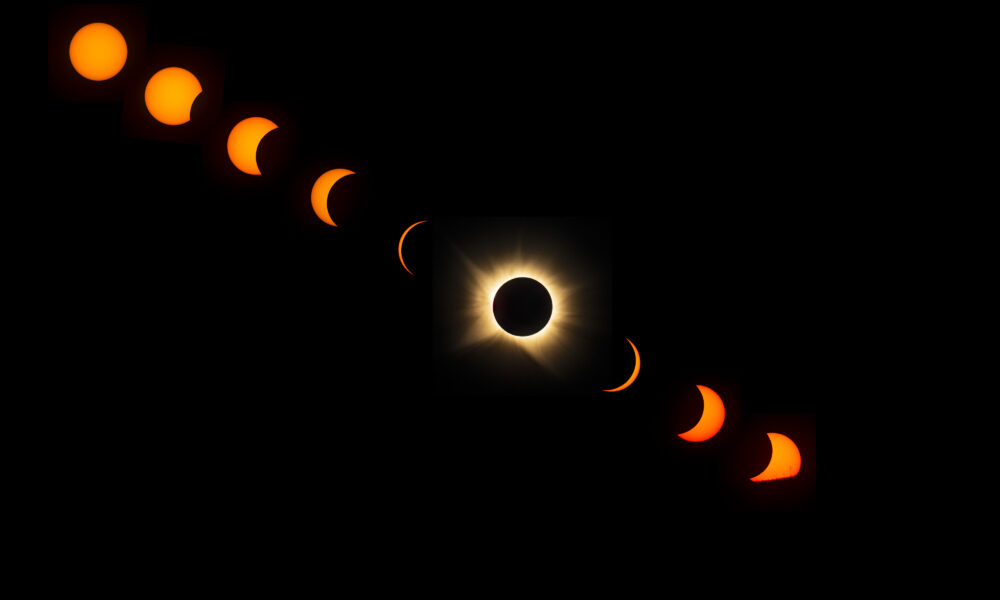
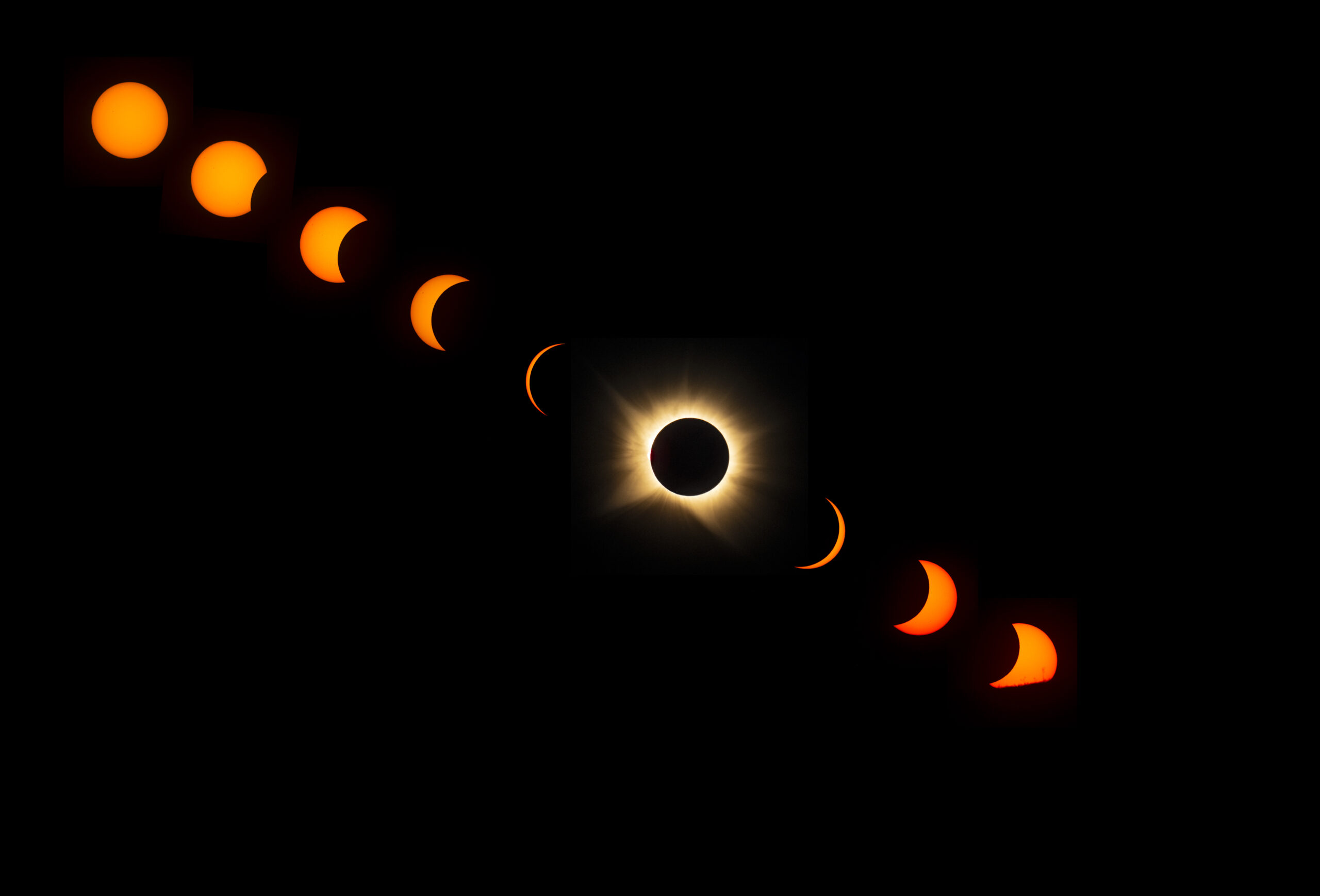
A total solar eclipse occurs when the Moon fully covers the visible bright face of the Sun for viewers inside the path of totality. With the bright surface blocked, the faint outer solar atmosphere, the corona, becomes visible. NASA’s real photographic sequence above shows the transition from a shrinking bright crescent to a dark center surrounded by a glowing corona.
What is an annular or ring-of-fire eclipse?
An annular eclipse happens when the Moon appears slightly too small to cover the whole Sun, often because the Moon is relatively far from Earth in its elliptical orbit. Even at maximum eclipse, a luminous ring of the Sun remains visible. This is not a period of safe naked-eye totality: proper solar filters are essential throughout an annular eclipse. Our annular eclipse guide uses a genuine 2023 ring-of-fire image and describes this difference in detail.
What is a partial or hybrid solar eclipse?
A partial eclipse means only some of the solar disk is covered for a particular viewer. A hybrid eclipse is a rarer event that appears total along some parts of its track and annular along others because Earth’s curved surface and the geometry of the Moon’s shadow change the appearance. NASA identifies these as the four broad types of solar eclipse.
How does a lunar eclipse happen?
A lunar eclipse occurs when Earth passes between the Sun and a full Moon and casts its shadow across the lunar surface. Instead of seeing the Moon in front of the Sun, we watch the Moon gradually darken as it moves through Earth’s shadow. Sometimes the lunar disk looks copper, orange or red during the deepest phase.
The key difference is the Moon is being shaded, not blocking the Sun for us. A lunar eclipse is also visible across a much broader area than the total phase of a solar eclipse, because everyone on Earth’s nighttime side with the eclipsed Moon above the horizon is looking toward essentially the same object.
Why does a lunar eclipse happen only at a full moon?
At a full moon, the Sun and Moon are on opposite sides of Earth, which allows Earth’s shadow to fall toward the Moon. But the Moon normally passes above or below most of that shadow because its orbital plane is tilted. A full moon is a necessary condition for a lunar eclipse, not proof that one will happen every month.
What is a total lunar eclipse?
In a total lunar eclipse, the entire Moon passes into Earth’s dark inner shadow, the umbra. The Moon can remain dimly visible with a reddish hue rather than disappearing completely. Its brightness and color depend in part on conditions in Earth’s atmosphere at the time.
What is a partial lunar eclipse?
In a partial lunar eclipse, only a portion of the Moon enters Earth’s umbra. A curved dark region gradually covers part of the lunar face. As the Moon moves into and later exits the shadow, the dark patch changes shape and position. The remaining uneclipsed portion can stay relatively bright.
What is a penumbral lunar eclipse?
A penumbral lunar eclipse occurs when the Moon moves into Earth’s outer, lighter shadow without entering the umbra. The dimming may be subtle and challenging to notice without comparing photographs. Our penumbral lunar eclipse explainer shows an authentic event photo and how it differs from a dramatic total lunar eclipse.
Why is the Moon red during a total lunar eclipse?
The familiar blood moon color has a physical explanation. Even when Earth blocks direct sunlight, some sunlight passes through our planet’s atmosphere and is bent into the shadow. Shorter blue and violet wavelengths are scattered more efficiently, while longer orange and red wavelengths can reach the lunar surface and reflect back toward us.
In effect, Earth filters and bends a ring of sunset and sunrise colors into its shadow, faintly illuminating the Moon. Volcanic dust, smoke and clouds at different altitudes may also affect the final brightness and shade. According to NASA’s Moon eclipse guide, this is why one total eclipse can look deep brown-red while another appears much brighter.
Is a blood moon the same as a lunar eclipse?
“Blood moon” is a descriptive nickname most commonly used for a total lunar eclipse when the Moon takes on a reddish color. It is not a separate orbital event or a different kind of astronomical body. The shade is produced by Earth’s atmosphere and eclipse geometry, not by the Moon changing its material.
Is a red Moon always caused by an eclipse?
No. A low Moon near the horizon can appear yellow, orange or red because its light travels through more of Earth’s atmosphere. Smoke or haze can deepen that color too. For a lunar eclipse, there must also be the correct full-moon alignment and Earth’s shadow crossing the Moon.
Why don’t solar and lunar eclipses happen every month?
Solar and lunar eclipses require alignment in three dimensions, not just two objects appearing opposite each other in a flat drawing. The Moon’s orbit around Earth is inclined by roughly five degrees to the plane of Earth’s orbit around the Sun. Most new moons pass above or below the Sun from our viewpoint, and most full moons pass above or below Earth’s central shadow.
When the Moon reaches a point where its tilted orbital plane crosses Earth’s orbital plane, that point is called a node. Eclipses occur when the Sun is sufficiently close to one of these nodes near a new or full moon. The opportunities cluster into periods astronomers call eclipse seasons, roughly twice per year. NASA’s eclipse geometry guide explains the Moon’s orbital tilt and the shifting shadow paths.
What is eclipse season?
An eclipse season is a window of several weeks when solar, Earth and lunar geometry is favorable for one or more eclipses. It is not a guarantee that an eclipse will be visible from your town. A season can produce an eclipse visible halfway around the world while your own sky shows no special event at all.
Why is a lunar eclipse usually easier to observe?
A total solar eclipse is visible only along the narrow path traced by the Moon’s darkest shadow. A lunar eclipse can be visible from many regions facing the Moon during the event. That difference in geographical reach, plus the absence of special solar viewing glasses, often makes lunar eclipses more accessible for casual skywatchers.
How long does each type of eclipse last?
| Stage | Solar eclipse at one location | Lunar eclipse |
|---|---|---|
| Whole event | May span several hours as partial phases come and go | Can span several hours as the Moon enters and leaves Earth’s shadow |
| Deepest or total phase | Usually minutes; varies by eclipse and observing location | Can last more than an hour depending on geometry |
| Geographical visibility | Especially narrow for complete totality | Broad across Earth’s night-facing side |
| Safety changes by phase? | Yes; solar filters needed except during verified complete totality | No special eye protection required in any phase |
Do not confuse the time the Moon’s shadow takes to travel across Earth with the duration of totality at a particular town. A solar eclipse may be visible somewhere on Earth for hours while the fully dark phase at one point lasts only minutes. A lunar eclipse develops more slowly across the face of the Moon because the shadow geometry is different.
How to watch an eclipse safely
This is the most important practical difference. A lunar eclipse is safe to watch directly with your eyes at every stage, and binoculars or a telescope can make it more interesting if used under normal safe nighttime conditions. A solar eclipse is not safe to stare at without the correct solar protection unless the bright face of the Sun is completely covered during the brief totality phase of a total eclipse.
What glasses are safe for a solar eclipse?
Use purpose-made ISO 12312-2 compliant eclipse glasses or a safe handheld solar viewer, inspect them for damage and follow current reliable guidance. Ordinary sunglasses—even very dark ones—are not a substitute. NASA does not approve individual commercial products, and a vendor’s marketing claim is not itself certification. Supervise children and never point an unfiltered optical instrument at the Sun.
Can you use binoculars or a telescope to watch a solar eclipse?
Not without a dedicated, properly secured solar filter fitted over the front of the optics and appropriate expert guidance. Wearing eclipse glasses while looking into an unfiltered telescope or binoculars does not protect your eyes, because the optics concentrate sunlight. Cameras also require appropriate front-of-lens solar filtration during bright phases. See NASA’s solar eclipse eye-safety instructions before any solar observing.
When can the glasses come off during totality?
Only when you are inside the path of totality of a total solar eclipse and the Moon is completely covering the Sun’s bright surface. Replace protection immediately when any part of the bright Sun returns. If you cannot confidently determine you are experiencing complete totality, keep the proper filters on or use indirect projection instead. For partial, annular and hybrid events at an annular location, there is no safe unfiltered phase.
Can you safely watch a lunar eclipse through a telescope?
Yes. Unlike the Sun, the eclipsed Moon is a safe nighttime object to view through ordinary binoculars or telescopes. Seeing the Earth’s curved umbral edge move across craters can be striking, and a camera can document the changes without the specialized solar filters used for daytime Sun viewing.
Solar and lunar eclipses in 2026 and 2027
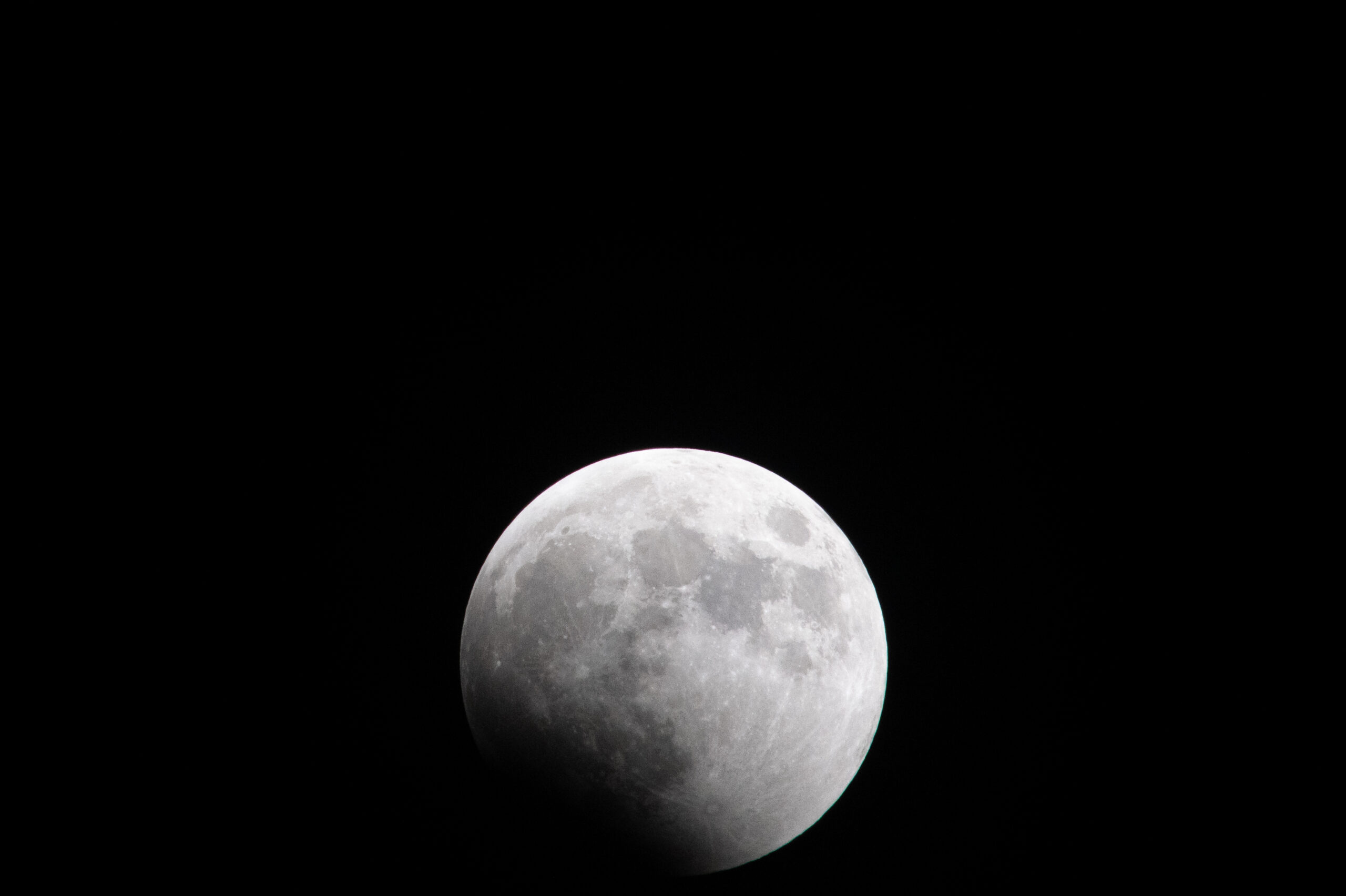
For a concrete recent example, NASA photographer Bill Ingalls documented the August 12, 2026 total solar eclipse from Spain; the featured photographic sequence is based on that event. For a lunar example, NASA Glenn Research Center photographed the March 14, 2025 total lunar eclipse in Ohio, shown above. These photos represent different events in different years rather than a pair of eclipses visible from the same location.
Looking ahead, NASA lists an annular solar eclipse on February 6, 2027 in portions of South America and Africa and a total solar eclipse on August 2, 2027 crossing parts of southern Europe, North Africa—including Morocco—and the Middle East. It also lists penumbral lunar eclipses on February 20–21 and August 16–17, 2027. Exact local viewing circumstances vary, so consult NASA’s future eclipses calendar before travel or telescope setup.
Will the 2027 total solar eclipse be visible everywhere in Morocco?
No. A total eclipse is visible only within its narrow path of totality. Other places may see a partial eclipse, depending on position and weather. Verify a city-specific NASA map before planning a trip; a country appearing in the visibility list does not guarantee totality in its every city.
Can solar and lunar eclipses occur in the same eclipse season?
Yes. Because an eclipse season spans weeks, it can include both a solar eclipse around a new moon and a lunar eclipse around an adjacent full moon. Their alignments differ, but both take advantage of the Moon being close to the orbital nodes during the same season.
How to recognize a genuine eclipse photograph
A real solar eclipse photograph may show the Sun as a partial crescent, a bright ring in an annular event, or the corona during totality. A time-sequence composite can place several genuine phases into one image, but it should be identified clearly as a photographic composite rather than claiming it was one single exposure. The real NASA solar image at the beginning of this article is such a sequence.
A real lunar eclipse photograph may show the Moon with a curved dark bite, subtle penumbral shading or a deep reddish disk. NASA’s 2025 photo above captures an actual lunar event rather than simulating it. Magnification, camera settings and local atmosphere change a photo’s appearance, and an image should not be used to assert an exact location, date or color without a reliable source record.
For other verified eclipse examples, read our 2024 North American total solar eclipse guide or our separate annular ring-of-fire explainer. Those articles describe historically specific events, while this comparison explains the geometry and safety rules that apply more generally.
Common mistakes about eclipses
- Believing solar and lunar eclipses occur at the same Moon phase. Solar eclipses require new moon; lunar eclipses require full moon.
- Assuming every new or full moon creates an eclipse. The orbit is inclined by around five degrees, so exact alignment is occasional.
- Thinking all solar eclipses have totality. Partial and annular eclipses never completely hide the bright solar disk from affected viewers.
- Using dark sunglasses to stare at the Sun. Ordinary sunglasses are not safe eclipse viewers.
- Believing a blood moon is an astronomical omen. Its red color is sunlight passing through Earth’s atmosphere.
- Assuming an eclipse visible in a country is total everywhere in that country. Totality has a narrow track.
- Calling a NASA photo sequence a fabricated eclipse. Many image sequences combine real separate exposures and should be labeled as composites.
Frequently asked questions
What is the difference between a solar and lunar eclipse?
In a solar eclipse, the Moon blocks our view of the Sun and casts a shadow on Earth. In a lunar eclipse, Earth’s shadow covers the Moon.
Which one happens during a full moon?
A lunar eclipse. Solar eclipses happen at new moon.
Which eclipse is safe to watch without glasses?
A lunar eclipse is always safe to look at directly. A solar eclipse requires proper protection except for the brief confirmed totality of a total eclipse.
Why is the Moon red during a lunar eclipse?
Sunlight passes through Earth’s atmosphere; shorter blue wavelengths scatter away more effectively, leaving red and orange light to illuminate the Moon inside Earth’s shadow.
How rare is a total solar eclipse?
Total solar eclipses occur on Earth, but any particular location is rarely crossed by a totality track. A lunar eclipse is visible from a much larger portion of Earth’s surface during the event.
Can the same day have both a solar and lunar eclipse?
No, not in the usual Earth-observer sense: a solar eclipse requires new moon and a lunar eclipse requires full moon, which occur roughly two weeks apart. They can occur within one eclipse season.
Can I use ordinary sunglasses to watch a solar eclipse?
No. Use proper eclipse viewers and avoid looking through unfiltered binoculars, telescopes or cameras. NASA says regular sunglasses are not protective enough.
Primary references and photograph provenance
- NASA: Types of Solar Eclipses — total, annular, partial and hybrid forms.
- NASA: The Moon and Eclipses — lunar eclipse types, blood moon physics and seasonal alignment.
- NASA: Why Eclipses Happen — orbital nodes, shadows and Moon-orbit tilt.
- NASA: Eclipse Viewing Safety — solar filter, totality and optical instrument precautions.
- NASA: Future Eclipses — NASA’s calendar for 2027 events and observing regions.
- Solar photograph provenance: NASA/Bill Ingalls, August 12, 2026, original official photograph record NHQ202608120208. Real multi-exposure photographic sequence, public-domain NASA government work. WordPress automatically reduced resolution for delivery.
- Lunar photograph provenance: NASA Glenn Research Center, March 14, 2025, photographer credit NASA/GRC/Jordan Salkin in source metadata and NASA/Jordan Cochran in source caption; NASA archive ID GRC-2025-C-01607. Real photograph from Ohio, public-domain NASA government work. NASA does not endorse this website.
Updated October 17, 2026. The eclipse photographs are archived historic observations, not predictions or newly generated images. Observing circumstances for future eclipses vary by location and can change with weather; consult official NASA maps and current eye-safety guidance.