Penumbral Lunar Eclipse Explained: Real 2023 Photo, Subtle Moon Shadow and 2027 Date

Quick answer: A penumbral lunar eclipse happens when a full Moon passes through the faint outer region of Earth’s shadow but misses the darker inner shadow. Because Earth blocks only part of the sunlight reaching the Moon, the lunar disk usually remains almost fully illuminated, with subtle gray shading that can be difficult to notice. Unlike a total lunar eclipse, there is no dramatic deep-red “blood Moon,” and unlike a solar eclipse, watching the Moon requires no special eye protection. NASA lists a penumbral lunar eclipse on February 20, 2027 (UTC) as the next such event after October 2026.
Penumbral lunar eclipse: essential facts
| Question | Answer |
|---|---|
| Phase of Moon | Full Moon |
| Shadow | Earth’s lighter outer penumbra |
| Appearance | Subtle dimming, often stronger on one edge |
| Does the Moon turn dark red? | Not in a normal penumbral-only eclipse |
| Eye protection required? | No; ordinary lunar observing is safe |
| Next event on NASA’s calendar | February 20, 2027 (UTC) |
| Difference from partial lunar eclipse | Moon does not enter the darker umbra |
NASA explains the shadow types in its lunar eclipses guide and historic appearance analysis.
Why is the penumbral shadow so faint?
When the Moon is in Earth’s penumbra, an observer standing on the Moon would see Earth cover only a portion of the Sun’s bright face. Some sunlight still reaches the lunar surface, so it does not fall into deep darkness. Close to the inner umbra, more of the Sun is blocked and the gray shading becomes slightly easier to see from Earth. Near the edge of the penumbra, the difference is usually invisible to the naked eye.
NASA’s eclipse catalog explains that the dimming is often hard to detect until the Moon moves deeply into the penumbra; a penumbral magnitude greater than roughly 0.6 may be needed for experienced observers to perceive obvious shading. This is an observing guideline, not a declaration that no earlier part of an eclipse is happening.
Penumbral versus partial versus total lunar eclipse
| Type | Which shadow does the Moon enter? | What you see |
|---|---|---|
| Penumbral | Penumbra only | Faint shading or dimming |
| Partial lunar eclipse | Penumbra plus part of the umbra | A visible dark “bite” across the Moon |
| Total lunar eclipse | Entire Moon enters the umbra | Much darker copper-red disk at maximum |
All three involve Earth’s shadow moving across the Moon. Solar eclipses have a different alignment: the Moon comes between Earth and the Sun. You can safely watch a lunar eclipse without sunglasses or filters, but direct solar viewing requires purpose-made protection.
Why don’t lunar eclipses happen every full Moon?
The Moon’s orbital plane is tilted about five degrees relative to the plane of Earth’s orbit around the Sun. Most full Moons pass above or below Earth’s shadow. An eclipse becomes possible when a full Moon occurs sufficiently near one of the lunar orbital nodes, where the two planes intersect. The amount by which the Moon crosses Earth’s shadow determines whether a penumbral, partial or total eclipse takes place.
How to see a penumbral lunar eclipse
- Check the eclipse date, maximum time and visibility map for your location on NASA’s eclipse pages.
- Find a place with a clear view of the full Moon and relatively little cloud cover.
- Observe several times around maximum eclipse, not only at the moment of first penumbral contact.
- Compare the brightness of the Moon’s opposite edges, especially when a deep penumbral eclipse is forecast.
- Take images at consistent exposure settings to make subtle brightness differences easier to compare.
Binoculars may help reveal faint contrast, but they are not necessary for safe lunar viewing. Thin clouds and atmospheric haze can also change the Moon’s appearance, so one dark photograph does not prove a lunar eclipse occurred.
What happened during the May 5, 2023 penumbral lunar eclipse?
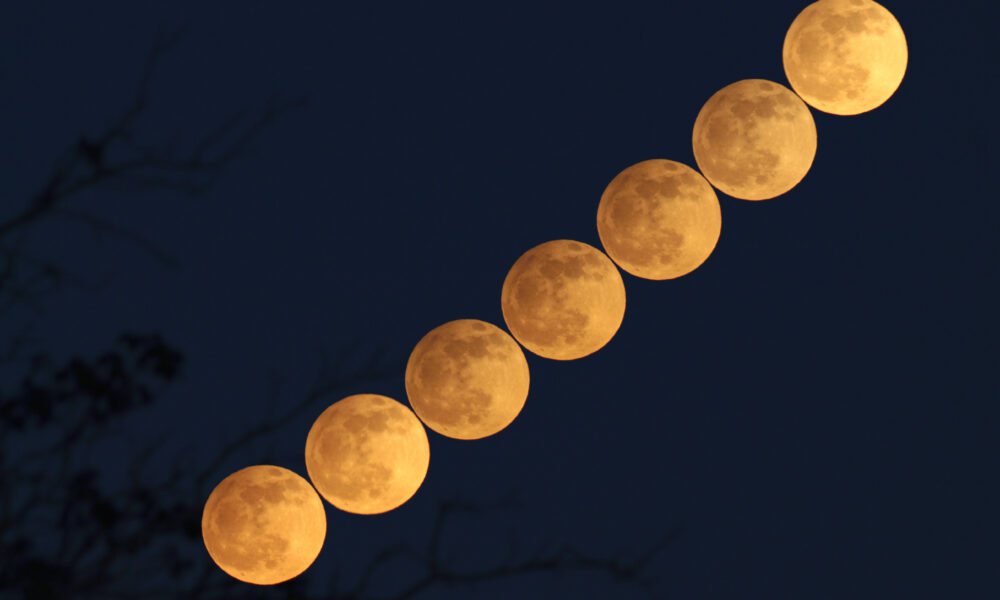
The May 2023 event was visible across parts of Europe, Africa, Asia and Australia and produced relatively noticeable shading during the deeper part of its passage through Earth’s outer shadow. The image featured here is a real photograph of that May 5, 2023 penumbral eclipse, shared under a CC0 public-domain dedication by its author. It shows actual lunar dimming and is not an illustrated Moon painted dark for a diagram.
Historic photographs are useful when they retain correct dates and conditions. An image of the March 2025 total red Moon should not be relabeled as a penumbral eclipse simply because the Moon is in shadow.
What does “penumbral magnitude” mean?
The penumbral eclipse magnitude compares how deeply the Moon’s diameter enters the outer shadow at maximum eclipse. A larger positive value generally means deeper penetration and a better chance of recognizing the shading. It is different from the fraction of sunlight lost at every point on the Moon and should not be casually interpreted as a percentage of lunar brightness.
Why are first and last contact hard to spot?
The edge of the penumbra is diffuse rather than sharp. At the moment the Moon barely touches it, the brightness change is imperceptible. NASA’s published penumbral first contact (P1) and last contact (P4) are calculated geometrical times, not moments when an obvious dark line crosses the lunar surface.
When is the next penumbral eclipse?
NASA’s current upcoming eclipse list shows a penumbral lunar eclipse on February 20, 2027, UTC, visible from parts of the Americas, Europe, Africa, Asia and western Australia. Visibility and exact local date depend on timezone and whether the Moon is above the horizon, so use NASA’s eclipse visibility calculations instead of relying on a single global local-clock time.
For a different Sun–Earth–Moon alignment, readers can consult NASA’s solar eclipse safety resource to understand why solar viewing requires filters even though lunar eclipse watching does not.
Frequently asked questions
Is penumbral lunar eclipse a blood Moon?
No. Penumbral-only eclipses usually show faint gray shading instead of the dark red appearance of a total umbral eclipse.
Can I see a penumbral eclipse without a telescope?
Yes if the eclipse is sufficiently deep and the sky is clear, but some events are too subtle for easy naked-eye detection.
Are penumbral lunar eclipses dangerous to look at?
No. Watching the full Moon during a lunar eclipse is safe without solar viewing glasses.
Is it the same as a partial lunar eclipse?
No. During a partial eclipse part of the Moon enters Earth’s darker umbral shadow, making a distinct dark region.
Why does the Moon look gray in an eclipse photograph?
The outer shadow reduces illumination, while exposure, camera settings and atmospheric conditions also affect apparent color and brightness.
October 2026 review. Official sources: NASA lunar eclipse types and schedule, NASA visual appearance of lunar eclipses, NASA eclipse contacts.

Other Articles