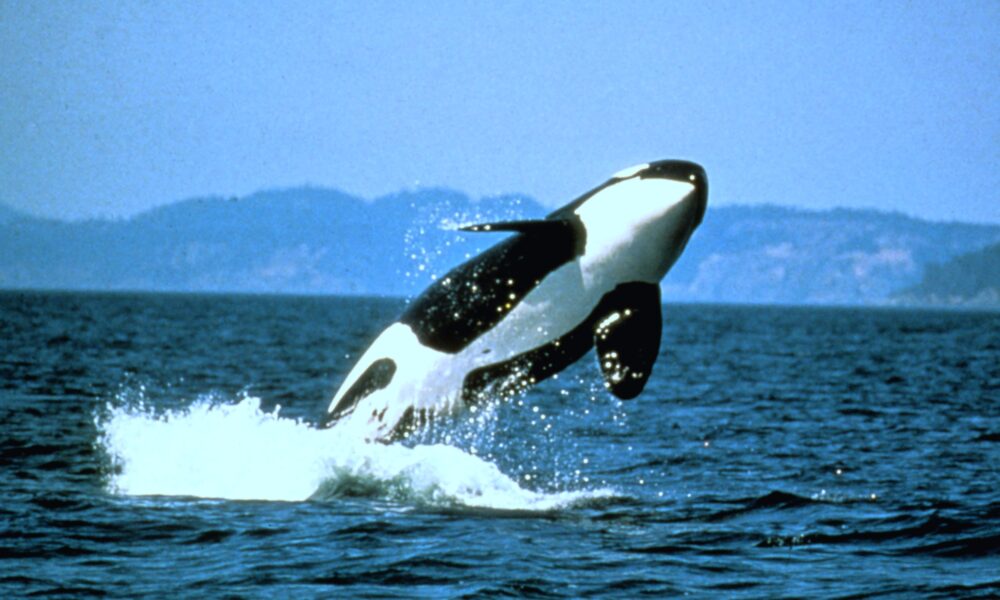

Quick answer — fact-checked October 17, 2026: An orca whale, also called a killer whale, can reach approximately 32 feet (9.8 meters) long and weigh up to 11 tons, according to NOAA Fisheries. Adult males are generally larger than females; a NOAA technical document describes especially large females reaching approximately 28 feet (8.5 meters) and 16,500 pounds, whereas very large males can reach 32 feet and 22,000 pounds. A newborn orca is often about 7 feet long in NOAA educational comparisons. These are approximate species or population size benchmarks, not measurements of every individual whale.
What makes orca size especially interesting is that the species is actually the largest member of the dolphin family, with a distinctly long male dorsal fin and a broad, muscular body. Below, we’ll compare male, female and calf measurements, explain why weights vary, distinguish orcas from humpback and blue whales, and show why a real breaching photograph cannot determine exact body length without a scale.
How big is a killer whale? Important measurements
| Measurement | Best-supported size | Qualification |
|---|---|---|
| Largest adult orca length | Up to 32 ft (9.8 m) | NOAA’s species-level upper-end figure |
| Largest adult orca weight | Up to 11 tons / approximately 22,000 lb | Not an average body weight |
| Very large adult female length | About 28 ft (8.5 m) | From NOAA technical material; females vary by population |
| Very large adult female mass | About 16,500 lb (7,500 kg) | Upper reference figure, not typical of every female |
| Illustrative newborn length | About 7 ft (2.1 m) | NOAA Springer education kit; individual newborns vary |
| Commonly compared adult female | About 23 ft (7 m) | Educational example, not a universal mean for all populations |
| Scientific name | Orcinus orca | Same animal as an orca or killer whale |
| Biological family | Delphinidae (oceanic dolphins) | It is also a toothed whale in the wider cetacean group |
NOAA’s killer whale species overview provides the familiar 32-foot and 11-ton maximum values. The NOAA technical report gives additional male-versus-female upper figures, while a NOAA education exercise about Springer uses the 7-foot newborn and 23-foot adult female examples. None of those sources claims that every orca fits one fixed length.
How long is an adult orca whale?
When someone says an orca is 32 feet long, they are describing a very large individual and measuring its body, not the height of its dorsal fin or the distance between two splashes. Adult killer whales are substantial marine predators, but animals in different populations do not always grow to the same size.
NOAA’s general upper-end benchmark is nearly 10 meters. A more practical image is to compare it with a vehicle: a particularly large male orca can be longer than many city cars parked end to end, though vehicles differ too much to make “three cars” an exact scientific unit.
Are all killer whales 32 feet long?
No. The 32-foot figure is a maximum reported benchmark, not an average. It would be inaccurate to assume every adult animal in the ocean is at the maximum length. Sex, maturity, food supply, genetic population and measurement method all matter. If a website quotes an exact “average killer whale length,” check whether it distinguishes male from female and young from fully mature orcas.
Are males larger than females?
Generally, yes. Orcas show strong sexual size dimorphism. NOAA explains that adult males develop larger dorsal fins, pectoral flippers, tail flukes and body girths than females. Technical NOAA material describes males reaching approximately 32 feet and females about 28 feet at the upper end. The visual size difference can help specialists identify sex in the right context, but a single distant photo may not provide enough evidence to sex a whale reliably.
How tall is the killer whale’s dorsal fin?
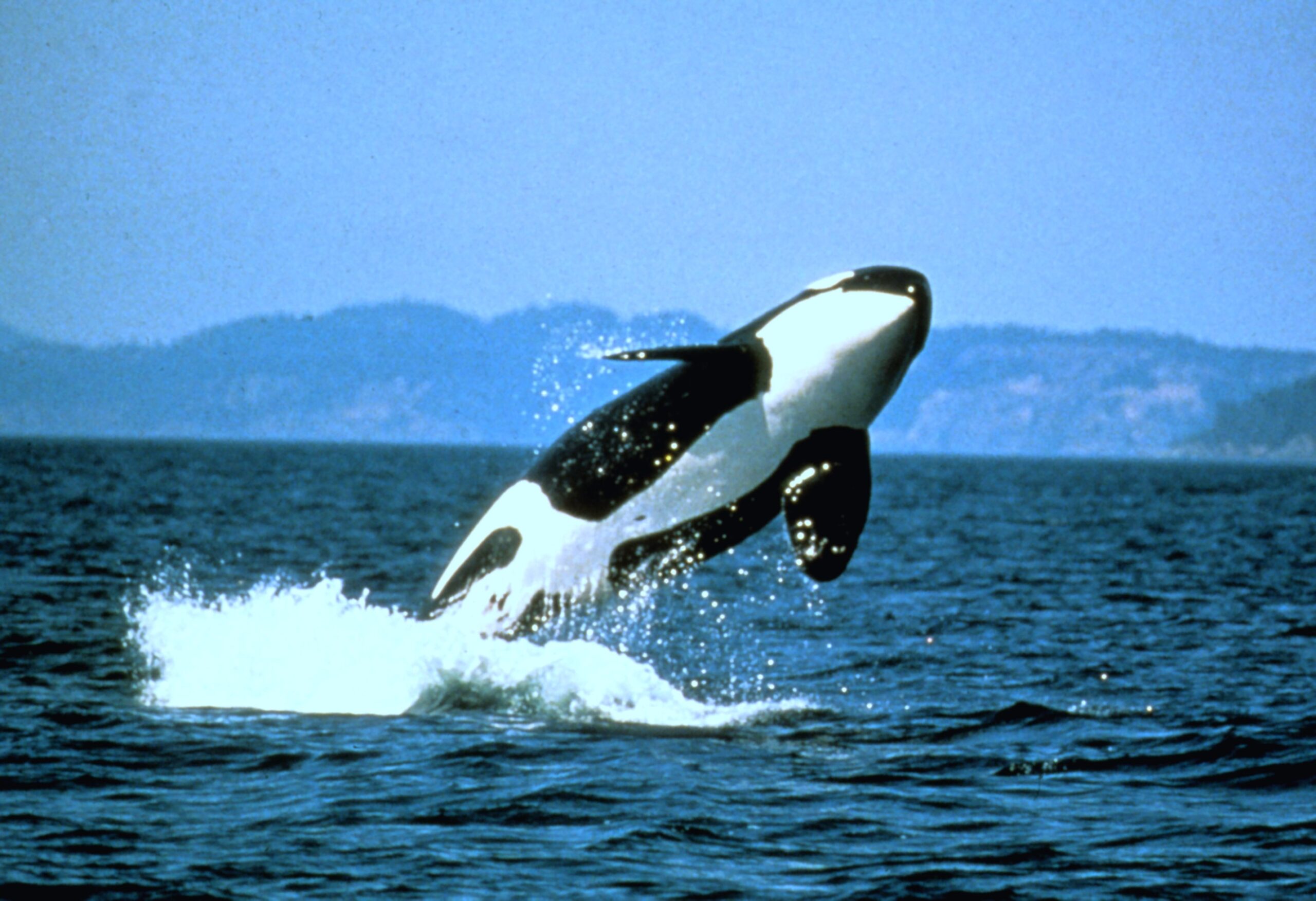
Adult males are famous for their relatively high and straight dorsal fins, whereas adult females and younger whales generally have smaller, more curved fins. The dorsal fin is not counted as extra body length. An orca’s apparent height above water can be dramatic during a breach, but do not confuse the fin’s height or the visible black-and-white section of the body with the total whale’s nose-to-tail length.
How much does an orca weigh?
NOAA Fisheries lists the killer whale’s upper-end weight as 11 tons. A NOAA technical report separately describes exceptionally large adult males at about 22,000 pounds and females around 16,500 pounds. The 22,000-pound figure is 11 US short tons, but not 11 metric tonnes. Be careful when converting a popular “tons” claim into metric units.
Weight is more difficult to measure than body length for free-swimming whales. Marine researchers use direct biological records where available, estimated volume from calibrated drone photographs, or relationships between measured girth and length. Most whale-watching photos lack enough reliable scale to tell you an exact weight.
Why can two orcas of the same length have different weights?
Body mass depends on girth, stored fat, age, feeding conditions, individual health and reproductive status. A whale recovering from a poor feeding season may be visibly thinner than another whale of similar length. Females may change body condition around gestation and nursing. That is why NOAA researchers track body condition, not just nose-to-tail length.
Can you weigh a killer whale from a drone image?
Researchers can sometimes obtain photogrammetric estimates of a whale’s body length and body condition using carefully calibrated aerial images. They account for the drone’s altitude, optics and geometry. That does not make one ordinary action photo a reliable scale; the image used in this article is an authentic observation of a breach and is not presented as a measured weigh-in.
How big is a baby orca whale?
Orca calves are born surprisingly large. A NOAA educational exercise on the rescued orca Springer has students compare a 7-foot newborn, an approximately 11-foot juvenile Springer, a 23-foot adult female and a 32-foot adult male. The 7-foot example is useful for understanding scale, but different newborns are not all exactly seven feet long.
NOAA describes a gestation period around 15–18 months, typically followed by the birth of one calf. Calves nurse exclusively for at least a year and remain close to their mothers for longer. A newborn cannot be expected to swim or hunt like a mature adult, even though it is already longer than most adult humans.
How fast do calves grow?
Young killer whales grow as they nurse and gradually learn feeding behaviors within their family groups. Rates can vary by population and food availability, so a single growth rate would be misleading. NOAA uses repeat photographs and population monitoring to assess the condition of individual orcas, rather than measuring every youngster the same way.
Are newborns smaller than dolphins?
A newborn orca can be longer than many fully grown small dolphin species. This is not surprising because the killer whale is itself the world’s largest oceanic dolphin species. Species-level comparisons are more meaningful than treating “dolphin” as one fixed-size animal.
Orca size vs blue whale and humpback whale
Orcas are exceptionally large dolphins, but they do not approach the maximum body size of the largest baleen whales. Humpbacks may grow to around 60 feet and up to 40 tons, according to NOAA, while the largest blue whales can exceed 100 feet. Their feeding anatomy, body shape and life histories also differ.
| Animal | Approximate upper length | What makes it distinctive |
|---|---|---|
| Killer whale / orca | 32 feet | Toothed dolphin-family predator, often hunts cooperatively |
| Humpback whale | 60 feet | Baleen whale with very long pectoral fins, filters prey |
| Blue whale | 110 feet in NOAA’s species reference | Largest living animal, specialized krill filter-feeder |
The table uses upper-size benchmarks, not average adult lengths; it is not a claim that every blue whale reaches 110 feet or every orca reaches 32. For more detailed comparisons, read our humpback whale size guide and blue whale size guide, both with species-specific real NOAA photographs.
Can orcas kill animals bigger than themselves?
Some populations of killer whales hunt marine mammals and other large prey in groups, while other populations specialize in salmon or other fish. Coordinated behavior helps them hunt, but it would be false to say all orcas regularly attack blue whales or that the diet is uniform worldwide. NOAA emphasizes that food preferences and learned hunting methods vary substantially by population.
Are orcas actually dolphins or whales?
Both terms can be used in context. An orca is a toothed whale within the cetaceans, and specifically the largest member of the dolphin family Delphinidae. Our toothed whales explainer covers echolocation, dolphins, orcas and the difference between toothed and baleen whales.
How can you tell an adult male orca from an adult female?
Sex-related size differences are useful, but markings and dorsal fins should be interpreted carefully. Adult males are often conspicuous because their dorsal fin is taller and more upright, while adult females have a smaller, often curved fin. NOAA notes that males tend to have larger body girths and flippers, too.
- Dorsal fin: taller and straighter in many fully mature males, but shape changes with age and can vary among individuals.
- Body girth: adult males are often more robust, although body condition varies with feeding.
- Length: the upper female and male measurements differ, but individuals overlap in size.
- Family grouping: repeated sightings and known family relationships help trained observers identify individuals more accurately than one snapshot.
- Markings: the white eye patches and saddle patches behind the dorsal fin help identify whales, not automatically determine their exact length or sex.
A natural-history photo is useful for recognizing a black-and-white body and overall shape, but do not infer a particular individual’s age, sex, length or reproductive status unless researchers have actually documented them.
Why are some killer whale populations different sizes?
Killer whales are found in every ocean, with different ecological populations occupying coastal and offshore habitats. NOAA describes several ecotypes, including fish-specializing resident killer whales, marine-mammal-hunting Bigg’s whales, and offshore populations. These differences may involve body shape, teeth, size and behavior.
The precise classification of some ecotypes continues to develop with genetics and taxonomy research; you may encounter proposals to recognize additional species or subspecies. For a general size article, it is safer to use NOAA’s broad Orcinus orca species-level ranges rather than pretend one population’s maximum applies equally to every distinct group.
Can you identify a population from its size alone?
Usually not. Researchers compare social associations, location, calls, saddle-patch shapes, genetics and repeated observations. An orca 22 feet long could plausibly belong to different populations, while a large male’s impressive dorsal fin alone does not reveal its entire ancestry.
Why accurate orca size estimates matter
Biologists monitor changes in whale length and body condition to understand growth, reproduction and food supply. In some Southern Resident killer whale populations, nutritional stress and prey availability are important conservation concerns. A thinner animal may be at greater risk even if its body length is unchanged.
NOAA Fisheries identifies food shortages, chemical pollution, vessel traffic and noise, oil spills and entanglement as significant threats. Southern Resident orcas are federally endangered, but that does not mean all killer whale populations everywhere share the same endangered designation. Size data should be read together with regional population research.
How can whale watchers help?
Follow current local vessel-distance rules and marine mammal viewing guidance, avoid chasing animals or attempting to force close encounters, and never use an uncontrolled drone near wildlife. Real whale photography can support education, but harassment is not justified by the desire for an unusually dramatic image.
Common orca size mistakes
- Confusing a maximum with an average. NOAA’s 32-foot figure is not the length of every adult.
- Mixing metric and US tons. An 11-US-short-ton figure is approximately 22,000 pounds, but is not exactly 11 metric tonnes.
- Assuming all dolphin species are small. Orcas are the largest dolphin species.
- Calling a calf a miniature adult hunter. Young animals rely on mothers and family groups.
- Using one breaching photo as a measuring tool. Perspective can exaggerate height, width and body length.
- Applying male upper figures to females. Adult males are generally larger, but populations differ.
- Using a photo of another whale species. Humpback, blue and killer whales have distinct body shapes and taxonomy.
Orca whale size FAQ
How long is the biggest killer whale?
NOAA’s species overview gives up to 32 feet, or approximately 9.8 meters. That is an upper species benchmark, not an average.
How much does an orca whale weigh?
NOAA lists a maximum of 11 tons. A related NOAA technical report gives especially large male orcas at approximately 22,000 pounds.
Are female orcas smaller than males?
Generally, yes. NOAA technical material cites very large females around 28 feet compared with males up to 32 feet. Individual sizes can overlap.
How big is a newborn orca?
NOAA educational material uses approximately 7 feet for a newborn orca. Actual newborns vary rather than arriving at an identical measurement.
Are orcas bigger than humpback whales?
No. Humpback whales can be much longer and heavier at the upper end, though orcas are enormous compared with most members of the dolphin family.
Why is a killer whale called a dolphin?
Because Orcinus orca is part of the Delphinidae biological family; this makes it the largest oceanic dolphin, and it is also a toothed whale.
Can an orca be measured from a boat photo?
Not precisely without reliable scale or calibrated measurements. Researchers often need multiple known-distance images or dedicated aerial methods to estimate body dimensions.
Does the photo on this page show the largest orca ever?
No. The image is a genuine NOAA photograph of a breaching killer whale. No documented individual body length or weight is attributed to that particular photographed animal.
Scientific sources and photo provenance
- NOAA Fisheries: Killer Whale — species classification, maximum length and weight, sex differences, diet and conservation.
- NOAA technical document — upper male and female body measurements.
- NOAA Saving Springer education resource — documented size-comparison exercise for newborn, adult and juvenile orcas.
- NOAA: Humpback Whale and NOAA: Blue Whale — separate species size references.
- NOAA Photo Library original photographic record — authentic breaching killer whale image. The file originated from NOAA Photo Library, is labeled U.S. government public domain, and also has a Creative Commons Attribution 2.0 notice in its original Flickr/Commons record. The only alteration made for this article was WordPress’s automatic size optimization from 2856 to 2560 pixels wide; no content was added or removed. No claim to original U.S. Government works is made.
Editorial verification: October 17, 2026. Individual killer whale measurements, weights and population biology vary. The article reports NOAA upper-range estimates and does not claim to weigh or photograph an identified orca in October 2026.