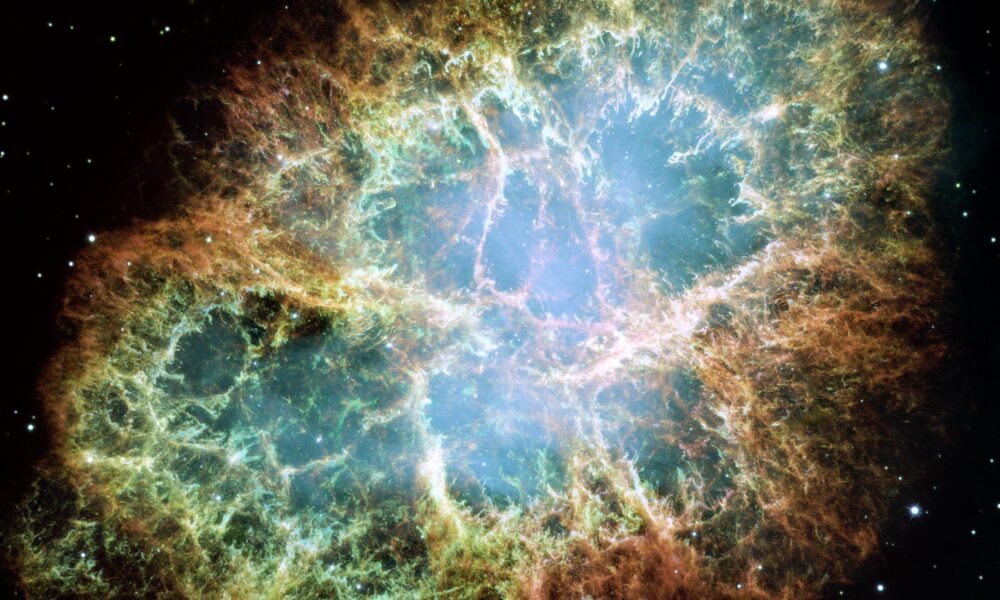

The Crab Nebula, also called Messier 1 (M1) or NGC 1952, is the expanding debris of a stellar explosion recorded by astronomers in 1054 CE. It lies around 6,500 light-years away in the constellation Taurus. At its center is the Crab Pulsar, an exceptionally dense neutron star spinning about 30 times per second. What looks like a spectacular multicolored cloud is the remnant of a real supernova, continually energized by the central star’s intense particle wind.
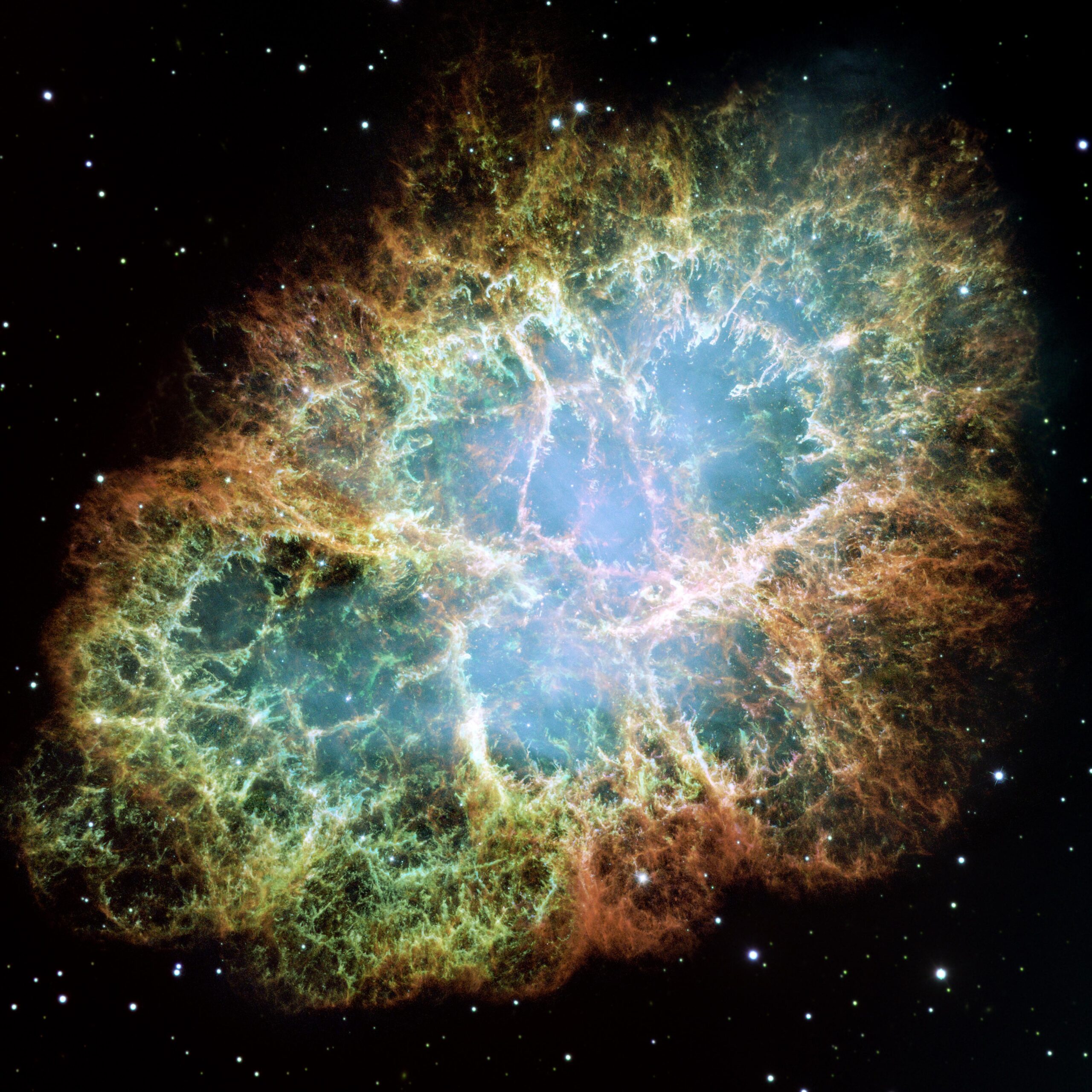
Two images in this article are authentic NASA astronomical observations: Hubble’s detailed 2005 optical view of the filaments and a 2017 multiwavelength composite combining data from five observatories. The colors in these telescope products are assigned to observations to reveal physical processes, not painted images of what the human eye would see in space. Below we explain the historical explosion, remnant size, pulsar, telescope differences and the remaining debate about the star that exploded.
Crab Nebula key facts
| Topic | Verified detail |
|---|---|
| Other names | Messier 1, M1, NGC 1952 |
| Constellation | Taurus |
| Distance | About 6,500 light-years |
| Type | Supernova remnant and pulsar wind nebula |
| Event seen from Earth | 1054 CE |
| Size | On the order of 10 light-years; boundaries and measurements vary |
| Central compact object | Crab Pulsar, a neutron star |
| Pulsar spin | About 30 rotations each second, period ~33 milliseconds |
| Visible apparent magnitude | Approximately 8.4 |
NASA’s Messier 1 guide provides the constellation, distance, magnitude and history. A physical extent around 10 light-years is widely quoted; the reported diameter can differ depending on which faint shell emission is counted.
What happened in 1054 CE?
Historical observers recorded a brilliant guest star in 1054 CE. Its brightness and appearance later helped astronomers identify the event as a supernova, a catastrophic stellar explosion. The apparent point of light faded from human view, but the glowing remnants kept expanding into space. The shell now seen through telescopes is matter thrown out by the dying star plus energetic particles and radiation associated with the neutron star left behind.
NASA says the guest star was bright enough to be observed during daylight for a period of time. This is not a claim that the nebula itself is now visible in daylight: the faint present-day object requires suitable nighttime skies and optical equipment. The connection between the historical event and the Crab Nebula was suggested in the twentieth century as astronomers analyzed expansion and archival records.
What is the Crab Pulsar and why does it flash?
The supernova left behind an ultra-dense neutron star, the collapsed core of the original massive star. This remnant has an intense magnetic field and rotates approximately once every 33 milliseconds. Emission directed along rotating magnetic poles sweeps across space, appearing to a distant observer like recurring flashes from a lighthouse. These signals are observed in radio and other parts of the electromagnetic spectrum.
The pulsar powers a wind of charged particles. As the energetic material interacts with the ejected gas, it produces bright filaments, wisps and radiation extending well beyond the compact neutron star. NASA’s multiwavelength explanation describes both the spinning source and the mechanisms affecting its intricate nebular structure.
How large is the Crab Nebula?
The glowing remnant spans roughly 10 light-years, although astronomy references describe slightly different figures based on field of view and the measured emission boundaries. A light-year is the distance light travels in a year, approximately 9.46 trillion kilometers. Thus even a single arc of the Crab’s image can represent huge volumes of extremely thin gas.
It is easy to mistake its faint apparent size in the sky for a physically small object. At 6,500 light-years, the expanding cloud looks tiny through modest equipment but would be enormous if placed next to our solar system. The neutron star in the middle, in contrast, is compact—roughly the size of a town despite holding stellar-scale mass.
What does the 2005 Hubble photo reveal?
Hubble assembled a mosaic using 24 separate exposures from its Wide Field and Planetary Camera 2. The image highlights intertwined gas filaments, complex knots and the overall oval-like structure of the remnant. It is a physical image of an actual object, though the color-mapping highlights emission from gas of different temperatures and chemical compositions.
The original NASA image is cataloged PIA03606. It is not a live 2026 view, nor a photograph of a star still exploding in real time. Read the NASA Photojournal description to understand how the mosaic was built.
What do five different telescopes show?
Scientists also published an image in 2017 combining five observational bands. The image below is an authentic multiwavelength scientific composite, PIA21474. Red indicates radio measurements from the Very Large Array, yellow comes from Spitzer infrared data, green represents Hubble optical light, blue is ultraviolet information from XMM-Newton, and purple reveals X-rays from Chandra. Each color is tied to an actual instrument rather than a fictional visual effect.
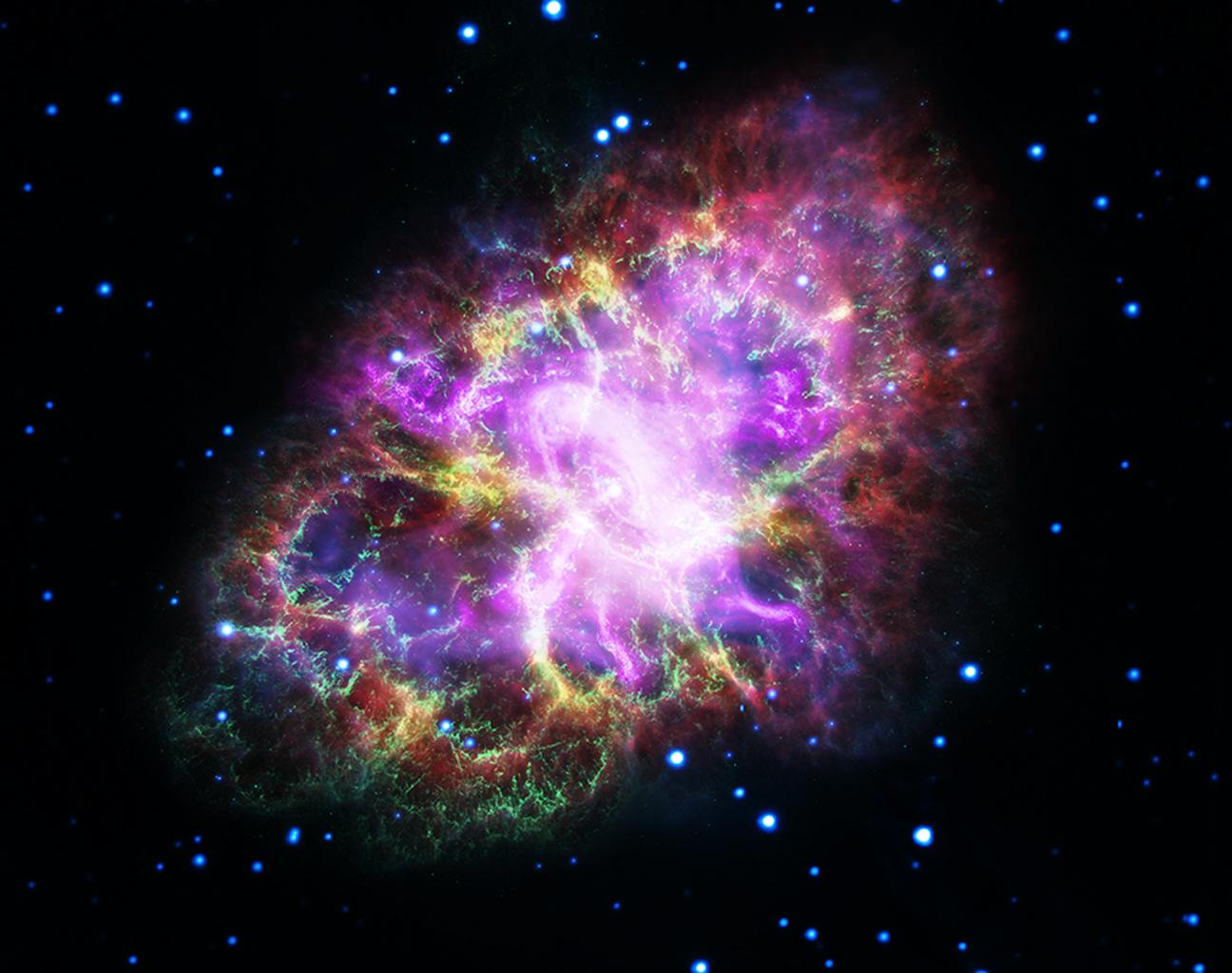
Different wavelengths trace different structures. Radio emission responds to relativistic electrons interacting with magnetic fields, infrared observations capture the warmth and distribution of dust, optical images emphasize glowing gas, and X-rays reveal very energetic regions close to the pulsar. This is why astronomers combine instruments: no single camera tells the complete story. NASA’s PIA21474 source page documents the individual instruments and their colors.
What did James Webb discover about the Crab Nebula?
Webb’s NIRCam and MIRI studied the remnant in infrared light, gathering new evidence about its chemistry and original supernova mechanism. In June 2024, scientists reported that the measured nickel-to-iron abundance ratio was lower than some older estimates. This means the data do not uniquely establish that the event was an electron-capture supernova; a relatively weak iron core-collapse event remains a possible explanation.
The distinction is important because some summaries state confidently that Webb proved one precise type of original explosion. NASA’s 2024 mission study instead explains the competing interpretations and need for additional observations. The Crab Nebula’s origin is not in doubt as a supernova remnant, but the precise physical channel that produced the explosion is still being tested.
Can you see the Crab Nebula through a telescope?
Yes. M1 is a traditional deep-sky target for many amateur telescopes. Under dark skies it can appear as a small pale fuzzy patch, but the dramatic colored filaments often require long-exposure photography or much larger instruments to distinguish clearly. Plan your search in Taurus, near the horn region and the star Zeta Tauri. Winter evenings are generally favorable in the Northern Hemisphere.
Use a low or moderate magnification to locate the faint diffuse glow, and confirm its position with a reliable star chart. City lighting and poor atmospheric conditions reduce contrast. The object’s apparent magnitude is about 8.4, but the spread-out nature of the light makes it more difficult than a similarly bright point-like star.
Crab Nebula vs. a normal emission nebula
Both can contain bright glowing gas, but the physical origin is different. The Crab is the ejecta of a supernova, powered partly by its neutron star. A star-forming emission region such as the Orion or Rosette Nebula is energized by young stars and is associated with clouds where stars are forming. These regions can look colorful in photographs yet follow different evolutionary stories.
For contrasting examples, read our Rosette Nebula guide and Hubble Deep Field explainer. Those articles address stellar nurseries and distant galaxy imaging, respectively, rather than the remnant of the 1054 explosion.
Crab Nebula frequently asked questions
Is the Crab Nebula the same as a crab animal?
No. The name comes from an early drawing and the nebula’s perceived shape, not a biological organism.
When did the Crab Nebula form?
The supernova was recorded by observers on Earth in 1054 CE; the present nebula is the resulting expanding remnant.
How many times does the Crab Pulsar spin per second?
Approximately 30 times per second, or one rotation every 33 milliseconds.
Why are the NASA pictures so colorful?
They use scientifically mapped colors to represent filters or radiation bands; the five-observatory composite includes radio through X-ray measurements that human eyes cannot directly see.
Will the Crab Pulsar explode again?
It is already the collapsed remnant left by a supernova. A claim of another identical supernova on a predictable schedule would be scientifically unfounded.
What constellation contains M1?
Taurus, about 6,500 light-years from Earth.
Is the Crab a star-forming nebula?
No. It is a supernova remnant, not the same type of object as the Orion Nebula.
Primary scientific references and authentic photo credits
The photographs are distinct, authentic NASA astronomy data products uploaded to AVARIXO Media Library: Hubble PIA03606 (2005) credited to NASA/ESA/JPL/Arizona State University, and NASA PIA21474 (2017) credited to NASA, ESA, university research teams and the VLA, Chandra, Spitzer, XMM-Newton and Hubble observatories as documented. Technical facts follow NASA’s multiwavelength explanation and its 2024 Webb research. Source and credit details are recorded in the Media Library; NASA endorsement is not implied.