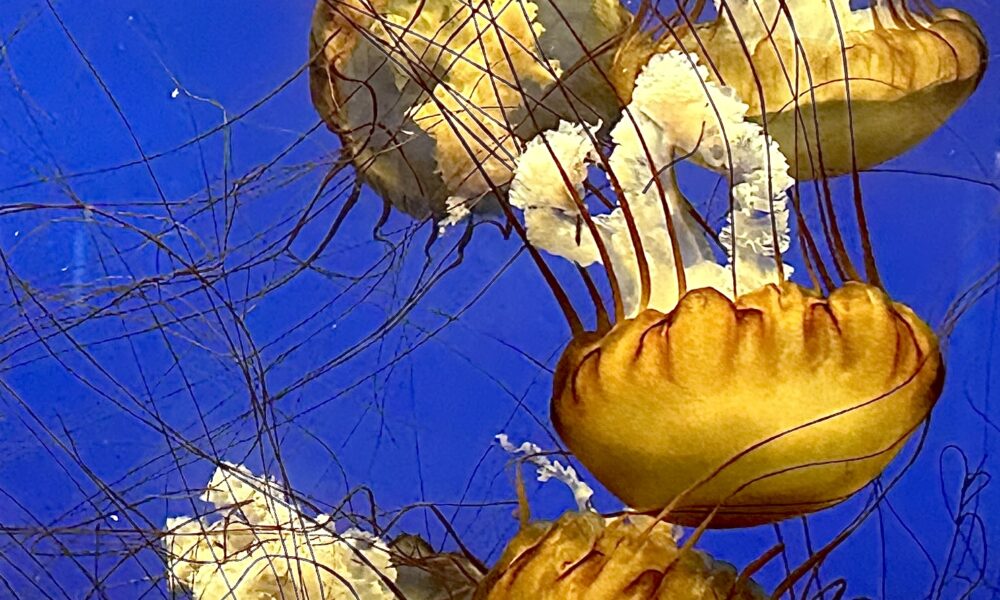

Quick answer: The Pacific sea nettle (Chrysaora fuscescens) is a golden-brown, stinging jelly found primarily in temperate North Pacific waters, especially around California and Oregon. It has a saucer-like bell, 24 slender tentacles and four frilly oral arms that help move captured food to its mouth. Its tentacles can sting swimmers, although serious complications are unusual. These jellies eat zooplankton, fish larvae and other jellyfish, and can appear in seasonal blooms along the West Coast.
Pacific sea nettle facts at a glance
| Attribute | Typical description |
|---|---|
| Scientific name | Chrysaora fuscescens |
| Animal group | True jellyfish, class Scyphozoa |
| Appearance | Golden to reddish-brown bell, trailing thread-like tentacles and lacy oral arms |
| Number of marginal tentacles | Typically 24 in adults |
| Bell size | Often around a foot across, but size varies |
| Oral arms | Can be several meters long in large specimens |
| Range | Pacific coastal waters around California and Oregon, extending more broadly in the North Pacific |
| Food | Zooplankton, fish eggs and larvae, other gelatinous animals |
| Defense and feeding | Stinging cells called nematocysts |
Species descriptions are documented in the Monterey Bay Aquarium species account and the Aquarium of the Pacific’s updated 2026 natural history guide.
How to identify a Pacific sea nettle
The bell usually shows a warm amber, ocher or reddish-brown color with a darker margin. A row of scallops runs around its rim. Long, relatively thin tentacles trail behind, while four more substantial, frilly oral arms extend from the center. The arms may appear to swirl or curl as the animal pulses through the water.
Not every yellow jelly is a Pacific sea nettle. The Atlantic sea nettle and Japanese sea nettle belong to related but different species, and the black sea nettle (Chrysaora achlyos) is another large West Coast jelly. Geographic location, bell pattern and tentacle arrangement help avoid photo misidentification.
Where do Pacific sea nettles live?
Pacific sea nettles inhabit offshore waters and nearshore bays along the West Coast of North America, with records extending across temperate regions of the North Pacific. Aquarium of the Pacific describes seasonal patterns in which jellies may occur near the surface in shallow bays during cooler months and in large open-water swarms during spring or summer.
Because their position depends partly on currents, weather and food availability, an unusually dense bloom off one beach should not be generalized to every California coastal location that week.
What do they eat?
Pacific sea nettles are carnivorous despite not having a backbone, brain or limbs. They collect small planktonic animals, fish larvae and other jellies using tentacles armed with microscopic stinging cells. When an organism contacts a tentacle, nematocysts discharge and help immobilize the prey, which is brought toward the mouth via tentacles and oral arms.
How do stinging cells work?
A nematocyst is a specialized capsule inside a stinging cell. Physical and chemical cues can trigger an extremely rapid discharge of a coiled microscopic structure that helps deliver venom. These cells evolved to capture prey and deter threats; the animal does not make a conscious choice about which swimmer it stings.
How large can sea nettle tentacles become?
Descriptions vary because specimens differ greatly in age and growing conditions. The Monterey Bay Aquarium reports bell diameters approaching 45 centimeters in large animals and oral arms that can extend about 3.6–4.6 meters. Most jellyfish encountered or exhibited may be smaller. Maximum recorded length should not be mistaken for an ordinary animal’s exact size.
How do Pacific sea nettles swim?
They contract and relax the bell to push water backward and generate forward movement. Currents remain important, so their movement is a combination of self-propulsion and drifting. Sea nettles do not possess a centralized human-like brain, but they can still coordinate bell pulses, respond to light and environmental changes, and capture prey effectively.
Can Pacific sea nettles sting people?
Yes. Their stinging tentacles can produce painful skin irritation. Severity varies with a person’s sensitivity, the amount of contact and the species involved. A person with difficulty breathing, a severe allergic response or other serious symptoms should seek emergency medical attention. Beach managers may close swimming areas during large blooms.
How to reduce the risk
- Read local beach flags and jellyfish advisories before swimming.
- Do not touch a jellyfish, even if it looks stranded on sand.
- Keep children and pets away from washed-up tentacles, which may still contain active stinging cells.
- If contact occurs, follow local lifeguard or healthcare guidance tailored to that species and setting.
- Do not rely on viral home remedies; recommended treatment methods differ among jellyfish species.
What eats Pacific sea nettles?
Jellies are prey for various animals including sea turtles and jelly-eating fish. The Monterey Bay Aquarium notes that leatherback sea turtles can travel across the ocean and feed extensively on sea nettles and related jellies. Such relationships make jellies part of the marine food web rather than simply pests that need removing.
How do Pacific sea nettles reproduce?
Like many true jellyfish, sea nettles have a life cycle with several distinct stages. Adults release reproductive cells; developing larvae eventually settle on suitable surfaces and become attached polyps. Under the right environmental conditions, the polyp produces small juvenile jellies called ephyrae, which grow into the familiar swimming medusae. A bloom is therefore the visible adult stage of a more complex life history.
Pacific sea nettle versus moon jelly
| Trait | Pacific sea nettle | Moon jelly |
|---|---|---|
| Color | Amber or reddish-brown | Often nearly transparent |
| Long tentacles | Conspicuous thin tentacles and frilly oral arms | Usually much shorter marginal tentacles |
| Sting to people | Can be painful | Usually mild or not felt by many swimmers |
| Identification | Chrysaora fuscescens | Commonly Aurelia species |
Frequently asked questions
Are Pacific sea nettles dangerous?
They can cause painful stings, although severe reactions are uncommon. Keep a safe distance and follow beach advisories.
Is a sea nettle a jellyfish?
Yes. Pacific sea nettles are true jellyfish in the class Scyphozoa.
What does a sea nettle eat?
It eats zooplankton, young fish and other gelatinous ocean animals using stinging tentacles.
Where can I see one?
Pacific coastal waters and public aquariums such as Monterey Bay Aquarium, depending on exhibit availability.
Do Pacific sea nettles have eyes?
Jellies can possess simple light-sensing structures, but they do not see the world in the way a human eye does.
Reviewed October 2026. References: Monterey Bay Aquarium, Aquarium of the Pacific 2026 fact sheet, Jellyfish life cycles.