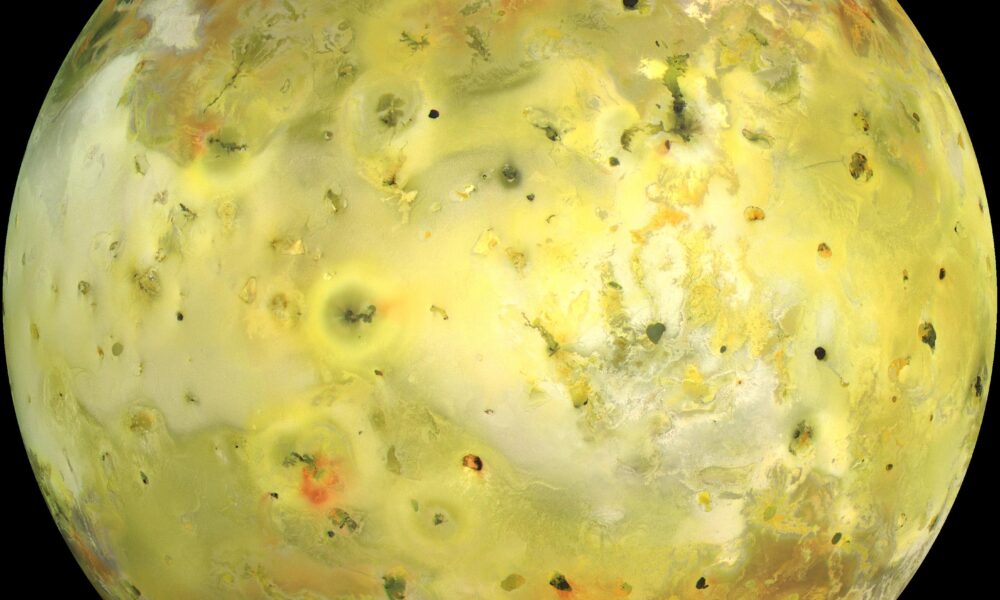

Quick answer: Io is Jupiter’s extraordinarily volcanic Galilean moon, slightly larger than Earth’s Moon. Jupiter’s gravity and orbital interactions with Europa and Ganymede repeatedly flex Io’s interior, generating heat that drives countless active volcanic features. The image below is a genuine approximately true-color NASA Galileo observation, not an illustration.
Jupiter’s moon Io: quick facts
| Question | Verified fact |
|---|---|
| Orbits | Jupiter |
| Moon family | One of four large Galilean moons |
| Diameter | Approximately 3,640 km |
| Orbital period | About 1.77 Earth days |
| Most distinctive feature | Very active volcanism |
| Heating source | Strong changing tides from Jupiter’s gravity |
| Key orbital relationship | Laplace resonance with Europa and Ganymede |
| Atmosphere | Extremely thin; sulfur dioxide-rich |
| Featured photograph | NASA Galileo July 1999 observation PIA02308 |
What is Io and where is it?
Io is one of Jupiter’s four large Galilean moons, discovered during the early telescopic study of the giant planet in 1610. It orbits close to Jupiter and is among the most active worlds in the Solar System. Its surface is so frequently resurfaced by eruptions and other geological processes that familiar impact craters are uncommon compared with airless bodies such as Earth’s Moon. Io is a natural satellite, not a planet or an artificial spacecraft. Its bright yellow-orange appearance in many photographs comes from complex sulfur-rich surface deposits associated with repeated volcanic activity.
Why scientists call Io the most volcanic world
Io is famous for persistent intense volcanic activity, including lava flows, volcanic calderas and plumes that can rise hundreds of kilometers above the surface. NASA has described hundreds of volcanic centers on the moon. A large eruption can alter the appearance of a region between spacecraft visits, giving researchers a way to compare real surface changes. It is not correct to claim that every dark patch in a color photograph is currently erupting: scientists identify active hot spots through additional measurements and observations at appropriate wavelengths. The geological activity is powerful because Io continuously receives internal heating from tidal forces.
Jupiter’s gravity is the source of tidal heating
The enormous gravitational field of Jupiter pulls more strongly on Io’s near side than its far side. Because Io travels along a slightly elliptical orbit, the gravitational stretching of its interior changes during an orbit. Repeated deformation generates heat within the moon, making volcanism possible. This differs from sunlight heating a planet’s surface or from Earth-style plate tectonics alone. Io would have a different thermal history without the orbital conditions that maintain the repeated flexing. Scientists use this world as an example of how gravitational energy can heat a moon far from the Sun.
Europa and Ganymede help keep Io’s orbit eccentric
The inner Galilean moons Io, Europa and Ganymede follow an orbital relationship called the Laplace resonance. Their periods are approximately in a 1:2:4 relationship, so gravitational interactions recur in a regular pattern. Those interactions help maintain the small eccentricity in Io’s orbit, allowing tidal flexing to continue instead of rapidly settling into a more circular, less strongly heated path. This does not mean Europa or Ganymede physically touch Io or exchange magma with it. It is their gravity, together with Jupiter’s, that influences orbital dynamics over long timescales.
How large is Io compared with Earth’s Moon?
Io is slightly larger than Earth’s Moon, with a diameter of approximately 3,640 kilometers. In raw size it can resemble a familiar rocky moon, but its environment and activity are radically different. Io’s surface is shaped by repeated volcanic deposits rather than mainly by preserved impact craters. It also experiences Jupiter’s magnetospheric environment, which affects charged particles and gas near the moon. An image of Io as a colorful round disk therefore conceals a dynamic landscape where molten material and sulfur compounds can transform the surface.
A day and a year are not like Earth’s
Io takes about 1.77 Earth days to complete an orbit around Jupiter. It is tidally locked, meaning the same hemisphere generally faces Jupiter as it travels, much as Earth’s Moon usually presents the same side toward Earth. This orbital period is sometimes loosely called Io’s ‘year,’ but Io is a moon rather than a planet orbiting a star. Its local lighting cycle involves its path around Jupiter and changing geometry with the Sun. Do not copy Earth-based calendar concepts into a claim that Io has conventional 24-hour days.
What the real NASA photograph shows
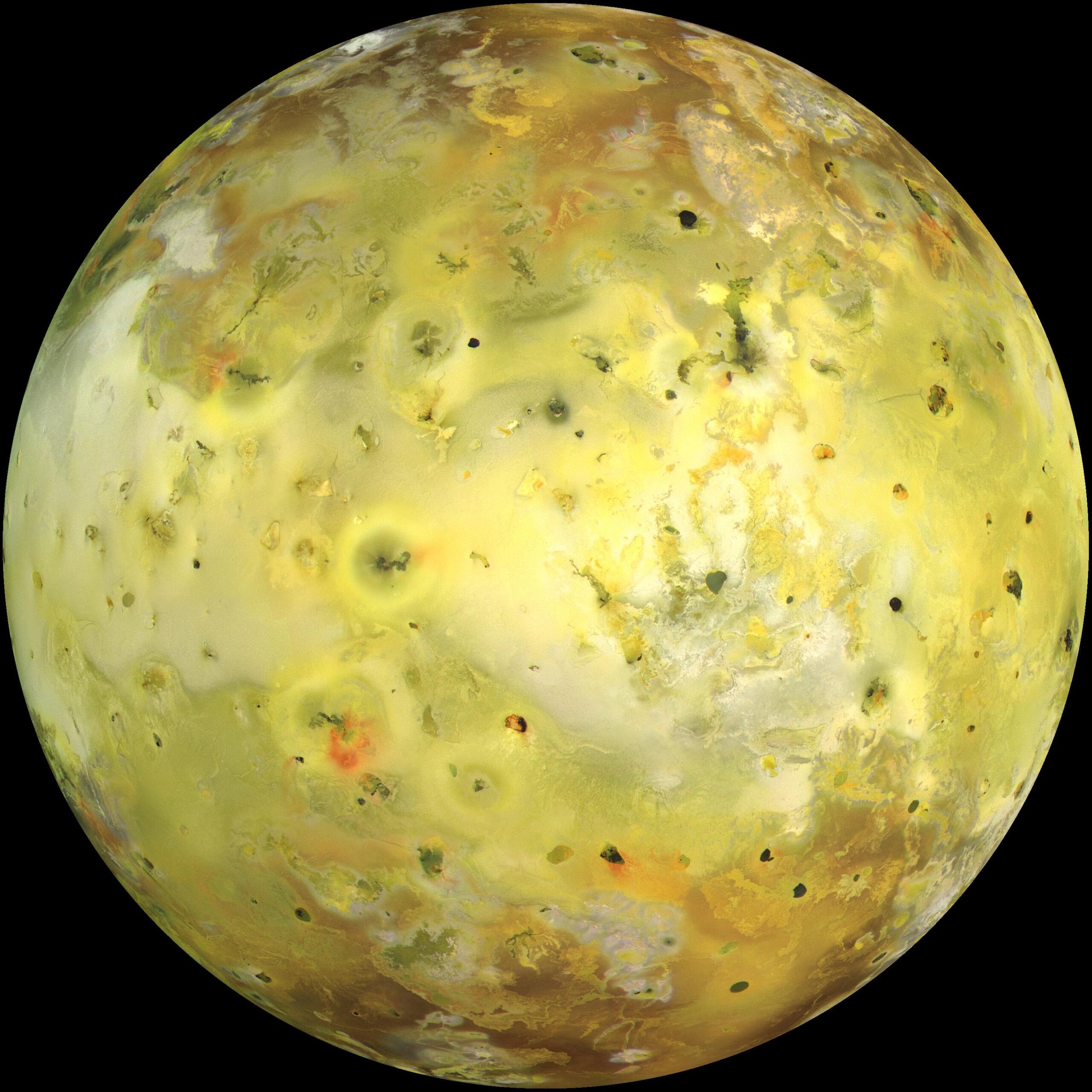
The photograph featured in this article comes from NASA’s Galileo spacecraft and is cataloged as PIA02308, a July 3, 1999 observation. NASA labels it an approximately true-color mosaic built from near-infrared, green and violet filter observations. It depicts actual variations in Io’s surface, including yellow, orange, reddish and dark areas associated with different materials and geological histories. The colors are broadly representative, but the image is still a calibrated scientific mosaic, not an ordinary smartphone photograph. NASA also published enhanced-color versions to highlight features that are less obvious in this presentation.
Sulfur and volcanic material explain the strange colors
Sulfur-rich compounds and volcanic deposits can produce Io’s distinctive yellow and orange regions, while darker materials may correspond to different lava flows or changes near active volcanic centers. These colors are not an indication that the surface is covered with a shallow ocean of liquid sulfur. Much of the material is solid between eruptions, and different surfaces respond to light in distinct ways. NASA’s Galileo image captions discuss mixtures of silicate lava and sulfurous deposits, emphasizing that identifying an exact composition requires more than merely looking at a color on a screen.
Does Io have air or water oceans?
Io has an extremely tenuous atmosphere made largely of sulfur dioxide, strongly affected by volcanic outgassing and environmental conditions. It is not breathable and would provide almost no protection to a person standing on the surface. Io is also not considered an Earth-like ocean world. Europa, another Galilean moon, is often discussed because of strong evidence for a subsurface water ocean beneath an icy crust. Confusing those two worlds leads to misleading descriptions of Jupiter’s moons. Io’s geological activity is principally volcanic, while Europa’s major astrobiology questions focus on its ice and liquid-water environment.
Volcanic plumes are not normal weather clouds
Images from spacecraft show plumes emerging above Io’s volcanic regions. These are driven by geologic activity rather than ordinary meteorological water-cloud systems such as those on Earth. Some plume particles return to the surface and form large deposits around an active center, helping create rings or broad bright regions. A single picture does not always distinguish a newly erupted plume from a deposit left by earlier events. Astronomers examine how an area changes between observations to determine which surface features have developed over time.
How Galileo and Juno revealed different details
NASA’s Galileo mission orbited Jupiter and captured extensive observations of Io in the 1990s and early 2000s, including the real color image used here. Decades later, Juno continued investigating the Jovian system, with particularly useful observations of Io and its active surface. Instruments and observing geometry differ, so a Juno infrared hot-spot map is not directly comparable with Galileo visible-light photography without accounting for what each sensor measures. Our Galileo spacecraft guide explains that mission’s instruments; the Juno guide covers the newer Jovian orbiter.
Could humans land on Io?
A fictional visit to Io would face severe obstacles: intense radiation in Jupiter’s magnetospheric environment, extreme geological activity, little protective atmosphere and a very remote location. Those problems differ from simply putting on a suit and walking near a volcano on Earth. NASA has studied Io primarily through remote spacecraft observation, not through a crewed landing. When stories claim a future human settlement is already scheduled, verify an official mission announcement before treating the proposal as confirmed. For now, observing and interpreting Io through spacecraft data is the practical scientific approach.
Where to see genuine Io images
NASA’s Global Image of Io (True Color) documents the exact Galileo observations and explains how the color mosaic was created. The Galileo Sees Io Erupt feature provides another actual view of volcanic activity. Compare the two photographs and their dates before assuming they show the same event. NASA also publishes enhanced-color images with stronger contrasts; those scientific renderings serve a different purpose from an approximately true-color overview.
Frequently asked questions
Is Io a moon or a planet?
It is one of Jupiter’s natural satellites and one of the Galilean moons.
Why does Io have so many volcanoes?
Gravitational tides flex and heat its interior, keeping volcanism unusually active.
Does Io have a breathable atmosphere?
No. Its sulfur dioxide-rich atmosphere is extremely thin.
Is Io covered by a water ocean like Europa may be?
No. Io and Europa have very different geologic and environmental conditions.
Are the yellow colors in NASA’s image genuine?
The Galileo mosaic approximates visible appearance using calibrated filter data, while enhanced-color versions emphasize additional features.

Other Articles

Lunar Rover Explained: How Apollo Astronauts Drove on the Moon
