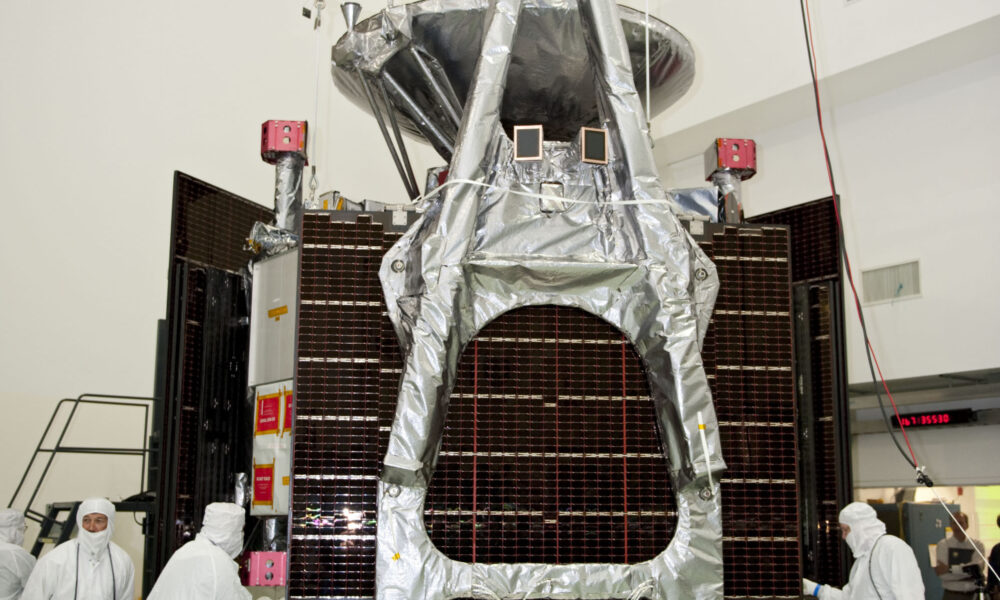

Quick answer: NASA’s Juno spacecraft is a spinning, solar-powered robotic orbiter built to study Jupiter’s atmosphere, gravity, magnetic field and deep interior. It launched on August 5, 2011, arrived at Jupiter on July 4, 2016, and went on to observe the giant planet’s moons. Unlike many dramatic images online, the real Juno spacecraft is not photographed from outside while flying around Jupiter: pictures of Juno beside Jupiter are usually artist’s illustrations. This guide uses actual NASA photos of Juno flight hardware before launch and distinguishes those from real JunoCam images of Jupiter.
2026 update: Scientific papers using Juno data continued to appear in 2026, including a February measurement refining Jupiter’s size and a July result about the subsurface of the volcanic moon Io. Publication of a new study does not on its own confirm that a spacecraft is still transmitting today. NASA’s publicly available mission pages still include a September 2025 extended-mission endpoint, so readers should avoid treating that date or the website’s ‘Current’ badge as a fully verified live telemetry status.
Juno spacecraft: mission facts at a glance
| Question | Verified answer |
|---|---|
| Who built and operates it? | NASA mission managed by JPL; Lockheed Martin built the spacecraft, and Southwest Research Institute leads the science investigation. |
| Launch | August 5, 2011, aboard an Atlas V rocket from Cape Canaveral. |
| Arrival at Jupiter | July 4, 2016, after an approximately five-year voyage and Earth gravity assist in 2013. |
| Mission type | Uncrewed Jupiter orbiter; it is not a rover or lander. |
| Power source | Three large solar arrays, not a plutonium-based radioisotope power source. |
| Rotation | Spin-stabilized; it changed its spin rate for the critical 2016 orbit insertion. |
| Science targets | Jupiter’s interior, atmosphere, magnetic field, auroras and major moons. |
| Camera | JunoCam, the mission’s visible-light camera with publicly released image data. |
| Extended-mission public schedule | NASA mission pages list operations through September 2025 or end of life; check for later official announcements. |
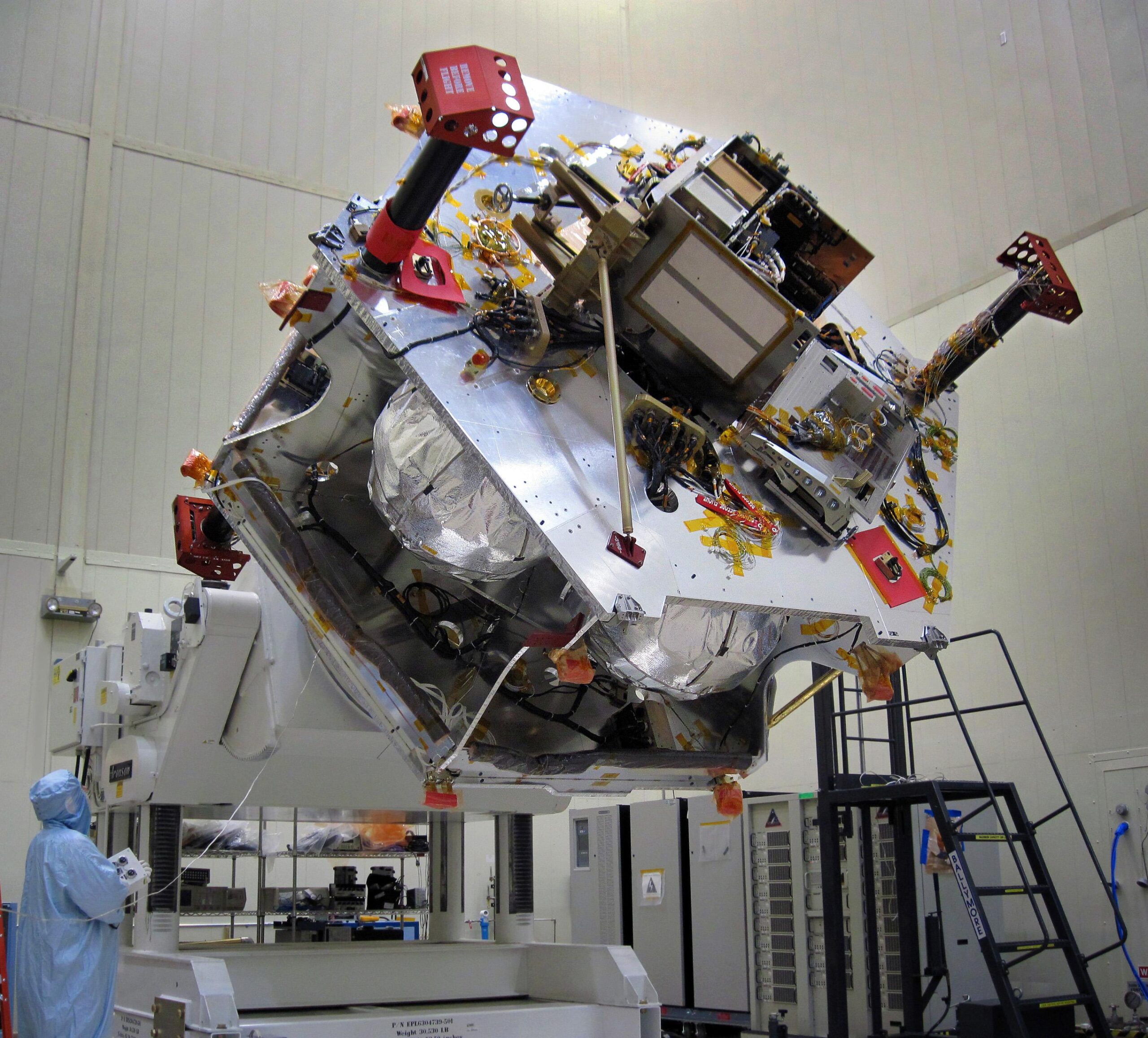
This is a real NASA/JPL-Caltech/Lockheed Martin cleanroom photograph of Juno undergoing hardware integration in June 2010—not a computer-generated view of the spacecraft already orbiting Jupiter. The big pieces visible in early assembly photos can look quite different from the finished spacecraft because the solar arrays and protective coverings were not yet all in their flight configuration.
Why NASA built Juno
Jupiter’s colorful clouds conceal deep atmospheric layers and its internal structure. Juno was designed to probe what scientists could not determine simply by photographing the cloud tops. It measures how the planet’s gravity and magnetic field affect the spacecraft, samples microwave emissions from different depths, and observes charged particles and auroras in the polar environment. These measurements help scientists infer how Jupiter formed and evolved, and how gas giants elsewhere may form.
Juno’s trajectory passes over Jupiter’s poles and close to its clouds for short periods, followed by long arcs farther away. This allows valuable measurements without leaving sensitive hardware in the planet’s extreme radiation environment continuously. During the original prime mission, NASA reported 35 orbits and over three terabits of science data. Its subsequent extended mission included major flybys of Ganymede, Europa and Io.
How did Juno get to Jupiter?
- 2011 launch: An Atlas V launched Juno from Cape Canaveral on August 5, 2011.
- 2012 trajectory changes: Deep-space propulsion maneuvers redirected the probe onto a return path near Earth.
- 2013 gravity assist: Juno passed Earth on October 9, 2013, gaining additional energy for its long trip outward.
- July 4, 2016 orbit insertion: With commands prepared in advance, the spacecraft used its main engine to slow enough for Jupiter’s gravity to capture it into orbit.
- Science and extended exploration: It began close passes across Jupiter’s polar regions and later targeted important moons.
The gravity assist is not the spacecraft ‘refueling’ at Earth: it changes Juno’s motion through a precisely planned flyby. The key 2016 insertion burn was autonomous because the radio signal delay made last-second intervention from Earth impossible.
What does the actual Juno spacecraft look like?
Flight-hardware photos show a central bus with a prominent high-gain communication antenna and three large solar-array wings. Many online concept images place Juno against dramatic Jupiter clouds; those are useful illustrations, but they should not be mistaken for an astronaut’s or another spacecraft’s photograph of the Juno orbiter in flight. Our featured photo shows the physical Juno probe being prepared for tests in 2011 before launch.
Why solar panels work so far from the Sun
Juno was a pioneering solar-powered Jupiter orbiter. Sunlight at Jupiter is much weaker than at Earth, so Juno’s three large solar-array wings were designed to supply electricity far from the Sun. This is unlike earlier Jupiter missions such as Galileo, which used radioisotope power sources. Solar panels power onboard electronics and science instruments; they do not provide thrust to move the craft around the planet.
Why does Juno need a radiation vault?
Jupiter has enormous radiation belts capable of damaging electronics. Engineers placed vulnerable electronics in a titanium radiation vault as a protective barrier. NASA reported that the vault’s walls are roughly one centimeter thick and enclose numerous electronic assemblies. A vault reduces radiation exposure; it cannot make the planet’s environment risk-free or guarantee indefinite spacecraft operation.
How Juno studies Jupiter: instruments in plain English
| Instrument or measurement | What it does | Why it matters |
|---|---|---|
| Microwave Radiometer (MWR) | Samples microwave emissions at different wavelengths. | Reveals structure below visible cloud tops, including deep atmospheric conditions. |
| Gravity science | Measures small changes in spacecraft motion using precise radio signals. | Constrains the distribution of material inside Jupiter. |
| Magnetometer (MAG) | Measures magnetic field strength and direction. | Helps map Jupiter’s unusual magnetic environment. |
| JADE and JEDI | Measure charged particles of differing energies. | Connects particle populations with auroras and magnetic activity. |
| Waves | Measures radio and plasma waves. | Reveals processes in Jupiter’s magnetosphere. |
| JIRAM | Uses infrared observations. | Investigates auroras and the heat and surface properties of moons such as Io. |
| JunoCam | Takes visible-light images. | Shows clouds, storms and moons; public processing creates many familiar views. |
For a complete and current list, compare the instruments on NASA JPL’s Juno mission page. Note that processed JunoCam images may use image processing to increase detail or contrast; this is different from a fabricated view of the spacecraft.
What Juno discovered: Jupiter’s depths and its moons
Deep winds and a diffuse core
Juno gravity and microwave observations helped reveal that Jupiter’s weather extends below its visible water-cloud layer and that the interior differs from a simple small solid core surrounded by sharply separated material. Scientists use terms such as dilute core for a region in which heavy elements are distributed through a large volume. These are scientific inferences from measured data, not photographs of a rocky core.
February 2026: Jupiter is slightly narrower and flatter
On February 4, 2026, NASA summarized research using radio occultation measurements from 13 Juno flybys. The resulting analysis indicated a Jupiter approximately 8 km (5 mi) narrower at the equator and about 24 km (15 mi) flatter at the poles than previous estimates. Those are small refinements relative to the planet’s enormous size, but matter for models of its rotation and interior. A new model does not mean Jupiter physically shrank in 2026.
July 2026: heat beneath Io’s surface
NASA reported on July 22, 2026 that Juno microwave data collected during December 2023 and February 2024 close flybys revealed temperature information below the surface of Io. The research explores where heat is stored in the extremely volcanic moon and indicates low-density, smooth surface material across much of the area studied. This is a fresh 2026 scientific result based on earlier flyby data—not evidence of a newly photographed 2026 eruption or a claim that Juno made a fresh July 2026 pass.
Is Juno still operating in October 2026?
Avoid a confident yes or no based on an outdated mission timeline. NASA’s JPL mission page currently labels its status ‘Current’ but still says the published extended-mission period ran through September 2025 or spacecraft end of life. Meanwhile, NASA’s Planetary Data System published Juno instrument datasets in August 2026, some of which derive from observations made earlier. These facts do not independently establish a fully up-to-date October 2026 live contact status. For that, seek a specific dated statement from the mission team or NASA operations; do not treat a processed image upload as real-time contact confirmation.
Readers who want to compare another real robotic exploration mission can see our X-37B mission overview for the difference between NASA-developed experiments and Space Force spacecraft operations, or our Roman Space Telescope guide for a contrasting observatory mission.
Frequently asked questions about Juno
Did Juno land on Jupiter?
No. Juno is an orbiter. Jupiter has no ordinary solid surface on which it could land like a Mars rover, and the spacecraft was built to observe from orbit.
Is Juno nuclear powered?
No. It operates using three substantial solar arrays, an important design distinction from some other distant-spacecraft missions.
Did Juno photograph itself next to Jupiter?
Not in the familiar full-craft views. Images showing the entire probe dramatically suspended in front of the planet are generally artist’s concepts. Genuine JunoCam images show Jupiter and its moons, while prelaunch photos show Juno’s actual hardware on Earth.
Why are Juno pictures sometimes different colors?
Science and public-release images may be processed or enhanced from real camera data to make features easier to see. Processing real pixels is different from generating an illustrative image of the spacecraft.
When did Juno arrive at Jupiter?
July 4, 2016, after launching on August 5, 2011 and passing Earth for a gravity assist in 2013.
Is a 2026 paper proof Juno is still flying?
No. Scientists can publish new results using stored measurements years after data were collected. To determine current flight status, check specifically dated NASA or mission-team operational announcements.
Fact check updated October 14, 2026. Primary documentation: NASA Science’s Juno mission record, NASA’s February 4, 2026 size analysis and NASA’s July 22, 2026 Io temperature report.