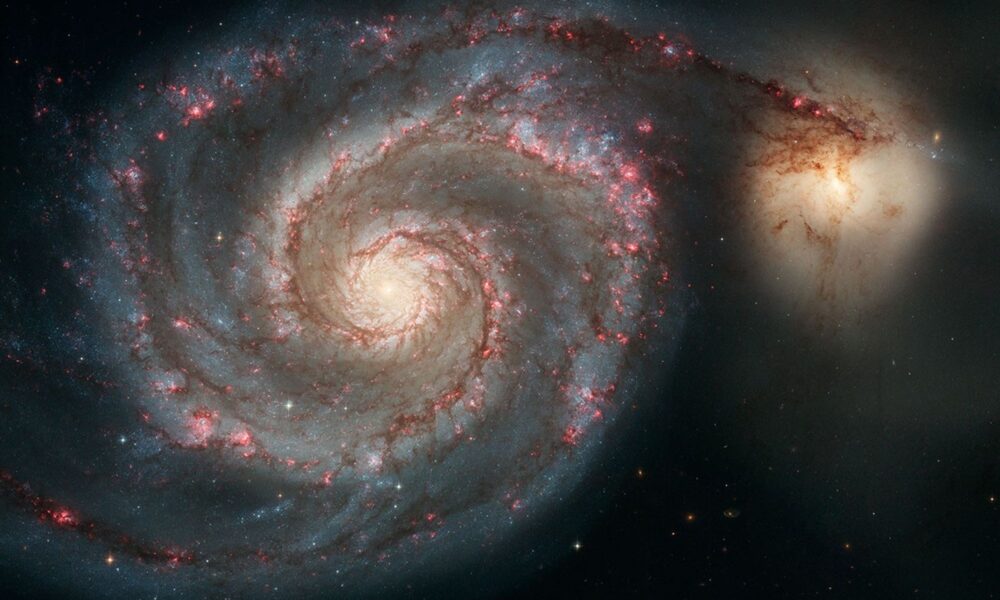

The Whirlpool Galaxy, also known as Messier 51 (M51) or NGC 5194, is a spectacular spiral galaxy about 31 million light-years from Earth in the constellation Canes Venatici. Seen almost face-on, it reveals two sweeping spiral arms, dark dust lanes and bright pink regions of new star formation. A smaller neighboring galaxy called NGC 5195 is interacting gravitationally with it, likely helping shape its striking spiral structure.
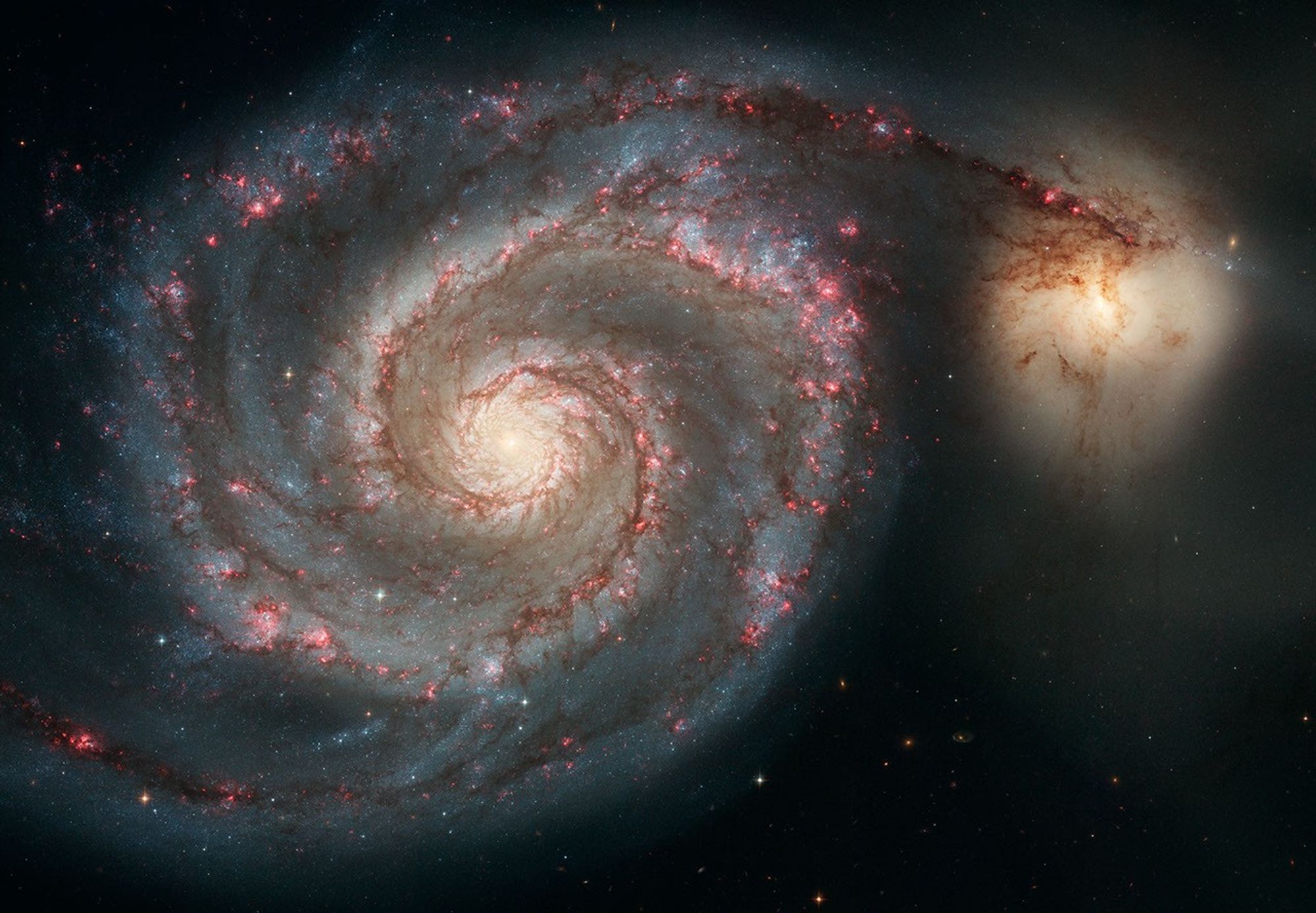
The two photographs in this article are actual NASA astronomy observations, not invented space illustrations. The first is a detailed Hubble mosaic from 2005, showing M51 and the companion. The second combines radio, infrared, visible, ultraviolet and X-ray measurements from multiple observatories, released in 2007. Comparing them reveals what makes the Whirlpool look like a spiral, why its arms are scientifically important, and how galaxies change when they interact.
Whirlpool Galaxy at a glance
| Fact | Documented value |
|---|---|
| Name | Whirlpool Galaxy, Messier 51 (M51), NGC 5194 |
| Companion | NGC 5195 |
| Constellation | Canes Venatici (the Hunting Dogs) |
| Distance | About 31 million light-years in NASA’s 2005 Hubble record; some historical sources use 23 or 30 million |
| Galaxy type | Grand-design spiral, viewed nearly face-on |
| Prominent visible disk width | NASA’s 2005 image description spans approximately 87,000 light-years, including the photographed galaxy structure |
| Hubble image date | Observed January 18–22, 2005; released April 25, 2005 |
| Multiwavelength image date | Released December 2007, combines data from several observatories |
| Big scientific interest | How gravitational interactions help compress gas and trigger star formation |
NASA’s original 2005 Hubble record provides the approximate distance, sky position, observing date, spiral-disk description and relation to NGC 5195. Measurements from different years can use different methods; the distance figure should always be associated with its source.
Why does M51 look like a perfect whirlpool?
Unlike many spirals seen from Earth at a steep angle, M51 is oriented almost face-on to us. This makes its disk and curved spiral arms appear unusually clear. Rather than viewing a thin side profile, telescopes see a broad circular pattern. The core glows warmly with light from numerous older stars, while the arms contain blue young star clusters, pinkish emission nebulae and long dusty threads.
A galaxy’s arms are not rigid wheels. Stars and gas orbit within its changing gravitational potential, and spiral density-wave behavior can concentrate the interstellar material into denser bands. Such regions can collapse, producing new stars and their associated nebulae. The spectacular “swirl” is a pattern in a huge collection of stars and clouds, not a literal liquid vortex.
Is the Whirlpool Galaxy colliding with NGC 5195?
M51 has been interacting gravitationally with a smaller companion, NGC 5195, for hundreds of millions of years. In the Hubble view, NGC 5195 appears attached to the end of one outer arm. NASA explains that the two galaxies pass close enough for gravitational forces to distort their disks and compress gas. Their motions are more complicated than a single static photograph makes them appear.
Some numerical simulations suggest an earlier close passage between NGC 5195 and the main disk hundreds of millions of years ago. This interaction may have strengthened the obvious spiral structure and influenced where new stars formed. It does not necessarily mean that NGC 5195 is being swallowed at the exact instant of the photograph. The relative motion occurs on astronomical timescales.
What are the bright pink knots in its arms?
The bright pinkish spots mark star-forming regions where hydrogen gas is excited by ultraviolet radiation from very young massive stars. Blue groups nearby are clusters of hot stars that recently emerged from dusty nurseries. The dark lanes trace concentrations of interstellar dust mixed with gas. Together these features show stages of the star-formation process arranged along the spiral arms.
NASA describes a general sequence: dense clouds pile up on the inner edge of an arm, young luminous stars emerge in bright nebulae, and their radiation, winds and eventual explosions shape the surrounding gas. This framework explains why the Whirlpool is a favorite laboratory for studying star formation. It is not proof that stars in every arm form at one fixed rate, since conditions vary across the disk.
What did Hubble actually photograph in 2005?
The featured image is a color composite made from data acquired by Hubble’s Advanced Camera for Surveys between January 18 and 22, 2005. NASA describes approximately nine hours of observation in four filters, mapping blue, green and red information to visible colors. The release on April 25 celebrated Hubble’s fifteenth anniversary and showed the Whirlpool and its companion in unusually fine detail.
The image resolves dense dusty lanes, bright star-forming regions and the galaxy’s yellowish nucleus. Although the colors reflect real filtered light, the final mosaic is processed as most professional astronomical pictures are; no human astronaut went there to photograph M51. NASA’s full Hubble image documentation lists the actual filters and exposure dates.
How does the 2007 multiband image differ?
The second image below is NASA Photojournal PIA10200, which combines measurements from different observatories into an informative scientific composite. X-rays are represented with purple from Chandra; ultraviolet information is blue from the Galaxy Evolution Explorer; Hubble optical data are green; and Spitzer infrared emissions appear red. These wavelengths trace different physical processes, some invisible to human eyes.
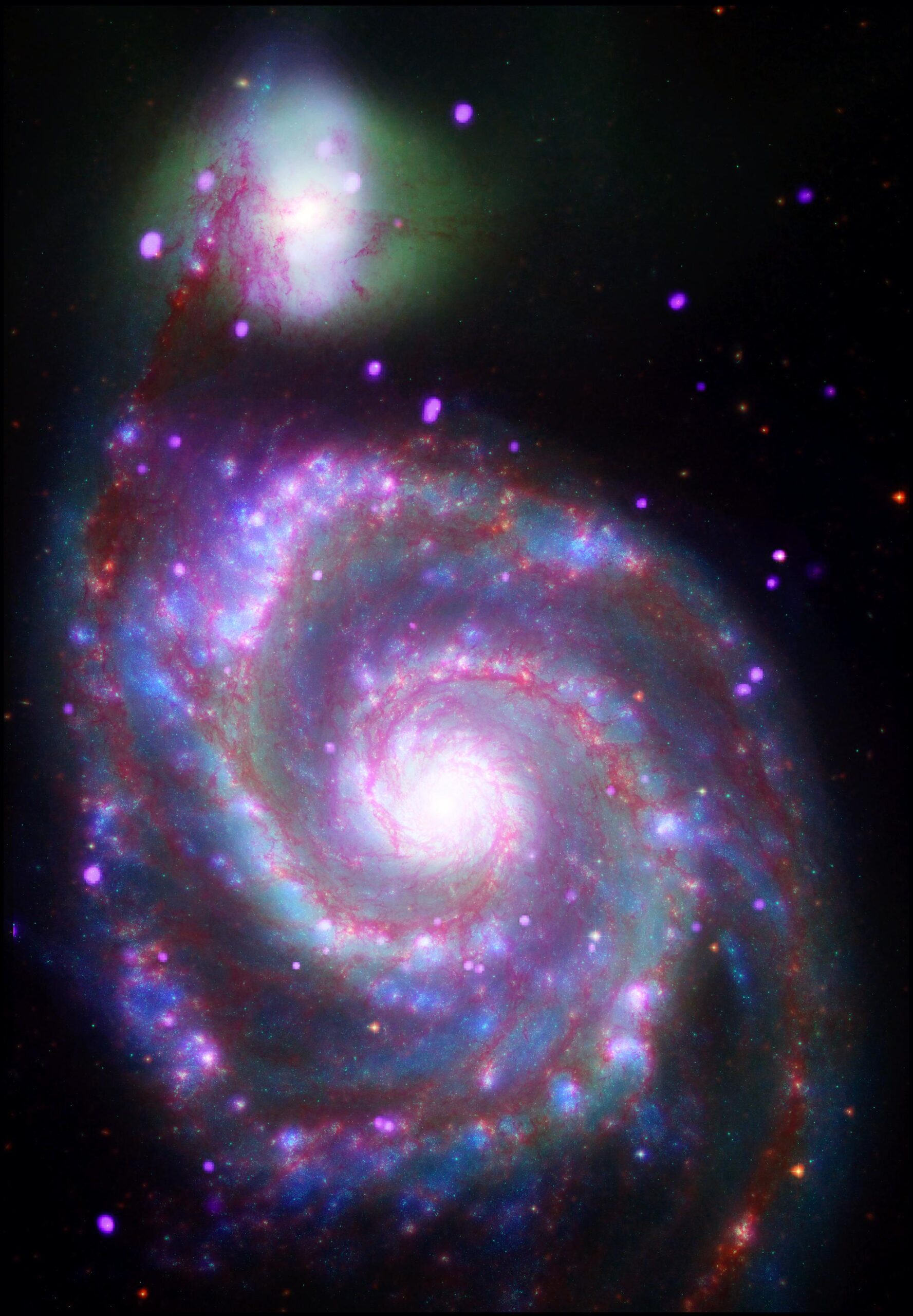
In particular, ultraviolet observations reveal the hottest young stars, infrared can trace dusty gas and star formation, and X-ray data highlight energetic compact objects including certain accreting black holes and neutron stars. Combining instruments reveals a fuller scientific picture than any single visible-light camera could provide. See NASA’s PIA10200 description for the instrument-by-instrument mapping.
How far away is the Whirlpool Galaxy?
The Hubble 2005 overview places it about 31 million light-years away. Some older science pages and catalogs use 23 million or around 30 million light-years, reflecting changes in distance estimates, measurement methods and rounding. The galaxy has not suddenly moved a huge distance between the dates those pages were published. A light-year is the distance light travels in one year, not the time astronomers need to travel there.
When observing the Whirlpool, we see light emitted millions of years in the past. The physical events currently happening there will only be visible to Earth when their light arrives. This is a basic property of astronomy and does not prove that the galaxy has stopped existing in the meantime.
How large is M51 compared with the Milky Way?
The bright disk of M51 spans many tens of thousands of light-years. NASA’s detailed 2005 Hubble image record lists roughly 87,000 light-years for its selected field or prominent structure, while some older overviews describe a roughly 60,000-light-year-wide galaxy. Such values can differ because of definitions of the outer faint structure and specific distance assumptions. Either way, M51 is an immense stellar system.
The Milky Way is often estimated to span about 100,000 light-years in its prominent disk. M51 is therefore of comparable order of magnitude but not necessarily identical. Its face-on orientation makes those structures particularly striking in photographs.
Can you see the Whirlpool Galaxy with a small telescope?
Under good dark-sky conditions, the Whirlpool Galaxy can be visible as a faint nebulous glow through modest amateur telescopes. However, resolving its spiral arms normally requires better conditions, suitable aperture, experience and/or long-exposure photography. The bright nuclei of M51 and NGC 5195 are often easier to notice than the diffuse arms.
To locate it, use a star chart for Canes Venatici, near the handle of the Big Dipper. Starting at a low power can make the paired galactic cores easier to frame. Increase magnification only when the sky is steady enough and the image remains bright. Under city light pollution, the spiral pattern may be invisible despite seeing the brighter central portions.
M51 vs the Triangulum Galaxy
| Feature | Whirlpool (M51) | Triangulum (M33) |
|---|---|---|
| Distance | About 31 million light-years | About 2.9 million light-years |
| Constellation | Canes Venatici | Triangulum |
| Apparent structure | Prominent grand-design arms and a nearby companion | Face-on spiral with many bright star-forming patches |
| Visual observing | Faint galaxy; arms difficult for beginners | Large diffuse target with low surface brightness |
The two galaxies both show vigorous star formation, but the Whirlpool’s interaction with NGC 5195 is a particularly clear feature of its environment. For a guide to a closer face-on system, see our Triangulum Galaxy (M33) explainer. Our Hubble Deep Field article explains how image depth and telescope exposure affect astronomical results.
Frequently asked questions
Where is M51 in the night sky?
It lies in Canes Venatici, near the Big Dipper’s handle from a Northern Hemisphere viewing perspective.
Why is it called Whirlpool?
The two obvious curving spiral arms resemble a whirlpool, especially in near face-on photographs.
How far away is Whirlpool Galaxy?
About 31 million light-years in NASA’s detailed 2005 Hubble description, with somewhat different historic estimates elsewhere.
Is M51 just one galaxy?
The central bright face-on spiral is NGC 5194. A smaller gravitational companion, NGC 5195, appears nearby and is included in many photographs of the Whirlpool system.
Are the pink parts actual stars?
Many pink knots are hydrogen-emission nebulae surrounding young stellar clusters. The blue patches trace hot young stars and star clusters.
Can I see its spiral arms through binoculars?
Usually not. Binoculars may show a faint glow in dark conditions, but the spiral structure is better revealed in larger telescopes or long-exposure photographs.
Do those colors match human vision?
Hubble’s filters approximate some optical colors, but processed scientific mosaics do not directly duplicate the naked-eye view. The 2007 image additionally maps invisible infrared, ultraviolet and X-ray radiation into visible colors.
Primary photo sources and attribution
Featured image: authentic Hubble ACS 2005 M51 and NGC 5195 mosaic, credited to NASA, ESA, S. Beckwith (STScI), and the Hubble Heritage Team (STScI/AURA). Second image: NASA 2007 PIA10200 multiwavelength observation, credited to NASA/CXC, NASA/ESA/STScI/AURA, NASA/JPL-Caltech and its collaborating institutions. Both files were locally uploaded to AVARIXO WordPress Media Library, with original credits and ALT descriptions. The site does not claim NASA endorsement and the images are not a generic galaxy substitute.

Other Articles