
Quick answer: A spacewalk is any activity in which an astronaut exits a spacecraft or space station while in space. NASA calls it an extravehicular activity (EVA). Spacewalkers wear protective suits with oxygen and life-support systems, and many work outside the International Space Station (ISS) to inspect equipment, carry out repairs or install new technology. The first human spacewalk was by Soviet cosmonaut Alexei Leonov on March 18, 1965; the first American spacewalk was by Ed White on June 3, 1965.
What is a spacewalk?
A spacewalk is not walking on a solid surface. An astronaut in Earth orbit and a spacecraft nearby are both in free fall around Earth, so the astronaut floats while using carefully planned handholds, tether points and restraint tools. A person outside a spacecraft can still be moving thousands of miles per hour around Earth even if they appear stationary relative to the station.
NASA explains that spacewalks typically last five to eight hours on today’s orbital missions, depending on the work. Durations are not fixed, and an emergency or a completed task can shorten an activity. The NASA spacewalk overview describes training, tether systems and work outside the ISS.
Spacewalk facts at a glance
| Question | Answer |
|---|---|
| Technical name | Extravehicular activity (EVA) |
| First person to spacewalk | Alexei Leonov, March 18, 1965, Voskhod 2 |
| First U.S. spacewalk | Ed White, June 3, 1965, Gemini 4 |
| Typical ISS EVA duration | About 5–8 hours, though it varies |
| Main reasons | Maintenance, assembly, repair, installation, inspections and experiments |
| Critical equipment | Spacesuit, helmet, oxygen, cooling, communication and restraints |
| Is there air outside? | No breathable atmosphere in orbital vacuum |
| Common misconception | Spacewalkers are not free of Earth’s gravity |
How do astronauts breathe during a spacewalk?
A working EVA suit is effectively a small personal spacecraft. It provides oxygen, maintains pressure, removes carbon dioxide, manages moisture and temperature, and supports communication. A person cannot safely rely on a normal scuba mask outside the ISS because vacuum, temperature extremes, radiation and micrometeoroids present hazards beyond the lack of breathable air.
Why cooling is important
Moving heavy tools and restraining the body in a stiff pressurized suit generates heat, even when the external environment is very cold. Spacesuits use cooling garments that circulate water near the astronaut’s skin and transfer heat away through the life-support system. Solar heating and orbital day-night cycles create additional thermal demands.
Why the suit is pressurized
In space vacuum, an unprotected human cannot breathe or function normally. The suit’s pressure and oxygen supply make it possible to work safely outside the station. The pressure also makes the suit more difficult to bend, which is why astronauts spend significant effort training their movements and tool use.
What are safety tethers and foot restraints?
During many ISS spacewalks, astronauts attach themselves to safety tethers and use handrails and foot restraints. A tether prevents an inadvertent release from sending someone drifting away from the station. Crews manage multiple connections as they move and follow strict rules for securing tools so dropped objects do not become dangerous orbital debris.
Some historic spacewalks used jet packs. On February 7, 1984, NASA astronaut Bruce McCandless II tested the Manned Maneuvering Unit and became the first person to move untethered using the nitrogen-propelled backpack. This was a specifically designed demonstration, not the standard work method for most ISS EVAs.
How was the first spacewalk performed in 1965?
Alexei Leonov: March 18, 1965
Leonov exited the Soviet Voskhod 2 spacecraft through a special airlock. This was the first time a human had worked outside an orbiting vehicle. His spacesuit became difficult to maneuver, making the return to the airlock dangerous; he managed to reenter and complete the mission. Early EVAs taught engineers how important suit flexibility and emergency procedures would become.
Ed White: June 3, 1965
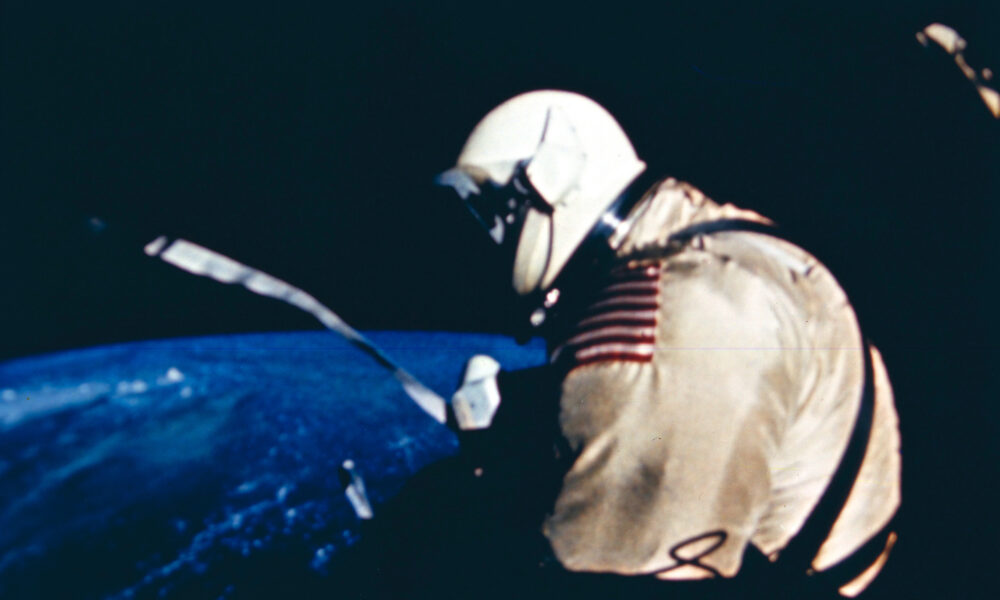
American astronaut Ed White conducted the first U.S. EVA during Gemini IV. His commander, James McDivitt, photographed him from inside the capsule. White used a hand-held gas maneuvering device at the beginning of the activity and remained connected by a life-support umbilical and tether. NASA’s official photo record states that the EVA lasted about 23 minutes.
A frequently reproduced photograph of White in his white suit against Earth is from this real mission. It should not be confused with a 1980s spacewalk photograph of Bruce McCandless or a simulated training session in a pool.
What did spacewalks accomplish in Gemini, Apollo and the ISS?
| Program | Primary EVA contribution |
|---|---|
| Voskhod and Gemini (1960s) | Proved humans could work outside spacecraft and revealed early suit limitations |
| Apollo (1960s–1970s) | Lunar surface EVAs and activities between spacecraft during specific missions |
| Space Shuttle (1981–2011) | Satellite servicing, construction experiments and space station assembly |
| ISS (1998 onward) | Station assembly, upkeep, electrical systems, science equipment and inspections |
NASA’s ISS spacewalking history shows how external operations made the station’s large modular assembly possible. For the Gemini spacecraft used in the first American EVA, AVARIXO also has a Gemini spacecraft explainer.
How do astronauts train for spacewalks?
Crews practice detailed step-by-step procedures before flight. NASA uses the Neutral Buoyancy Laboratory near Johnson Space Center, a large pool containing mock-ups of station hardware. Divers assist and maintain safety while suited astronauts rehearse movements and operations underwater.
Water is not exactly the same as microgravity: drag, suit behavior and orientation differ. Nonetheless, neutral buoyancy offers a valuable way to practice positioning, tool use and emergency scenarios. Crews also train with virtual reality, full-size hardware and communications rehearsals.
What can go wrong during an EVA?
Major risks include loss of oxygen or pressure, cooling-system failures, difficulty returning to an airlock, tether problems, impacts from tiny fast-moving debris and medical emergencies. Spacewalks are planned around safe work sequences and detailed contingency procedures. A ground team continuously monitors available suit data, while the crew uses checklists and regular status calls.
Why a spacewalk is not a casual tourist activity
Even experienced astronauts are carefully selected, trained and monitored. An orbital EVA requires an operational spacecraft or station, pressure systems, communications and trained rescue support. Promotional videos suggesting that anyone can open a spaceship door without specialized gear are not accurate.
What can you see in genuine spacewalk photographs?
Historic NASA photographs may show safety cords, gloves holding rails, maneuvering equipment, sunlight reflecting from the helmet and the blue Earth below. Lens perspective can exaggerate distances, and a photograph does not by itself prove that someone was untethered. Look for the mission name, date, photo ID and caption to identify the actual event.
Frequently asked questions
How long does a normal spacewalk last?
Many ISS spacewalks last roughly five to eight hours, but duration varies by task and conditions.
Who was the first person to walk in space?
Soviet cosmonaut Alexei Leonov, March 18, 1965.
Who was the first American to do a spacewalk?
Edward H. White II on Gemini 4, June 3, 1965.
Do spacewalkers use gravity boots?
No. They use restraints and handholds; orbiting astronauts are in free fall, not outside Earth’s gravitational field.
Can astronauts see stars outside a space station?
Yes under suitable lighting and viewing conditions. Bright sunlit spacecraft and camera exposure settings can hide stars in many photographs.
Has someone ever spacewalked without a tether?
Yes, Bruce McCandless II did so in 1984 using the Manned Maneuvering Unit. It was a specialized test rather than the common ISS work procedure.
Reviewed October 2026. NASA references: What Is a Spacewalk?, Spacewalking History and Ed White photo record.

Other Articles
Parker Solar Probe Explained: How NASA Touches the Sun