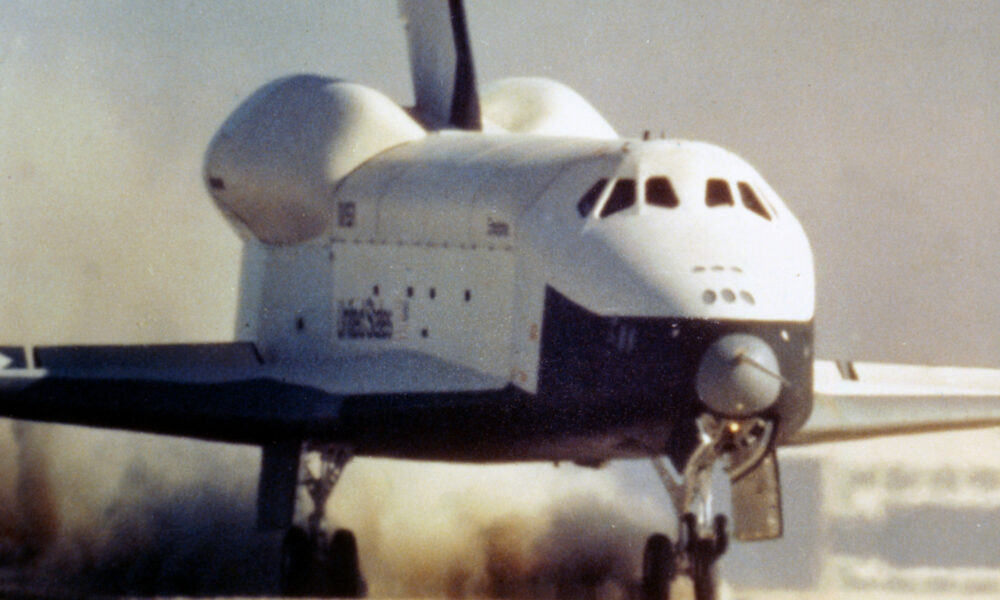

Space Shuttle Enterprise (OV-101) was NASA’s first full-size shuttle orbiter, but it never traveled into space. Instead, the prototype proved that a shuttle-shaped vehicle could safely separate from a modified Boeing 747, glide without engine power and land on a runway. Its 1977 Approach and Landing Tests helped prepare the way for Columbia‘s first orbital shuttle flight in 1981.
Space Shuttle Enterprise facts at a glance
| Question | Answer |
|---|---|
| Vehicle designation | OV-101 |
| Public rollout | September 17, 1976 |
| Purpose | Ground tests and atmospheric flight testing, not orbital missions |
| Test carrier | Modified Boeing 747 Shuttle Carrier Aircraft |
| First independent glide | August 12, 1977 |
| Free flights | Five in 1977 |
| Orbital flights | None |
| Current home | Intrepid Museum, New York City (check museum access before visiting) |
NASA’s Space Shuttle reference history and Enterprise historical account document the rollout, tests and why this orbiter differed from operational shuttles.
Why didn’t Enterprise fly in space?
The shuttle program needed to answer two different questions: could an orbiter reach orbit and return, and could it fly and land controllably after atmospheric entry? Enterprise was designed chiefly to investigate the second question. It was built as a test article, lacking the full systems and protection needed to launch on a rocket stack, survive orbital reentry and complete a space mission.
That distinction is why calling Enterprise a “failed space shuttle” is misleading. It did what NASA designed it to do. Engineers gathered flight data and made refinements for the orbiters that later flew in space.
How the Approach and Landing Tests worked
In 1977, NASA carried Enterprise above California’s Edwards Air Force Base on a specially modified Boeing 747 called the Shuttle Carrier Aircraft. The test program advanced in stages: ground work, carrier flights with the orbiter attached and, finally, unpowered free flights after separation.
Step 1: Taxi and captive-carry tests
Before letting the orbiter fly alone, crews examined how the two-aircraft combination behaved on the ground and in the air. These tests explored aerodynamics, handling and support equipment. NASA’s shuttle overview describes the roughly nine-month test campaign, from February through November 1977.
Step 2: Separation and powerless glide
For a free flight, Enterprise detached from the 747 at altitude and glided toward a runway. It did not use rocket engines to power the descent; the pilots had to manage energy with altitude, speed and the orbiter’s control surfaces. The vehicle’s shape gave it the capability to land, but with far less opportunity for corrections than a powered airplane has. NASA documents five free flights in its Approach and Landing Test image record.
Step 3: Landing precision and configuration checks
Later tests explored how the orbiter behaved with changes to its flight configuration, including the removal of a tail cone that had streamlined airflow around the aft end. NASA needed realistic information about control and approach characteristics that would matter when operational shuttles returned from orbit. The carrier and chase aircraft were test equipment; they were not part of how orbiting shuttles later landed.
1977 Enterprise free-flight timeline
| Date or period | Milestone | Why it mattered |
|---|---|---|
| September 17, 1976 | Rollout at Palmdale, California | The public saw NASA’s first full-size shuttle orbiter |
| February–July 1977 | Early ground and captive-carry work | Validated the carrier-orbiter combination ahead of release |
| August 12, 1977 | First unpowered free flight | Demonstrated an independent glide and landing |
| August–October 1977 | Additional free-flight tests | Expanded aerodynamics and landing data |
| April 12, 1981 | Columbia’s first orbital launch, STS-1 | Operational shuttle flights followed the prototype program |
The table summarizes program milestones rather than claiming each date was an orbital mission. For individual test-flight photos and captions, the NASA photo archive is a useful primary record.
Who flew Enterprise?
Two NASA crews alternated during the free-flight tests: Fred Haise and Gordon Fullerton, and Joe Engle and Richard Truly. The job was not to pilot a spaceship through the vacuum of space. They were test pilots collecting practical knowledge about a new type of glider-like landing craft. The crews’ work helped NASA understand approach profiles, flight controls and precision landings before astronauts attempted the full orbital missions.
Why was the vehicle called Enterprise?
NASA initially planned the name Constitution, but a public write-in campaign by Star Trek fans helped prompt the switch to Enterprise. NASA’s own account of the orbiter’s history records this unusual connection between television science fiction and a real aerospace engineering program. The vehicle was still a working test article despite its pop-culture name.
What did Enterprise contribute to later shuttles?
Enterprise’s value lay in answering questions before the program risked sending crewed orbiters into space. The atmospheric tests provided evidence that pilots could control the returning orbiter and land it on a runway with no engine power. NASA could compare expected and actual flight behavior and refine procedures, instrumentation and training.
That made Enterprise different from the earlier capsules described in our Mercury spacecraft guide, which returned to Earth beneath parachutes rather than with a runway landing. It also explains why Enterprise should not be confused with Columbia, Challenger, Discovery, Atlantis or Endeavour: those were the space-capable orbiters of the operational program.
Where is Space Shuttle Enterprise now?
The prototype is preserved at the Intrepid Museum in New York City. If you plan a visit, consult the museum’s current exhibition and accessibility information; galleries, admission and individual visitor arrangements can change. The important historical distinction remains the same: Enterprise is an actual NASA orbiter test vehicle, not a replica, but its flights were atmospheric rather than orbital.
Frequently asked questions
Was Enterprise the first space shuttle?
It was NASA’s first full-size shuttle orbiter and carried the designation OV-101, but Columbia was the first shuttle to reach orbit in 1981.
How many times did Space Shuttle Enterprise go to space?
Zero. Enterprise conducted atmospheric flight tests and never launched on an orbital mission.
How did Enterprise land without engines?
After release from the carrier 747, it converted altitude and speed into a controlled glide. The crew lined up for an unpowered runway landing rather than using engines to fly around again.
How many free flights did Enterprise make?
NASA documents five free flights in the 1977 Approach and Landing Tests.
Can you still see the real Enterprise?
Yes. It has been displayed at the Intrepid Museum in New York City; check the museum directly for current public access.
Fact review: October 16, 2026. Historical flight details verified against NASA’s shuttle program and Enterprise archive pages.