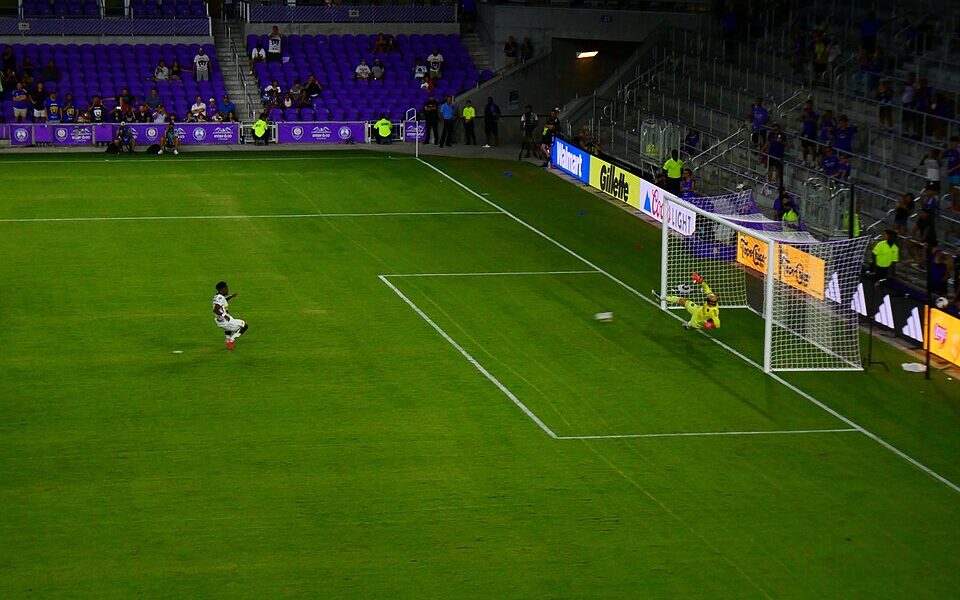
Soccer Penalty Kick Rules in 2026–27: Keeper Position, Rebounds and Double Touches

A soccer penalty kick is awarded when a defending player commits a direct-free-kick offense inside their own penalty area. The ball is placed on the penalty mark, 12 yards (11 meters) from the goal line. The identified kicker attempts to score while the goalkeeper stays on the goal line until the ball is kicked. Other players must stay outside the penalty area, behind the penalty mark and at least 10 yards (9.15 meters) from it until the ball is in play. Under the current IFAB Law 14, a goalkeeper needs at least part of one foot on, in line with or behind the line when the kick is taken.
When does the referee award a penalty kick?
The referee awards a penalty for a direct-free-kick offense committed by a defender in their own penalty area while the ball is in play. Common examples are careless tackles, holding, pushing, striking or handball offenses as defined by IFAB Law 12. Not every contact or every ball-to-arm incident is a foul; the referee must apply the applicable rule to the actual action. The location of the offense, not where the player finally falls, is normally decisive.
A foul just outside the area usually gives a direct free kick, not a penalty. A defender’s offense on the penalty-area boundary line is treated as inside because the lines form part of the area.
Soccer penalty kick rules at a glance
| Rule | Requirement |
|---|---|
| Ball position | Stationary, with part of the ball touching or overhanging the center of the penalty mark |
| Distance | Mark is 12 yards (11 m) from goal line |
| Goalkeeper position | Faces kicker on goal line; at least part of one foot on/in line with/behind goal line when kicked |
| Other players | Outside penalty area, behind mark and 10 yards from mark |
| Kick direction | Ball must be kicked forward; a forward-moving backheel is possible |
| Second touch | Kicker cannot play again until another player touches the ball |
| Goal | Can be scored directly from a penalty kick |
| Referee signal | Kick taken only after referee’s signal |
See the exact requirements in the IFAB’s official Law 14, which includes uncommon edge cases absent from most quick fan explanations.
What can the goalkeeper do during a penalty?
The keeper may move from side to side along the line and move their arms, provided the movement is not unfair or disrespectful. However, the keeper must remain facing the kicker, between the posts, and must not unfairly distract them or touch the goalposts, crossbar or net to interfere with the attempt. At the moment the ball is kicked, at least part of one foot must be touching, in line with or behind the goal line. A keeper does not need both feet planted on the line.
If the keeper leaves too early and saves the shot, the referee may order a retake. If the ball misses entirely, IFAB says play generally restarts with a goal kick unless the keeper’s infringement clearly affected the kicker. The precise outcome depends on what happened, not simply a freeze-frame of the feet.
Can you score from a rebound off the keeper or post?
During a penalty kick in normal match play, if the goalkeeper saves the ball and it rebounds to the original taker, that taker may legally score because another player—the keeper—touched the ball. But if the kick hits only the crossbar or post and rebounds straight to the taker without touching any other player, the kicker cannot play it again; a second-touch violation occurs. These are ordinary match penalties, not penalty shoot-outs.
| Rebound scenario | Can original taker play it immediately? |
|---|---|
| Goalkeeper parries ball back to taker | Yes; another player touched it |
| Ball strikes post and returns directly | No; no other player touched it |
| Ball strikes crossbar and returns directly | No |
| Keeper saves onto post and ball returns | Yes; goalkeeper touched it |
| Ball crosses goal line into goal directly | Goal, absent another offense |
What happens if the kicker accidentally touches the ball twice?
Law 14 now explicitly distinguishes an accidental simultaneous two-foot kick or immediate contact with the non-kicking foot/leg from some other offenses. If that accidental second touch happens and the ball goes into the goal, the kick is retaken. If it does not result in a goal, an indirect free kick goes to the defending team (subject to other applicable decisions). In a shoot-out the mechanics of an unsuccessful attempt differ, so do not automatically apply the same restart language to kicks from the penalty mark.
This matters when a player slips during the run-up: an accidental second touch is not the same as deliberately playing a rebound from the post.
Can another player score after a penalty save?
Yes, during a live match, if play continues and another attacker meets a saved or rebounding ball before a stoppage, that attacker may score, provided there was no offense such as offside, encroachment or foul. The taker’s kick starts play once kicked and clearly moving. In a penalty shoot-out, however, the attempt ends under the distinct shoot-out rules; teammates do not follow up rebounds as during regular play.
Penalty encroachment: when do players get punished?
The 2026/27 IFAB law uses an impact-based approach for many encroachment incidents. For example, an attacking teammate who enters the penalty area early is penalized if that movement clearly affects the goalkeeper or that same player plays the rebound or creates a scoring opportunity. A defending teammate entering early is penalized if it clearly impacts the kicker or that player later plays/challenges for the ball in a consequential way. Not every shoe over the paint automatically requires a retake.
Penalty kick vs. penalty shoot-out
A penalty awarded during the match is a method of restarting play after an offense. The ball remains in play after a save or rebound unless an infringement occurs or it goes out. A shoot-out after extra time is a tiebreaking procedure governed by IFAB Law 10; kicks are separate attempts and ordinary rebounds are not played by teammates. The standard five kicks per team and subsequent sudden-death format apply under the relevant rules, with various eligibility and goalkeeper provisions.
Frequently asked questions
Is a soccer penalty kick 12 yards or 11 meters?
It is called a 12-yard penalty in the laws’ traditional imperial measurement and 11 meters in metric shorthand. Exact published field-marking dimensions govern construction.
Can the goalkeeper leave the line early?
At least part of one foot must be on, in line with or behind the goal line at the instant the ball is kicked. Both feet cannot be fully ahead of the line.
Can the taker stop before kicking?
Feinting during the run-up can be legal, but illegal feinting at the end of a completed run-up may be punished. Referees judge the exact motion under Law 14.
Does a penalty always mean a red card?
No. The penalty is a restart; separate disciplinary action depends on the type and seriousness of the foul, including whether an obvious goal-scoring opportunity was denied.
Can a player shoot the penalty with a backheel?
Yes, provided the ball is kicked forward in accordance with Law 14.
Related: Our soccer offside rule guide explains a different class of infringement.
Primary source: IFAB, 2026/27 Laws of the Game, Law 14; for context Law 12. Checked October 11, 2026.

Other Articles

How to Redeem a Fortnite Gift Card vs. a V-Bucks Card (2026)