Soccer Free-Kick Wall Rules: 10 Yards, the 1-Yard Gap and Why Players Lie Down

A defensive wall in soccer is a line of players who stand between the ball and their goal during certain free kicks. The defending players are generally required to stay at least 9.15 meters (10 yards) from the ball before the kick. A less familiar rule protects a wall made of three or more defenders: all attacking players must stay at least 1 meter (1 yard) away from it until the ball is in play.
That means attackers cannot stand shoulder to shoulder with a full defensive wall at the moment of the free kick. These requirements are explained in IFAB Law 13, checked October 11, 2026. Here’s how the distances, positioning and referee decisions work.
Why teams build a wall for a free kick
A wall blocks the most direct shooting path to goal. The goalkeeper chooses a position covering part of the goal while defenders line up to protect another part. A carefully arranged wall can force the kicker to shoot over, around or under defenders rather than striking through a clear gap.
The number of players is a tactical choice. Close to goal, a team might use four or five players, while a wider or more distant free kick may need fewer. Using more players in the wall can protect the goal, but it also removes players from other defensive assignments. Coaches must weigh a direct shot against the possibility of a short pass, a cross or a second-ball rebound.
How far back must the wall stand?
Under IFAB Law 13, opponents must usually remain at least 9.15 m (10 yd) from the ball until the free kick is taken and the ball is in play. There is an exception for defenders already on their own goal line between the goalposts. The 10-yard measurement is taken from the ball; it is not the distance from the attacking player or from the edge of the penalty area.
A referee may use vanishing spray to mark the ball’s position and the line behind which a wall should stand. The spray is an administrative aid, not the source of the 10-yard rule. A free kick can also be taken quickly in appropriate circumstances, so not every free kick involves spray or a ceremonial wait for the whistle.
What happens if defenders move forward too soon?
When an opponent is too close to a free kick as it is taken, the normal remedy is a retake unless the referee can apply advantage. IFAB also distinguishes a quick free kick: if the attacking side chooses to restart quickly and an opponent already within 10 yards intercepts it, the referee may allow play to continue. A defender who deliberately prevents a free kick from being taken quickly, however, must be cautioned for delaying the restart.
For fans, these details explain why one seemingly close defender is tolerated on a quick restart while another is booked for standing over the ball and blocking the taker.
Why attacking players must stay one yard away from a wall
The one-meter rule applies specifically when three or more defending players form a wall. Attackers must be at least 1 m (1 yd) away from that wall until the ball is in play. The point is to keep the defensive line from becoming a wrestling match of pushing, leaning and obstructing opponents at the instant of the kick.
If an attacker stands too close to such a wall when the free kick is taken, IFAB Law 13 awards an indirect free kick to the defending team. This remains true even if the original attacking free kick was a promising scoring chance. The rule can overturn what spectators thought was an excellent set-piece routine.
Does the gap rule apply to two defenders?
The specific one-meter restriction is written for a wall of three or more. It is not automatically triggered by two teammates simply standing close together. But the referee still judges other possible offenses, including pushing or impeding, according to the wider Laws of the Game. A third defender lying behind the wall may still be considered part of its arrangement; the exact setup matters. IFAB’s own Law 13 FAQs discuss a wall with two standing players and another positioned on the ground.
Can an attacker move closer after the ball is kicked?
Yes. The restriction lasts until the ball is in play, which ordinarily happens when it has been kicked and clearly moves. After that point, players may move in accordance with the rest of the game’s rules. An attacker entering the area around the wall only after the ball is in play does not commit the specific one-meter encroachment violation merely by approaching the defenders.
Why does one defender sometimes lie behind the wall?
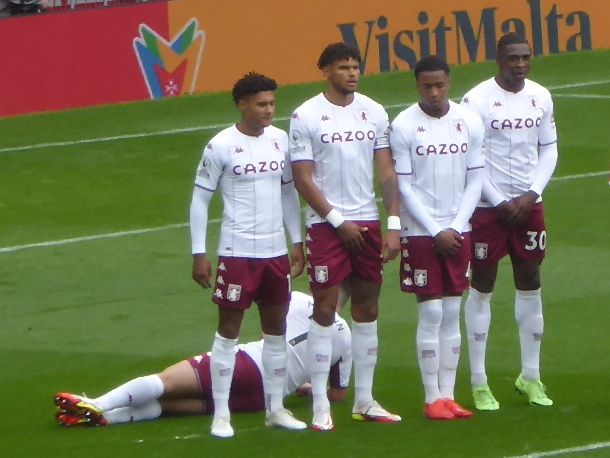
A standing wall is good at blocking a lifted shot but vulnerable if the entire line jumps together and leaves a gap near the ground. Some teams place a defender flat behind the wall to protect against a driven attempt under the jumping players. Commentators sometimes call the player a draft excluder. That expression is descriptive, not a separate position recognized by the Laws.
The tactic has trade-offs. A player lying on the ground cannot quickly cover an attacker elsewhere, and teammates must avoid dangerous collisions. It can also complicate the positioning of the wall and the attacking team’s one-meter gap. Teams use it selectively, often when the ball is in a favorable shooting position for a low strike.
Does a wall change direct vs. indirect free kicks?
No. Whether a free kick is direct or indirect depends on the original offense and the applicable Law, not on how the wall is arranged. A direct free kick can score directly against the opposing team. For an indirect free kick, the ball must touch another player before a goal can be scored against the opponents. The referee signals an indirect kick by raising an arm.
For a detailed breakdown, read AVARIXO’s guide to the indirect free kick in soccer or its broader primer on soccer fouls and the free-kick decisions. These questions are separate from how far the wall must be from the ball.
Set-piece decisions fans can watch for
The ball’s location: The closer the free kick, the harder it may be to clear the wall and bring the shot back under the crossbar. A wider angle can turn the situation into a crossing opportunity instead.
The wall’s alignment: The goalkeeper and defenders divide up the available shooting lanes. If defenders leave a gap, a clever taker may use it.
Quick versus managed restarts: A team may try to play before the wall is organized when the Laws allow. If the referee is administering the distance and requires a signal, players must wait for it.
Extra bodies behind the wall: A low-lying defender may discourage a ground shot, but this choice costs a player who could cover another area.
Attacker positioning: A runner positioned near a wall of at least three defenders must be mindful of the one-meter restriction at the instant the ball is put in play. A pass-and-run routine can be safer than physical contact with the wall.
Frequently asked questions
Is a free-kick wall always 10 yards away?
Defenders are generally required to stay at least 10 yards from the ball until it is in play, with the goal-line exception explained in Law 13 and special quick-free-kick/advantage situations.
How close can attackers stand to the defensive wall?
If the wall consists of three or more defending players, attackers must remain at least one meter away until the kick is taken and the ball is in play.
Can a soccer player lie on the ground behind the wall?
Yes. It is a tactical way to protect against a low shot beneath a jumping wall, subject to the ordinary rules on safety and prohibited contact.
What is the punishment when an attacker stands too close to the wall?
When a player of the attacking team is closer than one meter to a wall of at least three defenders as the kick is taken, an indirect free kick is awarded to the defending team.
Can a free-kick wall move when the ball is in play?
Yes. Once the ball has been kicked and clearly moves, the players may react and defend normally, while remaining subject to the other Laws.
Sources and image credit
Official reference: IFAB Law 13, Free Kicks (2026/27 Laws of the Game), verified October 11, 2026. Featured photograph of a free-kick wall at Manchester United vs. Aston Villa, September 2021: Ardfern / Wikimedia Commons, cropped by Commons contributor Adeletron, licensed CC BY-SA 4.0.