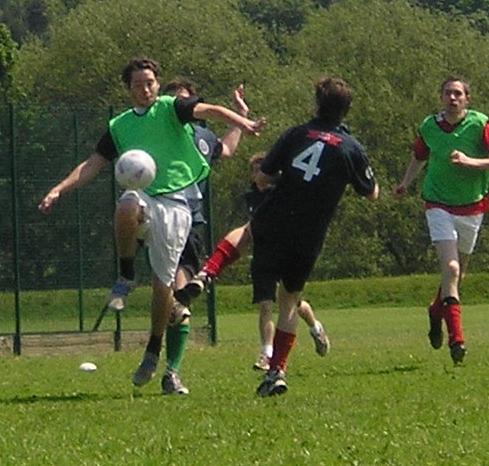

A foul in soccer is an offense defined by the Laws of the Game, such as an illegal tackle, push, trip, hold or certain handball actions. The referee decides whether the offense leads to a direct free kick, an indirect free kick or a penalty kick. A yellow or red card addresses misconduct; it is not automatically given for every foul.
Most confusion comes from assuming that any contact is illegal or that winning the ball first excuses dangerous play. Neither statement is correct. IFAB Law 12 explains how referees judge the action, its severity and the restart.
What counts as a foul in soccer?
IFAB lists challenges and acts that are penalized when committed in the required manner. They include kicking or attempting to kick an opponent, tripping or attempting to trip, pushing, striking, jumping at, charging and tackling or challenging an opponent carelessly, recklessly or with excessive force. Holding, certain handball offenses and impeding an opponent with contact also carry consequences.
Importantly, a referee looks at the specific event. Two players legally competing shoulder-to-shoulder may not have committed an offense. A late, uncontrolled or forceful challenge can be illegal even when the challenger made some contact with the ball.
Careless vs. reckless vs. excessive force
| Assessment | Meaning | Discipline in a typical Law 12 case |
|---|---|---|
| Careless | The player acts without necessary attention or precaution. | A foul can be awarded without a card. |
| Reckless | The player disregards danger or consequences for an opponent. | A caution (yellow card) is required. |
| Excessive force | The challenge exceeds the necessary force or endangers safety. | Sending off (red card) is required. |
This distinction does more work than the simplistic idea that a referee has a fixed number of warnings before cards can be shown. Severity—not a universal foul count—can decide the disciplinary action.
Direct free kicks vs. indirect free kicks
Direct free kicks
A direct free kick is given for offenses such as the qualifying illegal challenges listed above, holding and certain handball offenses. A goal may be scored directly against the opposing team from a properly taken direct free kick, subject to the Laws.
Indirect free kicks
Indirect free kicks apply to specified offenses such as dangerous play without contact, impeding an opponent without contact and certain goalkeeper restrictions. Another player must touch the ball before a goal can result from an indirect free kick. The referee typically raises an arm to indicate the indirect restart.
Common misconception: Not every no-contact incident is automatically an indirect-free-kick offense. For example, attempting to kick an opponent can qualify as a direct-free-kick offense under Law 12 even if contact is not made.
When does a foul become a penalty kick?
If a player commits a direct-free-kick offense inside that player’s own penalty area while the ball is in play, the opposing team is generally awarded a penalty kick, subject to the detailed Laws. An indirect-free-kick offense in the penalty area does not simply become a penalty. The place and nature of the offense determine the restart.
Other restarts still matter. If a defender is the last player to touch the ball before it crosses the goal line without a goal, a goal kick may be awarded even when there was no foul. A foul and a ball-out-of-play event should not be treated as interchangeable decisions.
Yellow cards, red cards and advantage
A yellow card cautions a player for a cautionable offense. A red card sends off a player for a sending-off offense, such as serious foul play. Some actions can be misconduct even when the restart is not a direct free kick. IFAB Law 12 governs the details, including denial of an obvious goal-scoring opportunity and unsporting behavior.
The referee may also allow play to continue under the advantage principle when the team that has been fouled would benefit from continuing. This does not mean the original offense necessarily disappears, and the referee can still take required disciplinary action at the appropriate time.
Examples to help recognize a foul
Late sliding challenge
A player slides after an opponent has moved the ball and makes illegal contact. The referee evaluates whether the challenge was careless, reckless or used excessive force.
Shoulder-to-shoulder contest
Two players legally challenge for the ball without illegal pushing. Contact by itself is not enough to establish a foul.
Player obstructs without contact
If the action meets IFAB’s conditions for impeding without contact, the restart is generally an indirect free kick rather than a direct one.
Frequently asked questions
Is every tackle in soccer a foul?
No. The referee assesses the nature of the challenge and any illegal conduct.
Does getting the ball first make a tackle legal?
No. A challenge can still be reckless or dangerous despite touching the ball.
Does every foul result in a yellow card?
No. A careless direct-free-kick foul generally does not require a card by itself.
Can a foul happen when the ball is out of play?
Misconduct can occur while the ball is out of play, but free kicks and penalty kicks for fouls under Law 12 have specific in-play requirements; the restart can differ.
For other decisions players often confuse with fouls, see our explanations of the offside rule and throw-in rules.

Other Articles

Basketball Fouls Explained: Personal, Technical and Flagrant Rules
Tennis Serve Rules: Where to Stand, Second Serves and Lets
