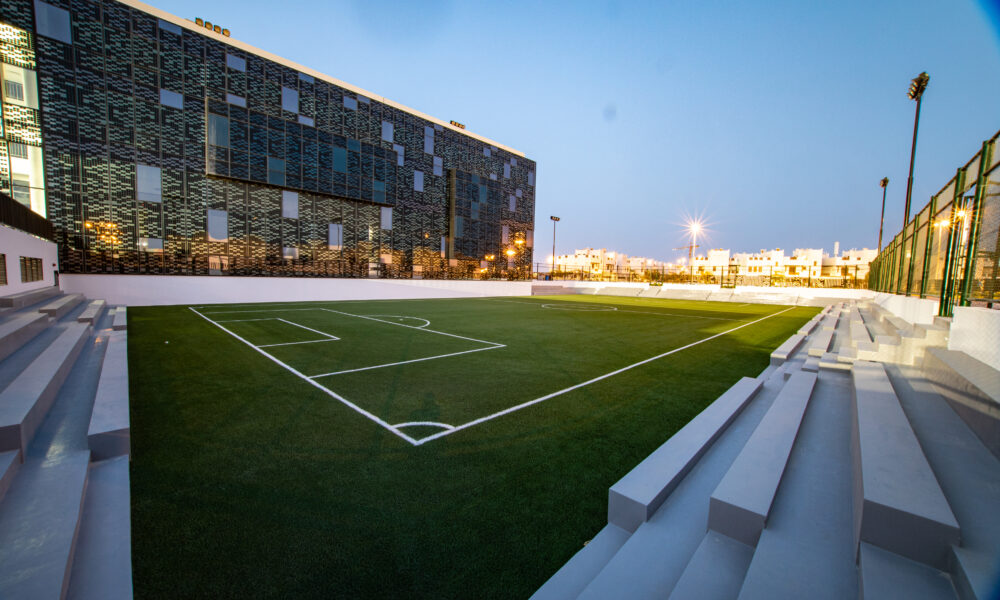

A regulation soccer field is not required to be one exact size. Under the IFAB Laws of the Game for 2026/27, an ordinary 11-a-side pitch can be 90–120 meters (100–130 yards) long and 45–90 meters (50–100 yards) wide. For international matches, the permitted ranges narrow to 100–110 meters in length and 64–75 meters in width. The commonly quoted 105 by 68 meters is a familiar elite-level layout, not the only legal one.
These numbers describe association football, called soccer in the United States. American football fields, futsal courts and youth mini-soccer pitches have separate dimensions. The correct reference for the rules below is IFAB Law 1: The Field of Play, checked October 11, 2026.
Soccer field dimensions at a glance
| Marking or area | Metric dimensions | Imperial equivalent |
|---|---|---|
| Regular 11v11 length | 90–120 m | 100–130 yd |
| Regular 11v11 width | 45–90 m | 50–100 yd |
| International length | 100–110 m | 110–120 yd |
| International width | 64–75 m | 70–80 yd |
| Center-circle radius | 9.15 m | 10 yd |
| Penalty mark from goal line | 11 m | 12 yd |
| Penalty area distance inward | 16.5 m | 18 yd |
| Goal width | 7.32 m | 8 yd |
| Goal height | 2.44 m | 8 ft |
IFAB states that the touchline must be longer than the goal line. Field lines are part of the area they enclose, and the lines must be no more than 12 cm (5 inches) wide. An authorized competition may pick its exact pitch dimensions within applicable limits.
What does a full-size soccer field look like?
A full-sized rectangular pitch has two long touchlines, two shorter goal lines, a halfway line, a center circle, penalty areas, goal areas and corner arcs. Goalposts sit centrally on each goal line. A grass or approved artificial surface can be used depending on the competition.

Photograph: ARKSDiyar / Wikimedia Commons, CC BY-SA 4.0, unchanged.
Why can professional soccer pitches have different dimensions?
Historically, football clubs developed in grounds with different shapes and space constraints. The laws therefore permit a range rather than dictating one universal footprint. Tournament organizers may impose their own narrower requirements, and broadcasters often show pitches that seem similar even when their measurements differ by several meters.
For a comparison, a 100-by-64-meter surface is 6,400 square meters, while a 105-by-68-meter pitch is 7,140 square meters. That extra space can affect how much ground fullbacks, midfielders and wingers have to cover. It does not determine a result by itself: coaching, player quality and defensive organization matter far more than one small size difference.
What are the penalty area dimensions?
The penalty area is marked by two lines extending 16.5 meters (18 yards) from the inside of each goalpost into the field, joined by a line parallel to the goal line. The resulting rectangle extends 16.5 meters out from the goal line. The penalty mark sits 11 meters (12 yards) from the midpoint of the goal, and a separate arc outside the box marks the required 9.15-meter distance from that spot during a penalty.
The position of a foul matters. If a direct-free-kick offense occurs inside the offender’s own penalty area while the ball is in play, a penalty kick is generally awarded. Because the lines are part of the area, a relevant foul on the penalty-area boundary counts as inside the box. Read the official penalty-kick law for the precise procedure.
How big is the goal area (six-yard box)?
The goal area is the smaller rectangle around the goal. Its lines extend 5.5 meters (6 yards) outward from the inside of each post and continue 5.5 meters into the field. Players sometimes call it the six-yard box, but the official metric distance is 5.5 meters because the laws express rounded conversions of traditional measurements.
A goal kick can be taken from anywhere within the goal area. Modern goal-kick rules no longer require the ball to leave the penalty area before it is in play; the ball is in play once kicked and clearly moving. For that restart, see IFAB Law 16.
How far is the center circle from the kick-off spot?
The center circle has a radius of 9.15 meters (10 yards). During a kick-off, opponents must be outside the center circle until the ball is in play, while the team taking the kick arranges its own players as allowed. The center circle gives officials and players a visible reference for the required separation.
Corner arcs and corner flags
At each corner, a quarter-circle with a radius of 1 meter (1 yard) marks the corner area. During a corner kick, the ball must be placed inside that area, including the arc line. A corner flagpost is required at each corner and must be at least 1.5 meters (5 feet) high with a non-pointed top.
Corner kicks can be taken directly into the goal for a score if the ball enters the opponents’ goal. That possibility is one reason placement, trajectory and opponents’ positioning matter. For a practical breakdown, see our soccer corner-kick guide.
Do youth soccer fields use the same size?
Usually not. Younger age groups commonly play smaller-sided formats, such as 4v4, 7v7 or 9v9, on proportionally smaller fields. The exact sizes depend on the relevant national association, regional league and age band. A U10 team should not simply assume that an international 11v11 pitch is suitable.
Before marking a youth field, confirm the league’s published rulebook and check the age-group instructions for goal size, retreat lines and penalty-area dimensions. These local modifications help younger players see more of the ball and develop basic positioning without covering full adult distances.
How do field dimensions affect soccer tactics?
A wider pitch can spread defenders and create passing lanes for the winger or advancing fullback. A narrower pitch compresses those lanes and can reward compact, coordinated pressing. A longer pitch offers more room behind a high defensive line but can also stretch a team vertically. The effects depend on whether a side can exploit the space and recover when possession changes.
For example, a 4-3-3 formation may use its front three to stretch the defense horizontally. The numbers on the formation board stay the same regardless of pitch width; actual player spacing and distances between units need adjusting for the surface.
Soccer field dimensions FAQ
Is every soccer field 100 yards long?
No. Standard 11v11 IFAB rules permit 100–130 yards, while international matches have a narrower permitted range.
Is the penalty spot 12 yards or 11 meters away?
Both describe the same regulation measurement at the precision used in the laws. The official spot is 11 m (12 yd) from the midpoint between the posts.
Are the soccer goal dimensions always the same?
For regulation 11v11 adult soccer, yes: 7.32 m between the inside faces of the posts and 2.44 m from the ground to the underside of the crossbar. Youth formats may use smaller goals under approved modifications.
What happens when a ball touches the touchline?
The ball is not out until it has wholly crossed the line, on the ground or in the air. A ball partly over the line remains in play.
Can a grass soccer field be shorter than an artificial one?
Surface material alone does not dictate legal dimensions. Both must comply with the applicable competition’s rules and IFAB limits.
Sources and editorial scope: IFAB Law 1 (2026/27) and Law 16. Measurements here describe association football, not futsal or American football.

Other Articles

Fortnite XP Maps Explained: What Works and How to Spot Fake Claims
Soccer Throw-In Rules: Feet, Hands, Offside and Foul Throws
