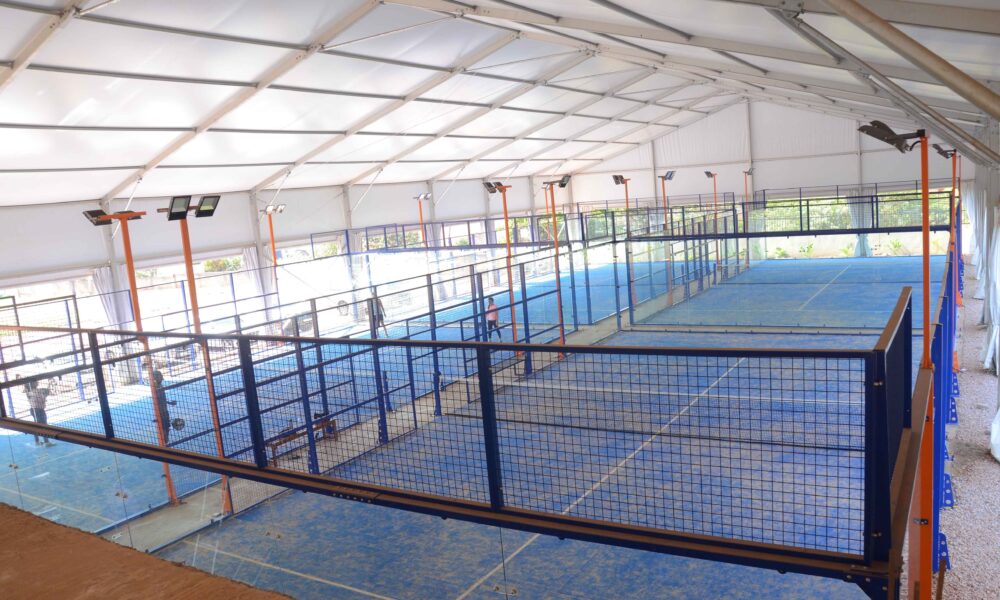

Padel and pickleball are different racket sports. The easiest way to tell them apart is the court: padel is usually played as doubles inside an enclosed court where the ball can rebound from walls, while pickleball is played with a perforated plastic ball on a smaller, open court that has a seven-foot non-volley zone beside the net. Padel feels more like doubles tennis with walls; pickleball rewards quick hands, placement and controlled exchanges near the kitchen line.
Featured photo: Padel courts at the Herman Padel Centre, photographed by Samson Ssemakadde. Original image on Wikimedia Commons, CC0 1.0. The photo shows a real padel venue; it is not a photograph of a pickleball court.
Padel vs. pickleball at a glance
| Feature | Padel | Pickleball |
|---|---|---|
| Standard court | 20 m long × 10 m wide (about 65.6 × 32.8 ft) | 44 ft long × 20 ft wide (about 13.4 × 6.1 m) |
| Walls | Enclosed by walls and fencing; certain rebounds remain in play | Standard court has no rebound walls |
| Usual format | Doubles | Singles or doubles |
| What you hit with | Short, solid-faced padel racket, often perforated | Flat, solid paddle without strings |
| Ball | Felt-covered pressurized ball similar in appearance to tennis | Lightweight perforated plastic ball |
| Serve | Ball bounced before contact; struck at or below waist height, diagonally | Legal volley serve or drop serve, diagonally |
| Typical scoring | Tennis-like 15, 30, 40 and games/sets; event-specific deciding-point formats | Common standard format is first to 11, win by 2; serving side scores, with some optional variations |
| Distinctive rule | Ball may rebound off walls after bouncing on court | Two-bounce rule and seven-foot non-volley zone |
These are the standard rules and dimensions, not assumptions based on every casual venue. The specifications above are supported by the International Padel Federation’s rules and the 2026 USA Pickleball rulebook.
Courts: padel has walls; pickleball has a kitchen
The padel court
The regulation padel court is 20 by 10 meters inside its enclosure. The transparent or solid walls and surrounding fencing are part of how the game works: after a legal bounce on your side, a ball may rebound from certain wall surfaces and remain playable. This extends rallies and rewards anticipation. The enclosure also makes the sport visually distinctive at a glance.
The larger enclosed venue means playing padel depends on finding a dedicated padel court. A normal tennis court with no walls does not automatically become a regulation padel court by adding a temporary net.
The pickleball court
Pickleball uses the same 20-foot by 44-foot court for both singles and doubles. On each side of the net, the non-volley zone—usually called the kitchen—extends seven feet from the net. Players may stand in that zone during a rally, but they may not volley a ball while they are in it, and volley-related momentum restrictions also apply.
This creates a distinctive short-game battle: players move up to the kitchen line, hit gentle dinks, then wait for a ball they can attack. See our pickleball rules guide for how the kitchen and serve rules interact.
How the ball and racket change the game
A padel ball looks similar to a tennis ball and is designed for the sport’s court and rebounds. A padel racket is short with a rigid hitting surface and no strings. Its holes are in the racket, not the ball. Players can use angled shots, lobs and the back glass to extend a defensive point.
A pickleball is made of perforated plastic. Its paddle is flat and comparatively light to maneuver near the net. The ball’s flight and bounce are not the same as those of a padel ball. Using one sport’s ball or paddle for the other is not a meaningful substitute for playing by regulation rules.
Both can be beginner-friendly, but timing feels different. Padel players learn to judge rebounds that travel toward the back wall; pickleball players learn how much pace to take off a shot so it lands just over the net.
How serving differs
Padel serve
Under FIP rules, the server bounces the ball in the designated service area, strikes it at or below waist height, and directs it diagonally into the opposite service box. The server has a first serve and, when needed, a second attempt. A successful serve can then lead into a rally that includes legal wall rebounds.
Pickleball serve
A standard pickleball serve travels diagonally beyond the non-volley zone into the correct service court. There are different legal techniques, including a volley serve struck without a preliminary bounce and a drop serve struck after the ball bounces. Both must satisfy their respective official constraints.
The two-bounce rule then requires the return of serve to bounce before it is hit, and the serving side must let that return bounce before striking its next shot. Only afterward may either side volley where allowed. That is a key distinction from padel. If the rules feel unfamiliar, our third-shot drop explanation shows why the third shot is a common pickleball tactic.
Scoring: tennis-style games vs. points to 11
Padel generally uses tennis-like counting within games: 15, 30, 40 and game, with sets and tiebreaks. The treatment of deuce can change by event or competition regulations. Do not assume every padel tournament uses the same deciding-point format; our 2026 padel scoring guide explains the distinctions between advantage, golden point and Star Point systems.
Standard pickleball is more commonly played to 11 points, win by two, with points scored by the serving team. Doubles serving has a particular sequence, and competitive formats may use different target scores. The 2026 USA Pickleball rules also provide for an optional rally-scoring variation in specified settings, so it is more precise to say standard side-out scoring than to claim all pickleball everywhere works identically.
Which one is easier for a beginner?
There is no universal winner, but the demands are different:
- Pickleball may feel quicker to start if you already have access to a lined court, paddles and a partner. Shorter distances and gentle introductory rallies can make the first session approachable. Accurate kitchen positioning takes practice.
- Padel may feel intuitive to a tennis player because of the felt ball, familiar scoring and doubles patterns, but learning to use the back wall well is a separate skill. A dedicated enclosed court is essential.
- Neither is automatically easier on the body. Both involve quick changes of direction. Playing intensity, footwear, skill and court conditions affect effort more than the sport’s name.
For a first session, prioritize a nearby introductory class or venue with loaner equipment. One supervised hour that teaches the serve and court boundaries is generally more useful than buying advanced equipment immediately.
Is padel or pickleball cheaper to play?
Equipment and court prices differ greatly by city and venue. In some places pickleball is available on community or shared surfaces with low fees; in others, dedicated pickleball clubs charge for bookings. Padel requires a purpose-built enclosure and may have fewer available venues, but this does not prove that every padel booking is more expensive.
Compare the real price of a trial session, racket or paddle rental, court booking per player and travel time before deciding. A four-player padel booking and a public pickleball drop-in session are not directly comparable unless the total cost per person is calculated.
Can you use a pickleball paddle for padel?
No, not as regulation padel equipment. Padel’s racket specifications and ball are different, and the enclosing walls are part of play. Likewise, a padel racket is not the standard equipment for sanctioned pickleball. For safe first-time play, use the equipment supplied by the facility or a sport-specific beginner set.
What should a first-time player choose?
Choose padel if you enjoy extended doubles rallies, learning creative wall rebounds and a tennis-like game format. Choose pickleball if you prefer short-court placement battles, quick net exchanges and a game that can be played in singles as well as doubles. The best sport is the one you can play regularly with a group that matches your level.
Frequently asked questions
Is padel the same as pickleball?
No. They use different court sizes, balls, rackets and key rules. Padel is characterized by an enclosed court and wall rebounds, while pickleball is played on an open 20-by-44-foot court with a seven-foot non-volley zone.
Does padel use the pickleball kitchen?
No. Padel has service boxes and an enclosed wall system, but it does not use pickleball’s seven-foot non-volley zone rule.
Can you play singles in both sports?
Pickleball’s standard court supports singles and doubles. Standard regulation padel is chiefly a doubles game, with specialty singles variations at some venues that should not be confused with the normal 20-by-10-meter court.
Are pickleball and padel played with tennis balls?
Neither uses a regular tennis ball under its official rules. Padel uses an approved felt-covered ball that resembles a tennis ball, while pickleball uses a perforated plastic ball.
Bottom line: padel is an enclosed-wall doubles racket sport; pickleball is an open-court paddle sport built around the kitchen and two-bounce rule. Compare court access and try each with proper equipment before picking a favorite.

Other Articles

Tennis Forehand Technique: Grip, Contact Point and Drills
Save in Baseball: The 3 Ways a Relief Pitcher Earns SV