
Quick answer: NASA’s Mission Control Center is the operations complex at Johnson Space Center in Houston, Texas, where flight controllers monitor spacecraft systems, coordinate crews and respond to problems during human spaceflight. It is not the rocket-launch control room at Kennedy Space Center in Florida. Houston assumed primary control of crewed NASA missions with Gemini IV in June 1965, and its famous Apollo-era Mission Operations Control Room guided the Moon-landing missions. The Apollo room has been restored to its historic appearance and can be seen on designated visitor tours.
NASA Mission Control Center: facts
| Question | Answer |
|---|---|
| Where? | Christopher C. Kraft Jr. Mission Control Center, NASA Johnson Space Center, Houston |
| Historical building | Building 30 at Johnson Space Center |
| First crewed mission primarily controlled from Houston | Gemini IV, June 1965 |
| Apollo 11 landing control room | Mission Operations Control Room 2 (MOCR-2) |
| Historic preservation | National Historic Landmark designation 1985 |
| Building renamed | 2011 in honor of flight director Christopher Kraft |
| Apollo-era restoration | Completed in 2019 |
| Visitor tours | Through Space Center Houston; check current capacity and schedule |
NASA’s history of the Houston Mission Control Center documents the building and its changes.
What does Mission Control actually do?
Flight controllers work at specialized consoles while engineers and support teams monitor data elsewhere. They help astronauts stay on a safe mission plan by following communications, propulsion, navigation, life-support, electrical power, flight rules and planned maneuvers. When an unexpected problem occurs, the ground team assesses options and communicates decisions to the crew.
Mission Control can send commands to many spacecraft systems but cannot simply press a button to fix every fault. Radio coverage, spacecraft safety rules and time-critical decisions constrain what ground controllers can do. Modern orbital missions often depend on international partners and ground networks, so the team shown in a photograph is only one part of a much larger operation.
FLIGHT: who makes the final operational decisions?
The flight director, called FLIGHT in mission-control voice loops, has overall responsibility for directing the flight control team. During a crisis, the flight director coordinates recommendations from specialists and chooses among options within mission rules.
CAPCOM: why does one astronaut speak to the crew?
The capsule communicator, or CAPCOM, traditionally serves as the principal person on the voice loop talking to the astronauts. Having a defined channel reduces confusion, especially when several specialists need to send instructions in rapid succession. During Apollo, CAPCOMs were astronauts who understood both the flight plan and the language of crews in orbit.
Houston Mission Control versus Florida Launch Control
| Feature | Mission Control, Houston | Launch Control, Florida |
|---|---|---|
| Primary setting | Johnson Space Center, Texas | Kennedy Space Center, Florida |
| Primary work | Mission operations during flight | Ground systems and launch countdown operations |
| Famous visual | Apollo flight-controller consoles and mission-status displays | Launch control rooms and firing-room consoles |
| Notable phrase | “Houston, …” voice communication from orbit | Countdown and launch coordination |
The sites work together, and responsibilities differ by program. A launch control photo at Kennedy should not be labeled as the 1969 Apollo mission-control room in Houston.
How Houston became the center of crewed spaceflight
NASA originally monitored its earliest Mercury missions from Cape Canaveral in Florida. After selecting Houston for the new Manned Spacecraft Center in 1961, it began building a dedicated control complex. Construction and installation of the real-time computing systems continued in 1963 and 1964. Houston monitored the uncrewed Gemini 2 flight as part of testing, backed up the earlier crewed Gemini 3 mission, then took primary flight-control responsibility starting with Gemini IV in June 1965.
That transition mattered because NASA planned increasingly long, complicated flights requiring many specialists to interpret more telemetry. The building included two mission-operations control rooms, allowing teams to equip, train and operate for different missions.
What happened in Apollo 11 Mission Control?
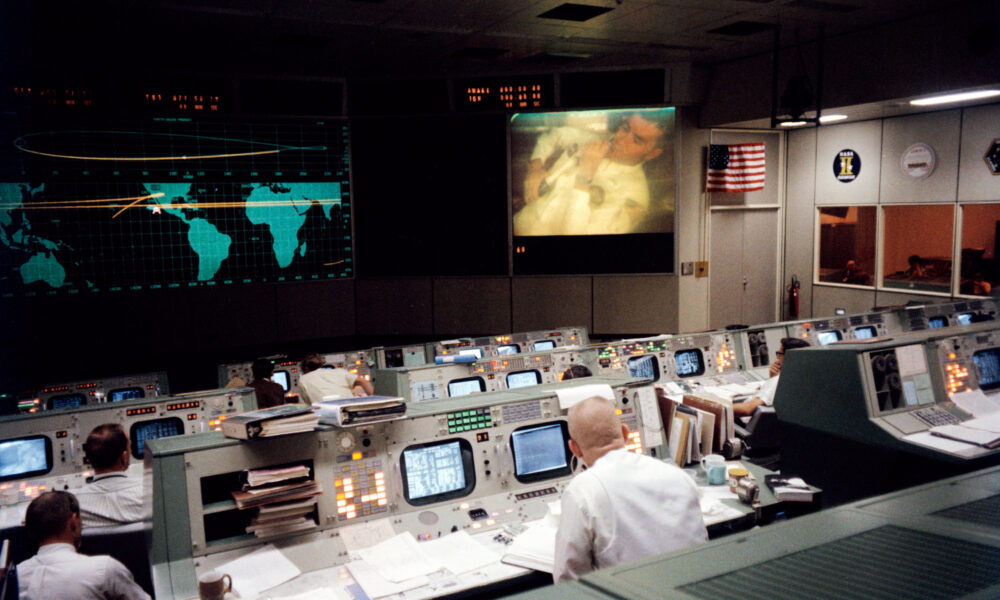
During July 1969, Houston flight controllers guided NASA’s first crewed Moon landing. When the lunar module descended, controllers watched telemetry, tracked mission rules and helped the crew respond to unexpected program alarms. The room later celebrated the safe conclusion of the mission on July 24, 1969. Photographs from that day show rows of consoles, a large status board and flight controllers congratulating each other.
Why original photographs matter
A genuine NASA image from 1969 documents the room and its people as it appeared during Apollo 11. A modern restored-room photograph can look very similar, but the captions should distinguish the two. In this article the featured image is an original NASA photograph of Mission Control during the successful conclusion of Apollo 11, not a contemporary tourist reconstruction.
Apollo 13 and other emergencies
When the Apollo 13 spacecraft suffered an oxygen-tank explosion in 1970, ground teams helped develop emergency operating procedures, power plans and a safer return trajectory. It was not a case of one dramatic person solving everything instantly: engineering specialists across NASA and supporting organizations worked together. The mission is remembered for demonstrating how disciplined ground operations can turn a catastrophe into a crew survival effort.
For a separate historical example of engineers adapting to a spacecraft control emergency, AVARIXO’s Gemini spacecraft overview explains how Gemini taught NASA essential rendezvous and operations techniques before Apollo.
What happened to the Apollo control room?
After the Apollo program, Johnson’s control facilities continued to support Skylab, Apollo-Soyuz and early shuttle missions. The original Apollo MOCR became a National Historic Landmark in 1985. As NASA modernized operations in the 1990s, the Apollo room was taken out of operational use. Years of visitor traffic and aging hardware made restoration increasingly important.
The 2019 restoration
NASA and its partners restored the Apollo-era room to resemble its late-1960s appearance, including original-style equipment and numerous period details. The historical restoration was completed in June–July 2019, and the restored space became accessible through selected visitor tours. It is now a preservation site, not the active room from which today’s missions must necessarily be commanded.
NASA’s Apollo Mission Control restoration record details the National Historic Landmark designation and preservation work.
Can visitors tour NASA Mission Control in Houston?
Historic Mission Control visits may be available through Space Center Houston, the official visitor center for Johnson Space Center. Some tours require reservations, age limits, capacity restrictions or security checks, and a general admission ticket does not always include any particular NASA behind-the-scenes tour. Before going, review the official attraction listing and operating schedule; do not depend on an old third-party description of “free unlimited access.”
Common Mission Control myths
- Myth: Houston launches all NASA rockets. Fact: Launch sites such as Kennedy have separate launch-control responsibilities.
- Myth: The Apollo room remained unchanged and operational through 2026. Fact: The historic room underwent major upgrades, decommissioning and restoration.
- Myth: The computer screens were as powerful as today’s laptops. Fact: The computing infrastructure of 1969 was fundamentally different.
- Myth: Every console is operated by an astronaut. Fact: Flight-control teams include specialists in engineering, navigation, flight dynamics, communications and many other disciplines.
Frequently asked questions
Why do astronauts say Houston?
They address the flight-control team based at NASA’s Johnson Space Center in Houston.
Where was Apollo 11 Mission Control?
The landing was controlled from Mission Operations Control Room 2, Building 30, at Johnson’s predecessor facility in Houston.
Is the old Apollo Mission Control still active?
No. The historic room is preserved for education and tours; NASA uses modern operations facilities for current missions.
When did NASA start using Mission Control in Houston?
Houston first took primary flight control for a crewed mission with Gemini IV in June 1965.
Can I see the original room?
Selected tours may visit the restored historic room. Check the current Space Center Houston options before buying a ticket.
Sources: NASA Building on a Mission, NASA restoration history and Space Center Houston tours. Reviewed October 2026.


