Quick answer: Mintonette volleyball refers to the original net-and-ball game developed by YMCA physical director William G. Morgan in Holyoke, Massachusetts, in 1895. It later acquired the name Volley Ball, because volleying the ball over a net was the central action. Its earliest documented form differed dramatically from today’s six-player volleyball: the 25-by-50-foot court, approximately 6-foot-6-inch net, flexible team numbers and unlimited contacts made it a much more open-ended recreational game.
The most important historical caveat is that an often-repeated claim that Mintonette was invented on February 9, 1895 is not securely documented. After reviewing primary sources, the International Volleyball Hall of Fame concluded that Morgan arrived at the Holyoke YMCA in August 1895 and that a start around December 1895 is more plausible. This guide distinguishes what the historical records support from what later summaries repeat.
What was Mintonette? The original name of volleyball
Mintonette was a game designed for indoor exercise without the heavy collisions or fast-running demands of basketball. Morgan was working in physical education at the YMCA when he began combining useful elements of familiar activities. Basketball suggested a ball; tennis offered the idea of a net; handball informed the use of hands; baseball inspired the inning-based structure of early scoring.
The name evoked badminton, another game where play passes across a net. It did not mean Mintonette had the modern badminton scoring rules or that it was played with rackets. Players used their hands to keep a ball moving over a net.
Who invented Mintonette volleyball?
William George Morgan (1870–1942) is correctly identified as the principal inventor. The International Volleyball Hall of Fame also points to contributions by Dr. Frank Woods and Holyoke Fire Chief John Lynch, whose roles have sometimes been lost in simplified retellings. In a later account of the game’s origins, Morgan himself credited both men for material assistance.
At the Holyoke YMCA, Morgan wanted a game that active adult members could play without the level of physical contact associated with basketball. That design goal helps explain the high net and early willingness to allow many players and multiple touches.
Important distinction: Crediting Morgan as inventor is consistent with recognizing Woods and Lynch as contributors. These are not contradictory historical claims.
When was Mintonette invented? Why February 9 is disputed
Many articles name February 9, 1895 as a precise invention date. The International Volleyball Hall of Fame specifically challenges that date after studying local newspaper records and Morgan’s employment timeline. It reports that Morgan did not assume the Holyoke YMCA physical director position until August 30, 1895. Its research therefore places the likely development of Mintonette nearer December 1895, not February.
There is a second date that is better documented: July 7, 1896, when Morgan demonstrated the developed game at a YMCA physical directors’ conference in Springfield, Massachusetts. The 1896 demonstration should not be mistaken for the exact day the game was invented.
| Date or period | What it means | Level of certainty |
|---|---|---|
| 1895 | Accepted year of Mintonette’s creation in Holyoke | Strong agreement across authoritative histories |
| February 9, 1895 | A widely repeated supposed invention date | Disputed by IVHF archival research |
| August 30, 1895 | Morgan arrived to take up the Holyoke YMCA position | Documented in period newspaper records cited by IVHF |
| Likely December 1895 | Approximate period when Mintonette took shape | IVHF historical inference, not a proven exact day |
| Early 1896 | Alfred Halstead proposed the descriptive name “Volley Ball” | Supported by IVHF’s account |
| July 7, 1896 | Public YMCA physical-directors’ conference demonstration | Documented event |
The original Mintonette rules compared with modern volleyball
The first version was less standardized than today’s international game. The International Volleyball Hall of Fame describes a court measuring 25 by 50 feet (approximately 7.6 by 15.2 meters) and a net about 6 feet 6 inches (1.98 meters) high. Teams could have many players, and teams were not restricted to three contacts. The inning-style format could even allow another player to help a serve over the net.
| Feature | Early Mintonette | Modern indoor volleyball |
|---|---|---|
| Court | About 25 × 50 feet | 18 × 9 meters (about 59 × 29.5 feet) |
| Net | About 6 feet 6 inches | Regulated heights vary; commonly 2.43 m men / 2.24 m women in senior play |
| Players | No fixed team-number limit in the earliest version | Six players per side on court in standard indoor volleyball |
| Team contacts | Unlimited in the early version | Normally up to three hits to return the ball, subject to official rules |
| Scoring framework | Nine innings and served opportunities | Rally scoring in sets; typically first four sets to 25, deciding set to 15 with a two-point margin |
| Purpose | Accessible YMCA recreation for adults | Recreational through elite competitive sport |
These are historical comparisons, not an instruction to use 1895 rules in sanctioned games. Early rules also evolved quickly as the YMCA spread the sport. The current official rules should be consulted for competitive play.
How did the original game get its name?
From Mintonette to Volley Ball
According to the International Volleyball Hall of Fame, Morgan described the game to Dr. Alfred Halstead in early 1896. Halstead thought Volley Ball was a better description of the exchanges over the net. The new name was adopted, with the familiar single-word spelling becoming standard later. The name was not chosen because volleyball suddenly acquired different equipment on one particular date.
Why the first ball was a problem
A regular basketball was too heavy for the desired game. Using only a basketball bladder made for a ball that was too soft. The Hall of Fame credits Morgan with turning to A. G. Spalding to produce a more suitable purpose-built ball, helping make repeated airborne exchanges more practical.
How Mintonette became the sport people recognize
Standardized rules did not emerge instantly. The YMCA network helped spread the game across North America and abroad. As play became more competitive, rules around team size, touches and organization changed. The Hall of Fame places the move to six players per side in 1918 and the rule limiting a team to three touches in 1922. These later changes are useful milestones when comparing early Mintonette to volleyball’s present rhythm.
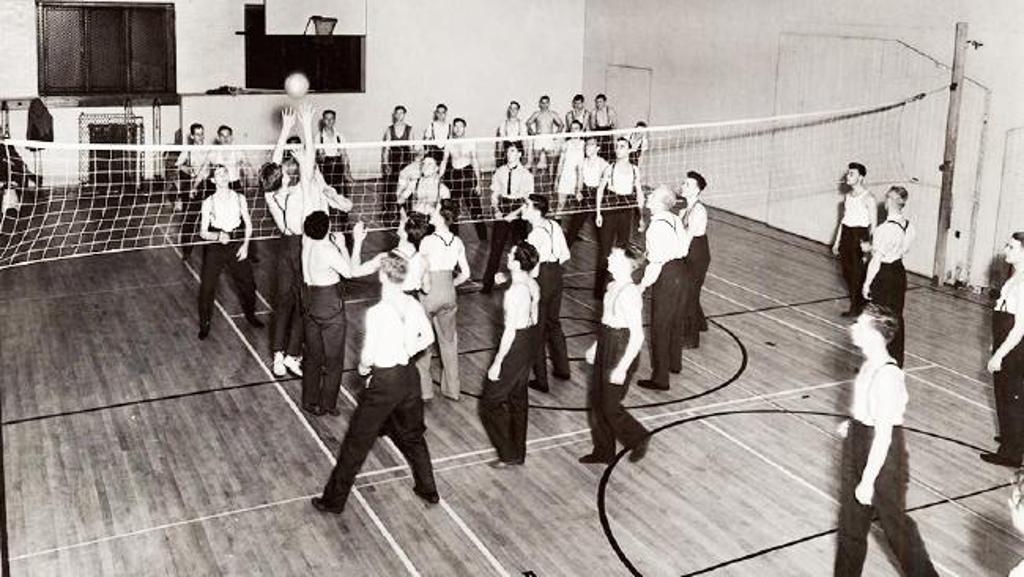
The photograph below is an authentic image of indoor volleyball from around 1910. It documents the game’s early development but does not depict Morgan’s initial 1895 invention or the 1896 YMCA demonstration.
What an 1895-style Mintonette demonstration would need to explain
An educational reenactment should tell visitors up front that it reconstructs the idea of early Mintonette, not reproduce a perfectly documented match. The original players did not wear today’s team uniforms or follow present-day rally-scoring rules. Demonstrators could explain:
- Net play: Keep the ball in the air and over a dividing net rather than carrying or throwing it.
- Participation: The early version did not impose today’s fixed six-person lineup.
- Multiple contacts: Organizing a return could involve more touches than permitted now.
- Innings: The earliest contest structure resembled innings rather than modern sets.
- Historical uncertainty: Rules developed as the YMCA circulated and revised the game.
This is a descriptive historical interpretation, not a sanctioned rule set. For contemporary instruction, see AVARIXO’s volleyball serving guide and volleyball net-height comparison.
Frequently asked questions
What does Mintonette mean in volleyball?
Mintonette was the original name of the game that evolved into volleyball. The wording drew inspiration from badminton and other net games; it is not the name of a separate modern volleyball format.
Was volleyball invented on February 9, 1895?
The sport’s accepted invention year is 1895, but the Hall of Fame disputes the February 9 date as unsupported and places its likely development late in 1895. An exact invention day should not be stated as settled fact.
Who suggested the name Volleyball?
The historical account maintained by the International Volleyball Hall of Fame credits Alfred Halstead with suggesting the name “Volley Ball” in early 1896 because players volleyed the ball back and forth.
Did Mintonette have six players and a three-touch rule?
No. In the earliest version, team size and touches were much more flexible. The six-player rule and three-touch limit became established later during the sport’s development.
Is Mintonette still played?
Mintonette is primarily a historical name today. Some education programs or clubs may reenact aspects of the early rules, but recognized competitive volleyball follows later standardized rule books.
Primary historical reading
For the evidence behind the date correction and original rules, see the International Volleyball Hall of Fame’s archival history and the FIVB’s history of the game. Those resources provide a more reliable starting point than unsourced anniversary-date infographics.