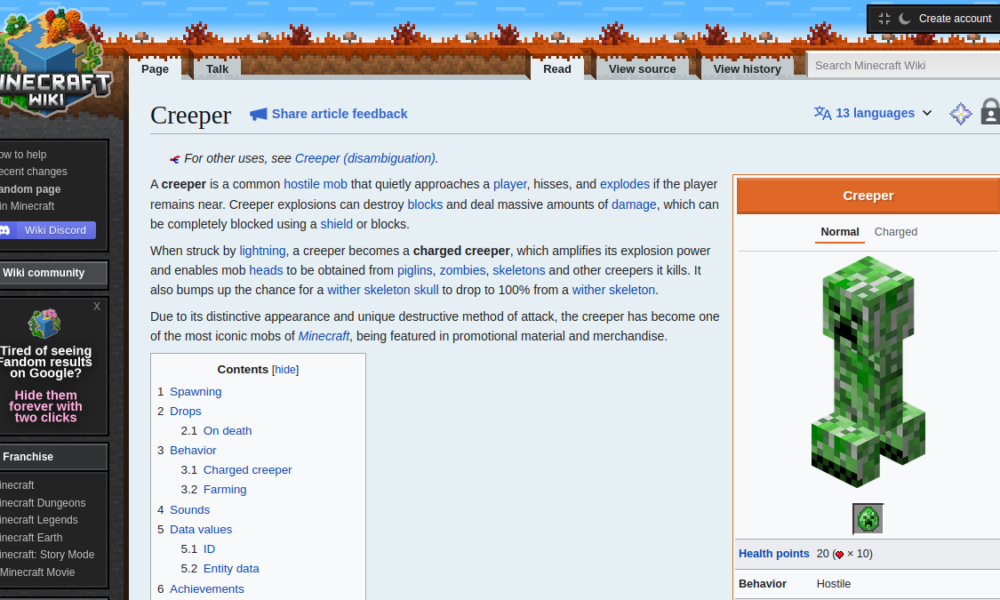

The creeper is one of Minecraft’s most recognizable hostile mobs. It approaches players quietly and can explode after starting its detonation behavior, making it especially dangerous near storage rooms, farms and decorative structures. Learning to manage distance and terrain is more reliable than assuming the mob is harmless when it seems to stand still.
Editorial icon by OpenMoji, CC BY-SA 4.0; not an official app or game screenshot.
What does a creeper do?
A creeper usually attempts to approach a target player and can begin a fuse that ends in an explosion. The blast may harm nearby entities and damage blocks depending on the world’s rules and explosion conditions. Creepers do not fight with swords or ranged projectiles; their threat comes from closing distance while you are distracted.
How to deal with a creeper safely
- Pay attention to movement and distinct audio cues while mining or building outdoors.
- Keep a clear escape route rather than backing into a wall.
- Use knockback and retreat to maintain distance.
- For ranged combat, avoid standing still where the creeper can approach unnoticed.
- Do not fight immediately beside valuable chests or other important constructions if you can move the encounter away.
Combat timing varies with difficulty, latency and current game mechanics. The best advice is to maintain a safety margin, not trust a fixed ‘three steps always works’ trick.
Why are creepers afraid of cats?
Under standard Minecraft mechanics, creepers tend to keep distance from cats and ocelots. This can help make a base’s approach less welcoming to creepers, but it is not an absolute shield for the entire building. Other hostile mobs have their own behaviors, and creepers may still become threats if conditions change.
Charged creepers explained
A creeper that is struck by lightning can become a charged creeper, a more dangerous variant with a stronger explosion under normal rules. Do not intentionally attempt to create one near a finished base without understanding the risk. Special mob-head interactions also depend on specific charged-creeper explosion conditions; the ordinary creeper does not guarantee those drops.
Protecting your Minecraft home
Improve lighting and spawn control
Use appropriate lighting and spawn-proof building surfaces according to your installed version. Modern hostile-mob spawning rules differ from older guides, so do not rely on a screenshot from a very old version.
Protect work areas
Keep a clear path between storage and crafting stations, and avoid narrow entrances where a mob can surprise you. Use barriers and controlled access points to reduce accidental encounters while organizing supplies.
Review world settings before enabling explosions
Game rules and server configuration can influence whether explosions damage terrain. Understand your current difficulty and server policies before assuming a design is ‘creeper proof’.
Creeper drops and farming
Gunpowder is a notable creeper drop in normal play, and it is useful for items including fireworks and splash potion creation. A farm’s output depends on spawning mechanics, collection design and simulation distance. Claims of an exact production rate require a tested farm and version; they cannot be inferred from the mob’s existence alone.
FAQ
Can a creeper destroy blocks?
Yes, if the relevant game rules and explosion conditions permit terrain damage.
Are charged creepers stronger?
Yes, their explosions are more dangerous than ordinary creepers.
Will a cat guarantee full creeper protection?
No. It can deter creepers nearby but is not a universal base shield.
Are creepers useful for crafting resources?
They can drop gunpowder under normal conditions.
See the Minecraft Wiki creeper reference for detailed version-specific behavior. For equipment preparation, our enchanting table guide explains getting started.


