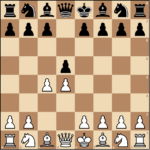

London System Chess Opening — a practical guide to the opening’s moves, strategy and common mistakes.
What is the London System?
The London System is a chess opening setup for White commonly built around d4, Nf3, Bf4, e3, c3 and Bd3. Instead of relying on one fixed sequence against Black’s moves, White aims for a recognizable piece structure and steady central control.
The London is popular with beginners because its ideas are relatively easy to learn. It is not a magic opening that can be played on autopilot, however. Black’s pawn breaks and piece placements still determine which moves are best.
A sample London System move order
1. d4 d5
2. Nf3 Nf6
3. Bf4 e6
4. e3 Bd6
5. Bd3 O-O
6. O-O
This is only one possible sequence. White often plays c3 to support d4, and can develop the queen’s knight to d2. The key concept is to develop the light-squared bishop to f4 before playing e3, which would otherwise restrict that bishop’s diagonal.
The sample position is not a requirement: Black may use …c5, …Bf5, …g6 or other setups, and White must respond to the actual threats on the board.
What the typical London pieces do
| Move or piece | Typical purpose |
|---|---|
| d4 | Claims central space and controls e5 |
| Bf4 | Develops the bishop actively before e3 |
| Nf3 | Develops and supports central squares |
| e3 | Supports d4 and opens the dark-squared bishop |
| c3 | Reinforces d4 and creates a stable pawn triangle |
| Bd3 | Develops toward the kingside and supports possible attacks |
| Nbd2 | Develops while leaving options for central play |
These are common ideas rather than a rigid checklist. For example, White may need to respond to an early …Qb6 that attacks b2 instead of completing the setup mechanically.
The London System and the e5 square
One important plan is to control the e5 square with the d4 pawn and pieces. A knight placed on e5 can become strong when Black cannot challenge it effectively. White sometimes follows with f4 or a kingside attack, but those plans require careful calculation and king safety.
Black can contest the center with …c5, …Nc6 and …Qb6 in suitable positions. The correct response depends on whether the d4 pawn is defended and whether White has completed development.
How Black can challenge the London
Black does not have to sit passively. Common ideas include an early …c5 against d4, developing the light-squared bishop outside the pawn chain with …Bf5, or putting pressure on b2 with …Qb6. In some positions Black can exchange White’s active bishop or force White to make structural concessions.
The London is a system, not a guarantee of equality or an advantage. Both players should evaluate the center, the king positions and the timing of pawn breaks rather than copying a move list.
London System versus Queen’s Gambit
The Queen’s Gambit usually starts 1. d4 d5 2. c4, immediately challenging Black’s d5 pawn with the c-pawn. The London more often develops pieces with Nf3 and Bf4 and uses c3 to support d4 rather than pushing c4 early.
As a result, the London often gives White a familiar structure while the Queen’s Gambit creates more direct central pawn tension. Both are sound ways to play 1. d4. See our Queen’s Gambit guide for the key Accepted and Declined structures.
A beginner’s London System plan
- Play d4 and develop your knight to f3.
- Develop the light-squared bishop to f4 before playing e3 if the position allows it.
- Support the center with e3 and c3.
- Develop the dark-squared bishop and the queen’s knight.
- Castle kingside when it is legal and safe.
- Watch for …c5 and …Qb6 rather than finishing the setup blindly.
- Choose a middlegame plan based on the central pawn structure and the opponent’s king.
Typical tactical motifs
White’s bishop on d3 and knight on e5 can create threats near Black’s king. A rook may join through the e-file, and White can sometimes play a central break with e4 after sufficient preparation. None of these ideas is automatically sound; Black may have tactical replies or counterplay against d4 and b2.

A photo of a final checkmate position illustrates the kind of tactical result that can arise, but the exact attack depends on the full move sequence. Do not infer that the London guarantees a quick checkmate.
Common London System mistakes
- Playing the same seven moves regardless of Black: You may miss a threat to b2 or d4.
- Moving the bishop repeatedly without reason: Black can gain time and control the center.
- Ignoring …c5: This can undermine White’s pawn structure.
- Attacking the king too early: Complete development and assess the center first.
- Assuming e5 is always available: A knight jump may be met by exchanges or pawn pressure.
- Never learning other structures: Studying the Queen’s Gambit and basic endgames improves your understanding.
London System FAQs
Is the London System good for beginners?
Yes. Its recurring setup can make development easier to learn, but you still need to respond to the opponent’s moves.
What are the key London moves?
Common moves include d4, Nf3, Bf4, e3, c3, Bd3 and Nbd2, with flexible ordering.
Is the London System only for White?
The name usually refers to White’s setup against Black’s defenses.
Can Black stop the London?
Black can challenge it with central pawn breaks and active piece play. There is no single automatic refutation.
Takeaway
The London System offers a recognizable way to develop after 1. d4. Learn why Bf4, e3 and c3 fit together, then pay close attention to Black’s central breaks. Use the setup as a starting point for thinking, not a substitute for calculation. Our chess notation guide explains the move symbols used above.