
What is the King’s Gambit?
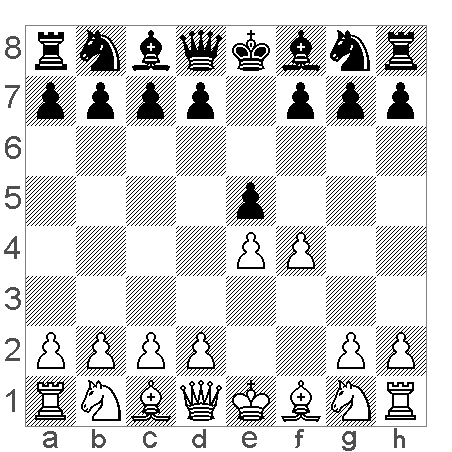
The King’s Gambit is a chess opening that begins 1. e4 e5 2. f4. White offers the f-pawn to challenge Black’s central e5 pawn and potentially open the f-file for an attack. The opening is famous for sharp play, rapid development and king-safety questions.
It is a genuine opening with a long history, not merely a trap. Black can accept the offered pawn with 2…exf4 or decline it with other moves. Both sides need accurate calculation because the f-pawn’s advance changes the protection around White’s king.
The first two moves and their purpose
1. e4 e5
2. f4
White occupies the center with e4, and Black answers with …e5. White then advances the f-pawn two squares to attack e5. If Black captures on f4, the e-file and f-file dynamics change, and White may try to develop quickly and regain the pawn later.
King’s Gambit Accepted versus Declined
| Black reply | Variation | Basic idea |
|---|---|---|
| 2…exf4 | King’s Gambit Accepted | Black takes the offered f-pawn, and White often seeks rapid development and attacking play |
| 2…Bc5 | Classical King’s Gambit Declined | Black develops a bishop and keeps the e5 pawn in place |
| 2…d5 | Falkbeer Countergambit | Black strikes back in the center immediately |
The word accepted refers to Black capturing on f4, not to whether White’s overall opening strategy succeeds. Declined variations can still produce complicated and tactical positions.
The King’s Gambit Accepted: a sample line
1. e4 e5
2. f4 exf4
3. Nf3 g5
White develops the knight to f3, helping control central squares and preventing some immediate queen-check ideas. Black’s …g5 tries to support the pawn on f4, but advancing kingside pawns can also create weaknesses. The sample is only one branch; Black can choose quieter development.
White should not assume the gambit pawn must be recaptured at once. Sometimes gaining development and attacking chances is the better practical plan. Black, meanwhile, should avoid keeping the pawn at any cost if doing so exposes the king.
What is the Falkbeer Countergambit?
After 1. e4 e5 2. f4 d5, Black immediately counters in the center. This is called the Falkbeer Countergambit. Instead of spending time defending e5, Black challenges White’s pawn structure and development.
White needs to calculate the consequences of captures on d5 and e5. The main lesson is that a gambit does not force the opponent to accept the pawn. Black can often meet an aggressive pawn offer with active central play.
White’s attacking ideas
White often aims for quick development, a rook on the f-file after the pawn exchange, and pressure against Black’s king. Knights and bishops can join an attack, but the plan only works if White completes development and calculates forcing replies. A queen sortie without support can waste time and leave the queen exposed.
The open f-file can be valuable, yet White’s own king may be vulnerable because the f-pawn no longer shields it. Castling kingside is not automatically safe in every King’s Gambit position. Evaluate open lines and enemy piece placement before choosing where to put the king.
Black’s defensive and counterattacking ideas
Black can accept the pawn and focus on development, decline the gambit with a bishop move, or strike at the center with …d5. The correct approach depends on the position. The most important defensive principles are to complete development, avoid unnecessary pawn moves and look for opportunities to challenge White’s exposed king.
Black should not become obsessed with holding the f4 pawn. A material advantage matters only if it can be kept without allowing a decisive attack. Likewise, sacrificing the pawn back to gain time or simplify can be entirely reasonable.
King’s Gambit versus Queen’s Gambit
The King’s Gambit begins 1. e4 e5 2. f4 and immediately changes the pawn cover around White’s king. The Queen’s Gambit begins 1. d4 d5 2. c4 and typically focuses on central pawn pressure and long-term positional play. Both involve an early pawn offer, but their strategic character is quite different.
For a comparison with the queen-pawn opening, see our Queen’s Gambit guide. Beginners should understand that the word gambit describes an offered pawn, not a guaranteed advantage.
Common King’s Gambit mistakes
- Attacking before developing: An open file is useful only when pieces can exploit it.
- Ignoring king safety: Moving the f-pawn weakens squares near White’s king.
- Trying to win the pawn back immediately: The resulting move may lose time or expose pieces.
- Holding the extra pawn at all costs as Black: A chain of pawn moves can leave Black underdeveloped.
- Assuming every line is a forced checkmate: Accurate defense can neutralize many speculative attacks.
- Mixing up accepted and declined lines: Their pawn structures and plans differ.
Is the King’s Gambit good for beginners?
It can be a useful training opening for tactics, initiative and the relationship between development and king safety. However, it is less forgiving than many quiet systems. If you are learning the basics, combine King’s Gambit games with practice in ordinary open positions and simple endgames.
Choose one reply to 2…exf4 and one plan against 2…Bc5 or 2…d5. After each game, review whether your pieces developed efficiently and whether the f-file actually helped your attack. Understanding the reasons for a move is more important than memorizing a trap.
A simple study checklist
- Memorize the starting moves 1. e4 e5 2. f4.
- Recognize whether Black accepted the pawn with …exf4.
- Identify which central squares changed after the pawn exchange.
- Develop knights and bishops before committing to an attack.
- Check whether your king can castle safely.
- Look for central counterplay from Black, especially …d5.
- Review the first moment a player sacrificed or recovered material.
Practicing these questions will improve tactical judgment beyond the opening itself.
King’s Gambit FAQs
What are the first moves of the King’s Gambit?
1. e4 e5 2. f4.
Does Black have to accept the gambit?
No. Black can capture with 2…exf4 or decline with alternatives such as 2…Bc5 and 2…d5.
Is the King’s Gambit a forced win?
No. Both sides have playable options, and the result depends on the accuracy of their moves.
Why does White play f4?
The pawn attacks e5 and can open the f-file for piece activity if Black captures it.
Is it still played today?
Yes. It appears in practical games and opening study, though it is not the only sound way to play 1. e4.
Takeaway
The King’s Gambit is an energetic opening defined by 1. e4 e5 2. f4. It trades some king security for central pressure and attacking possibilities. Learn the Accepted and Declined branches, develop pieces quickly and calculate before sacrificing more material. Our chess notation guide explains the symbols used in the examples.

Other Articles
Dutch Defense in Chess: Stonewall, Leningrad and Beginner Plans