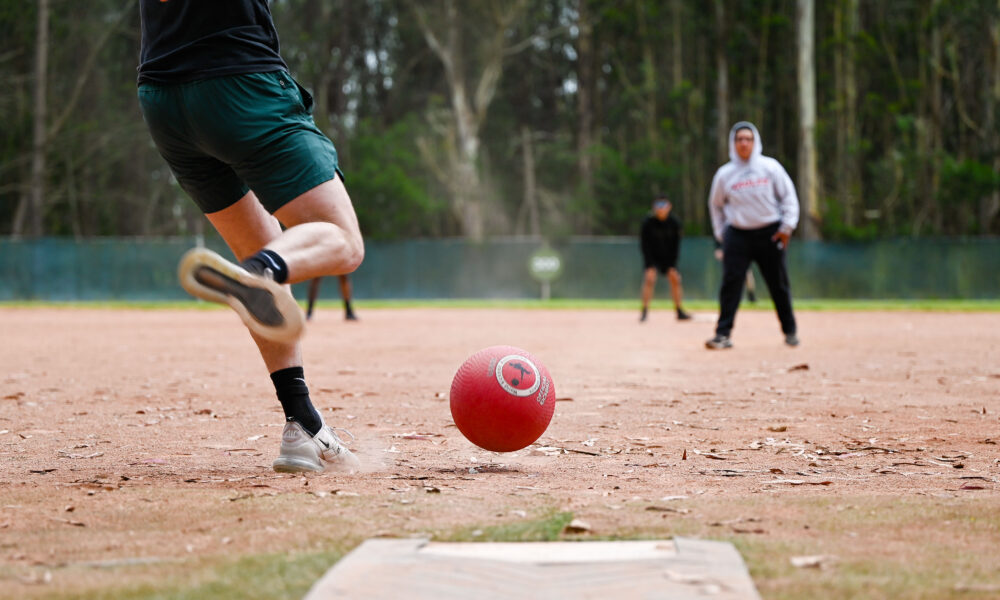

Quick answer: Kickball is a baseball-style game in which a pitcher rolls a large rubber ball to a kicker, who kicks it and runs first, second, third and home to score a run. Fielders can get runners out by catching a kick, making a force play at a base or tagging a runner with the ball. Teams normally swap kicking and fielding after three outs. The exact strike count, inning length and safety rules depend on whether you’re playing adult league kickball or a schoolyard version.
This guide uses the World Kickball Association’s published adult rules as one clear reference, and compares them with the Playworks playground version. Check your league’s local rulebook before a competitive match: there is no single set of rules used by every school, park and adult tournament.
How to play kickball: the basic sequence
- Mark four bases in a diamond: home, first, second and third. Use a safe playing area with plenty of open space.
- Divide players into two teams. One team kicks while the other fields. Decide the kicking order before play begins.
- Roll the ball toward home plate. The pitcher sends a legal rolling pitch toward the kicker rather than throwing a baseball-style pitch through the air.
- Kick from the designated kicking area. The kicker strikes the ball with the foot or lower leg, then runs toward first base.
- Field the ball and attempt an out. Catch it in the air, make a force out at an occupied base, or tag the runner as the applicable rules allow.
- Score runs and change sides. A legal runner who safely touches all four bases in order earns one run. Three outs ordinarily end the kicking team’s half-inning.
For a first game, agree on how many innings to play, whether thrown-ball tags are permitted, the foul-ball limit and whether the pitcher or an adult supervises. Those choices prevent most beginner disputes.
Kickball rules at a glance: adult league vs. playground
| Question | WAKA adult rule set | Playworks schoolyard guide |
|---|---|---|
| Fielders | 8–10 at a time, including pitcher and catcher | Two equal teams; positions spread across field |
| Typical game limit | Seven innings or up to 55 minutes under its regulation-game provisions | Flexible activity length; switch after three outs or nine runs |
| Base spacing | 60 feet between adjacent bases | 60 feet between bases for its standard layout |
| Strikeout | Three strikes | Playworks emphasizes fouls and outs rather than a universal strike-count rule |
| Foul-ball out | Three fouls, counted separately from strikes | Three fouls by one kicker |
| Ball-four walk | Four balls, with a special two-base award for a qualifying four-pitch walk | No equivalent universal adult-style walk count in the basic guide |
| Hitting runner with thrown ball | Ball tags permitted with head/neck protections | No throwing the ball at a player in the standard youth variation |
| Sliding and stealing | No leading off or stealing; see league’s other running restrictions | No sliding in the Playworks safety version |
Important: The two columns describe different published formats, not two options within a single match. Your league, gym teacher or recreation organizer can choose additional house rules.
How many players are on a kickball team?
A schoolyard game works with two reasonably balanced groups, while WAKA requires between eight and ten fielders on defense, including a pitcher and catcher. More players may be on the roster and in the kicking lineup. Adult teams typically use an orderly rotation; teams should exchange or agree on the kicking lineup before the game. You don’t need a baseball-sized squad to play informally, but moving the bases closer and using fewer fielders may be safer for small groups.
Kickball field dimensions and equipment
WAKA’s diamond uses 60-foot base paths. Its pitching strip is about 42 feet 5 inches from home plate, and its specified game ball is a roughly 10-inch red rubber kickball inflated as the rulebook directs. For neighborhood play, use four visible bases or flat markers, a soft rubber ball suitable for the players’ age and non-slip athletic shoes. Keep spectators outside the running lanes. Do not assume a standard baseball pitching mound or regulation baseball will work safely for kickball.
Where does the kicker stand?
In WAKA rules, kicks must be made at or behind home plate, with the plant foot appropriately positioned in the kicking box; an illegal kick in front of the plate can be called foul. Playworks also tells beginners to kick from behind home. Have players practice where to plant their non-kicking foot before their first inning.
Strikes, balls and fouls in WAKA kickball
A strike is a legal pitch in the strike zone that the kicker does not kick, or an attempted kick that misses. Three strikes make an out. A ball is generally a pitch outside the legal strike zone that the kicker leaves alone, or an illegal pitch such as one that fails the rolling or bounce requirement. Four balls normally award first base. Under WAKA’s distinctive four-pitch-walk provision, a kicker who is walked in exactly four pitches with no strike or foul can be awarded second base instead.
A foul is a kick that meets the format’s foul criteria, including certain balls first contacting the ground in foul territory, or kicks from an illegal position. WAKA treats fouls separately from strikes: the third foul is an out, and a foul never itself counts as a strike. This is not identical to baseball’s common two-strike foul handling. In Playworks, three fouls likewise result in an out. If you’re running a park game, announce before playing whether fouls count as strikes or are tracked separately.
Simple foul-ball example
A player kicks the ball down the first-base side. It lands foul before passing first base, without a fielder legally making it fair. Under the WAKA rules, record a foul. If that same player reaches three fouls in the plate appearance, they’re out even if they have not reached three strikes. Local league interpretations of fair/foul contact may vary.
What counts as an out in kickball?
- Caught ball: a fielder catches the kicked ball under the applicable catching rule.
- Force out: a fielder controls the ball while touching a base a runner is forced to reach, before the runner arrives.
- Ball tag: a fielder legally tags a runner with a held or thrown ball while the runner is off a base, as the competition rules permit.
- Strikeout or foul-out: a kicker reaches the format’s strike or foul limit.
- Running violation: for example, leaving a base early under WAKA’s no-leading-off rule, passing another runner or interfering with a fielding play.
A force out does not require tagging the runner’s body when the defender with the ball gets to the required base first. A tag out normally requires touching the runner when they are not forced to the next base. The same underlying distinction appears in baseball; our force out vs. tag out explanation uses detailed base-running examples to clarify it.
Can you throw the kickball at a runner?
It depends on the format. Adult WAKA rules allow qualifying thrown-ball tags but prohibit dangerous head and neck hits, with exceptions and interpretation details in the rulebook. Playworks’ standard recess rules explicitly prohibit throwing the ball at a player, making a hand-held ball tag or force play the safer choice for children. Do not apply adult ball-tag rules to a youth game without first agreeing on safety requirements.
Base running, overthrows and scoring
After a legal kick, runners advance in order: first, second, third and home. One completed circuit scores one run. In WAKA, runners cannot steal or lead off before a kick, and a runner generally must tag up before advancing after a caught fly ball. WAKA also restricts the number of additional bases a runner can take on certain overthrows into foul territory: its one-base limitation is a ceiling, not an automatic awarded base. Playworks uses a simplified one-base-on-overthrow rule for beginner games.
Teams trade roles after three outs in most formats. A single inning is complete only after both sides have had a turn to kick. In informal games, agree on a time limit or number of innings up front, rather than assuming everyone uses seven. If the game is tied when the limit arrives, agree before the opening pitch whether a tie stands or an extra inning will be played.
Six calls that cause arguments (with examples)
| Situation | Practical ruling to check |
|---|---|
| The kicked ball is caught in the air. | The kicker is out; runners may need to tag up before advancing. |
| A runner is going from first to second, and the defender with the ball touches second first. | Normally a force out when that runner must advance. |
| A fielded ball hits a runner above the shoulders. | Not a legal thrown-ball out under WAKA’s head/neck protection; school rules may prohibit all thrown-ball tags. |
| The kicker makes an attempted swing and completely misses. | A strike under the WAKA adult rule set. |
| The runner leaves first base before the ball is kicked. | Out under the WAKA no-leading-off rule. |
| The ball is thrown out of bounds in an overthrow. | Check the particular league’s advancement rule; WAKA limits advancement on certain overthrows. |
How to organize a beginner kickball game in 10 minutes
Place bases, mark clear foul boundaries, divide players into balanced teams, choose a pitcher and catcher, and agree on a consistent kicking order. Tell everyone the inning or time limit, the strike/foul rule, whether you use thrown-ball tags, and how play stops once a pitcher regains control. A trial half-inning is useful for explaining force outs and safe base running without keeping score.
For children or mixed abilities, the no-thrown-ball-tag approach from Playworks is a sensible safety default. For adults preparing for a recreational league, use that league’s actual rulebook. If you’re also learning about defensive roles, see our guide to baseball fielding positions; the sports use related diamond concepts, but the sports’ rules and permitted actions are not identical.
Kickball rules FAQ
How many outs end an inning in kickball?
Three outs normally end a team’s half-inning. Playworks offers a beginner rule that can also end a turn after nine runs.
Does kickball use three strikes or three fouls?
The published WAKA rules use three strikes for an out and three separately counted fouls for an out; not every school or league uses exactly the same rule.
How many bases does a kickball player run?
Four in order: first, second, third and home. Returning safely to home after the circuit scores one run.
Do you kick the ball from home plate?
Yes. The kicker strikes the rolled ball from the prescribed position at or behind home plate; league rules specify the kicking-box details.
Can you play kickball with fewer than ten people?
Yes, informally. Use balanced teams and a smaller safe field, and agree on any house rules. Formal adult competition may require more participants; WAKA’s defense minimum is eight fielders.
Are kickball rules the same as baseball rules?
No. Both use bases, innings and runs, but kickball uses a rolled rubber ball kicked by foot, and the details of strikes, fouls, tags and field dimensions differ.
Bottom line: For a casual game, agree on three outs, orderly base running, boundaries and a safe tagging method. For a competitive game, read the organizer’s current rulebook and do not mix adult WAKA provisions with playground rules without making the differences clear.