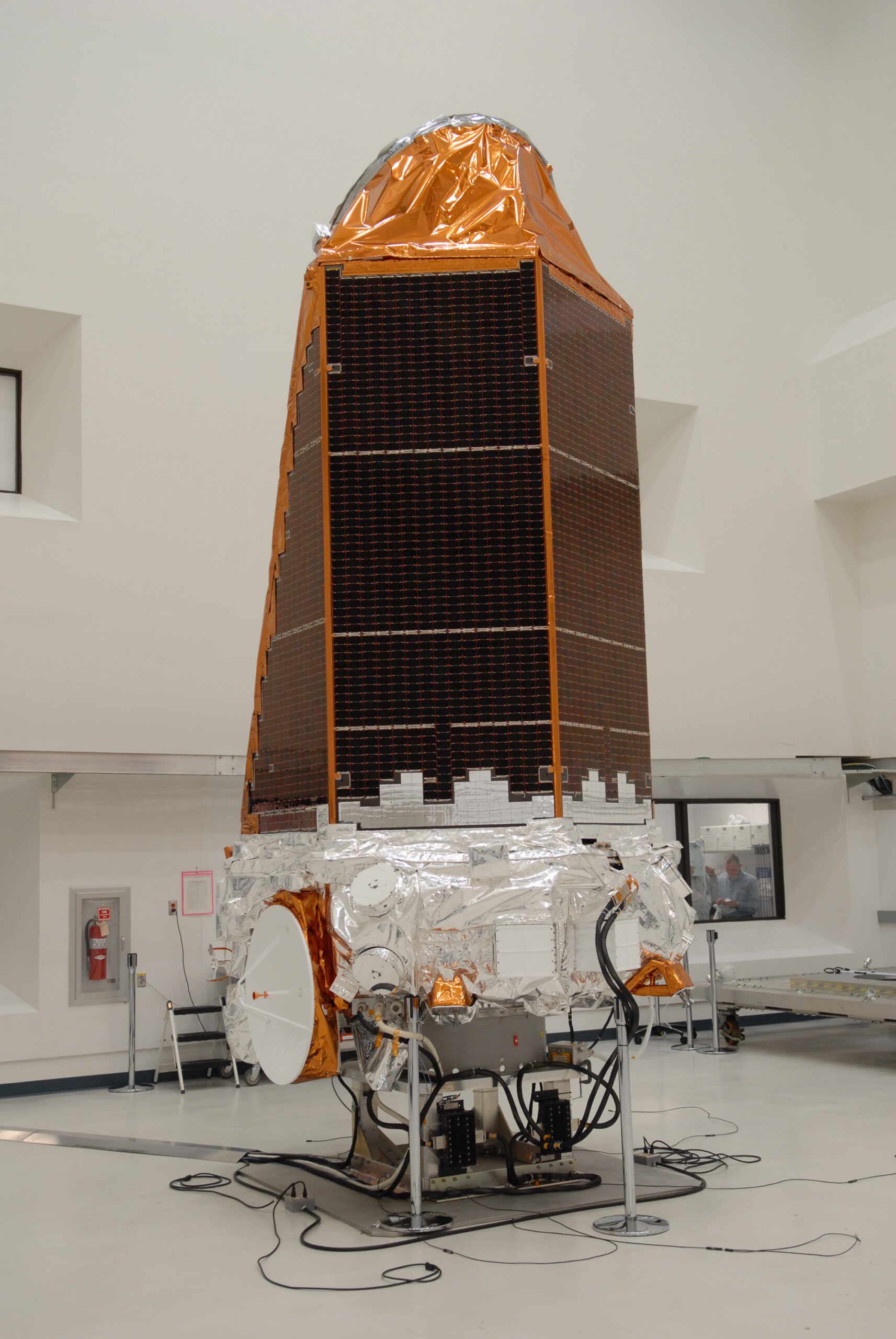
Quick answer: NASA’s Kepler spacecraft was a space telescope that searched for planets outside our solar system by watching stars for tiny, repeated dips in light. It launched from Florida on March 6, 2009 (US Eastern time; March 7 UTC), spent years collecting evidence for thousands of exoplanets, and was retired after it ran out of fuel in October 2018. The photograph of Kepler in this guide shows the actual spacecraft in a Florida processing facility, not a computer rendering.
Kepler spacecraft: facts at a glance
| Question | Answer |
|---|---|
| Mission operator | NASA, led by Ames Research Center with other mission partners |
| Spacecraft type | Space telescope / photometer optimized for precision brightness measurements |
| Launch | Delta II rocket, March 6, 2009 EST (March 7 UTC), Cape Canaveral |
| Orbit | Earth-trailing orbit around the Sun, not low Earth orbit |
| Original observing strategy | Monitor the brightness of stars in a fixed region of sky continuously |
| 2013 setback | A second reaction wheel failed, ending the original pointing configuration |
| Extended mission | K2, using solar radiation pressure and the two surviving wheels |
| Mission ended | October 2018, after depletion of maneuvering fuel; final commands in November |
| Legacy | More than 2,600 confirmed exoplanet discoveries cited by NASA at retirement |
What did Kepler look like in real life?
Many web results show a stylized gold telescope floating above Earth, but those are artists’ concepts. Actual NASA launch-processing photographs show the tall, covered telescope spacecraft with solar-cell surfaces, antennas and a thermal-blanket-wrapped structure. The featured image on this page was taken of the real telescope at the Astrotech facility in Titusville, Florida, on January 30, 2009, before it was launched. Kepler is visibly a machine designed to hold an exceptionally steady pointing direction, not a spacecraft built to fly close to individual planets.
Its main scientific instrument was a photometer using a telescope and detector array to measure the brightness of many stars at once. Because the sought-after brightness changes can be extremely small, stable pointing, calibration and repeated measurements mattered more than spectacular-looking planetary close-ups.
How did Kepler find planets it could not photograph?
Kepler relied on the transit method. A planet that crosses in front of its star from Earth’s line of sight blocks a little starlight, making the star appear to dim for a short time. If that dip repeats at a consistent interval and passes further analysis, it can signal an orbiting planet. The repeat interval helps estimate the planet’s orbital period; the fraction of light blocked helps estimate planet size relative to the star.
A simple example
Imagine a star whose brightness drops for several hours, then recovers, and shows the same type of drop again a set number of days later. That regularity might suggest an orbiting object, but it is not automatic proof. Starspots, eclipsing binary stars, instrument behavior and other phenomena can mimic part of the signal. Researchers examine the light-curve shape, consistency, nearby stars and independent follow-up observations before announcing a confirmed planet.
What Kepler could and could not determine
| What the data often tell scientists | What a transit alone does not prove |
|---|---|
| Whether repeated dips are consistent with a planet | That life exists on the planet |
| An approximate planet radius when star size is known | Direct surface photographs |
| Orbital period and relative distance clues | Whether surface water actually exists |
| Multiple transiting planets around one star | Planet mass without other constraints |
Important: “In the habitable zone” means a planet receives an amount of starlight that could allow liquid water under certain atmospheric conditions. It is not synonymous with habitable, Earth-like, or inhabited.
Why did the first Kepler mission end in 2013?
Kepler carried four reaction wheels that helped control its pointing. One failed in 2012, and a second failed in May 2013. The original precise three-axis pointing plan required at least three operating wheels, so NASA could no longer operate the original observing program as intended. This was an engineering failure, not evidence that Kepler had found nothing or that the telescope optics had stopped working.
NASA and its partners then developed a different strategy rather than simply giving up on a largely functional observatory.
What was K2, and how did it use sunlight?
K2 was the second operational phase of the same spacecraft. By positioning the telescope relative to the Sun so the pressure of sunlight helped balance the spacecraft, engineers could maintain useful stability with the two remaining reaction wheels and occasional thruster corrections. Instead of staring at the original star field for years, K2 examined a series of fields near the plane of Earth’s orbit, typically for shorter campaigns.
The difference matters when comparing Kepler data sets: the original mission’s long, continuous observations were particularly suited to finding long-period transits, whereas K2 surveyed additional directions and enabled diverse studies—including variable stars and some phenomena closer to home.
What did Kepler discover?
Planets are common, including small ones
Before Kepler, confirmed exoplanets were a much smaller catalog, often biased toward large planets easiest to detect. By repeatedly watching many stars, Kepler helped reveal how common smaller planetary systems are. NASA’s 2018 retirement announcement credited the mission with more than 2,600 discovered exoplanets. Do not treat this historical number as a permanently fixed 2026 count: later archive analyses can add planets, and different catalogs distinguish candidates from validated or confirmed worlds.
Some stars host several planets
Multiple recurring signals around a single star showed that multi-planet systems are not rare oddities. Their relative timing, apparent sizes and orbital patterns offered insight into how planetary systems form and vary.
Kepler changed questions for future telescopes
Kepler’s major contribution was a statistical one: it moved astronomers from asking whether planets around other stars exist to asking how often particular classes of planets occur. Later missions use different observing methods and targets to learn more about the planets Kepler and other surveys revealed.
Why Kepler was not the same as Hubble or the Roman Space Telescope
| Mission | Principal role | How the observing strategy differs |
|---|---|---|
| Kepler (retired) | Repeated precision brightness measurements for transiting exoplanets | Long monitoring of stellar light curves |
| Hubble | General-purpose observations across multiple astronomy fields | Imaging and spectroscopy of many targets |
| Nancy Grace Roman Space Telescope | Wide-field astronomy and other science objectives | Designed for a broad survey capability, not a continuation of the Kepler spacecraft |
Learn how one historical Hubble observing campaign worked in our Hubble Deep Field explainer. For the design and schedule of a newer survey telescope, see the Roman Space Telescope mission guide.
Why did NASA end Kepler’s mission in 2018?
Kepler eventually exhausted the fuel it needed for positioning and pointing. NASA announced its retirement on October 30, 2018. The spacecraft remained in a safe orbit around the Sun rather than falling to Earth, and NASA sent its final shutdown commands on November 15, 2018. It cannot send new observations in 2026. News stories about Kepler discoveries today generally mean fresh interpretation of observations Kepler collected years earlier.
Frequently asked questions
Is the Kepler spacecraft still working?
No. The spacecraft’s mission ended in 2018. Historic scientific data remain available for analysis.
Did Kepler launch on March 6 or March 7, 2009?
Both dates can appear in sources because the launch happened late on March 6 in Florida (EST), which was already March 7 in Coordinated Universal Time (UTC).
Did Kepler directly photograph distant planets?
Its best-known discoveries came from stellar brightness changes, not close-up photographs of planet surfaces.
What caused the K2 mission?
The loss of two reaction wheels made the original continuous pointing approach unusable. Engineers created a solar-pressure-assisted observing method using the same telescope.
Were all Kepler discoveries Earth-like worlds?
No. The mission found many sizes and types of planetary candidates and confirmed planets. Size or a possible habitable-zone orbit does not establish Earth-like conditions or life.
Final takeaway
Kepler was a real, remarkable space telescope whose advantage was patient and precise measurement rather than planetary close-up photography. Its first observing approach failed after reaction-wheel losses, but K2 extended the useful life of the instrument. The confirmed discoveries helped transform modern exoplanet science, even though Kepler itself has been retired since 2018. For original records, see NASA’s technical mission history, the Kepler/K2 overview and NASA’s retirement announcement.