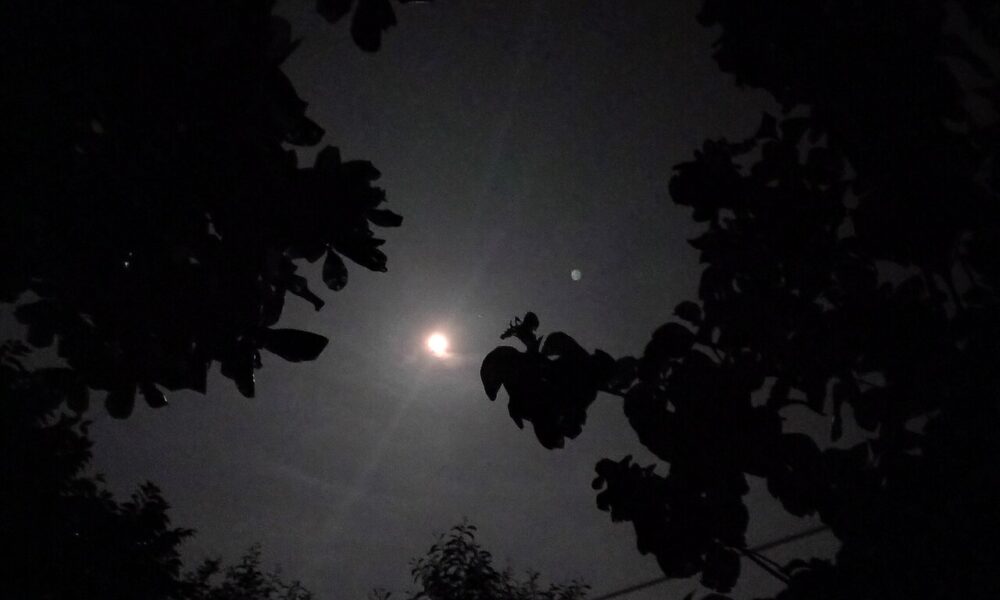

Quick answer (verified October 9, 2026): The October 2026 full Moon, traditionally called the Hunter’s Moon, occurs on Monday, October 26, around 04:11 UTC. That is approximately 12:11 a.m. Eastern Daylight Time on Monday and 9:11 p.m. Pacific Daylight Time on Sunday, October 25. The Moon will look nearly full to most observers on both surrounding evenings, so a precise one-minute alarm is not required.
What date and time is the October 2026 full Moon?
The astronomical full Moon is a single instant when the Moon is on the opposite side of Earth from the Sun in its monthly cycle. The event happens simultaneously worldwide, but calendars disagree about the local date when converted into time zones. Sources including Space.com’s 2026 full Moon calendar and Star Walk’s October 2026 guide place the peak at approximately 04:11 UTC on October 26.
| Location/time zone | Approximate full Moon instant |
|---|---|
| UTC | Monday October 26, 04:11 |
| U.S. Eastern Daylight Time | Monday October 26, 12:11 a.m. |
| U.S. Central Daylight Time | Sunday October 25, 11:11 p.m. |
| U.S. Mountain Daylight Time | Sunday October 25, 10:11 p.m. |
| U.S. Pacific Daylight Time | Sunday October 25, 9:11 p.m. |
The full Moon looks almost fully illuminated for a couple of days around the exact instant. A clear view on the evening of October 25 could be better than a cloudy October 26 in your city.
Why is it called the Hunter’s Moon?
The traditional name describes the first full Moon after the Harvest Moon, rather than an astronomical change in the Moon itself. Historic Northern Hemisphere folklore associated the bright evening moonlight after harvest with seasonal hunting. The name usually belongs to an October full Moon, but some years the Harvest Moon shifts into October and the Hunter’s Moon follows in November.
The Moon is not physically larger or more orange because it is called the Hunter’s Moon. Color near moonrise is influenced by the long atmospheric path its light travels through and by haze or dust. A red or orange appearance does not, by itself, mean a lunar eclipse or a “blood Moon.”
Best time to see the Hunter’s Moon in the United States
Choose a safe spot with a clear eastern horizon around local moonrise on October 25 or October 26. A nearly full Moon rises around the time the Sun sets, although the exact minute varies with latitude, local terrain and the date. You will usually see it rise in the east and then move higher across the night sky.
Near the horizon, foreground trees, hills or buildings can help with photography, provided the view is unobstructed where the Moon appears. The popular illusion of a bigger Moon near the horizon comes largely from human perception and the context of nearby objects, not from a sudden dramatic increase in its true angular diameter.
Is the Hunter’s Moon a supermoon in 2026?
No, the October 26 full Moon is not categorized as a supermoon by the astronomical guidance cited here. “Supermoon” is an informal term tied to the full Moon’s proximity to its closest orbital distance from Earth, and different publishers may use slightly different numerical thresholds. Do not assume that every impressive-looking Moon near the horizon qualifies.
Will the Moon be full on Halloween 2026?
No. Halloween is October 31, five days after the full Moon peak, so the Moon will be in a waning gibbous phase. It can still look notably bright, but it will not be astronomically full that night. The words “Halloween full Moon” often appear in themed artwork and social posts even in years when the real lunar calendar does not support them.
How to photograph the October full Moon
- Check a reliable moonrise/moonset app for your exact city, then scout an open eastern location while there is daylight.
- Use a tripod or stable support to keep the shot sharp, especially with a phone’s telephoto lens.
- Reduce exposure when the lunar disc looks like a white blob; the Moon is much brighter than the surrounding night sky.
- Try a foreground silhouette for context, but avoid presenting a composited enlarged Moon as a documentary photograph.
- Note the time and location in a caption so a real photo is not mistaken for a generic image.
For a separate late-October scene, the Moon will appear close to the Pleiades star cluster on October 27–28 according to NASA’s October skywatching guide. The Pleiades will be fainter than the full Moon, so binoculars and dark surroundings may improve the view. AVARIXO’s previously published Draconid meteor guide covers a different event earlier in October.
Hunter’s Moon October 2026 FAQ
Why do some websites say October 25 instead of October 26?
Because the same instant converts to Sunday evening in western U.S. time zones and Monday morning in UTC and U.S. Eastern time.
Does the Moon become fully illuminated for only one minute?
No. The exact peak can be given as a moment, but brightness changes gradually. For casual stargazing, the neighboring evenings look nearly full.
Does everyone see an orange Moon?
No. Its perceived color varies with atmospheric conditions and how low it is. A Moon high in a clear sky often appears pale or white.
Is the featured image the October 2026 Hunter’s Moon?
No. It is an archival 2024 full Moon photograph shared under CC0 by Mahjuja Islam through Wikimedia Commons. The October 2026 event has not happened at the time of this article.
Sources: Space.com 2026 full Moon calendar, Star Walk October 2026 full Moon, and NASA observing guidance. This article was fact checked October 9, 2026. All times are approximate; exact moonrise must be localized.