
Draconid Meteor Shower October 9, 2026: Can You Still See It Tonight?
Quick answer — checked Friday, October 9, 2026: The Draconid meteor shower reached its predicted peak around 01:00 UTC on October 9, or 9:00 p.m. Eastern on Thursday, October 8. The main peak has therefore passed for U.S. viewers checking on Friday morning. However, the broader Draconid activity window runs roughly October 6–10, so skywatchers may still glimpse an occasional Draconid after dark Friday night. Do not expect a repeat of peak activity or a meteor storm. NASA describes this as a normally modest shower producing only a few meteors per hour. (NASA’s October skywatching forecast; timeanddate.com’s 2026 peak forecast.)
If you came here after searching “meteor shower tonight,” the most useful distinction is peak timing versus remaining activity. A sky can be dark and clear on October 9 without delivering the shower’s expected maximum. The viewing guide below separates those two possibilities and explains how to pick a location rather than relying on viral claims about a guaranteed spectacular display.
Has the 2026 Draconid meteor shower already peaked?
Yes, by the time of this Friday-morning update. The published maximum was about 01:00 UTC on October 9. This was Thursday evening, October 8 in U.S. time zones. The distinction explains why one astronomy site may call the peak “October 8” and another “October 9”—they are describing essentially the same instant in different time zones.
| Time zone | Approximate predicted 2026 maximum | What it means |
|---|---|---|
| UTC | Fri, Oct 9 at 1:00 a.m. | Reference prediction |
| Eastern daylight time | Thu, Oct 8 at 9:00 p.m. | After dark in much of the East |
| Central daylight time | Thu, Oct 8 at 8:00 p.m. | Near early evening |
| Mountain daylight time | Thu, Oct 8 at 7:00 p.m. | May be around twilight |
| Pacific daylight time | Thu, Oct 8 at 6:00 p.m. | Could be before full darkness |
These times describe the predicted maximum not a scheduled showtime. An individual meteor can appear before or after a shower’s nominal peak, and observing depends on weather, local twilight, horizon, radiant altitude and nearby lights. The timeanddate Draconids page offers a location-based interactive sky map.
Will there be Draconids on Friday night, October 9?
Possibly a few, but the odds are lower than during Thursday’s peak. Astronomy calendars give October 6–10 as the wider seasonal activity period, though the most concentrated stream of debris has already been crossed. The American Meteor Society’s 2026 calendar treats the Draconids as a variable shower that often produces very sparse activity, with rare exceptional years. A quiet evening is a normal outcome, not evidence that the forecast was wrong.
For anyone with a clear northern view and an easy access to a genuinely dark location, a short observing session after twilight can still be worthwhile. But driving for hours specifically to see a major Friday-night Draconid display would not be supported by the published forecast. For U.S. cities farther south, the radiant is lower; cloud cover and street lighting can matter more than differences between time zones.
Where should you look for the Draconids?
Start after dusk in the Northern Hemisphere
The Draconids are unusual among annual meteor showers because early evening is generally preferable to staying awake until dawn. Their apparent radiant lies in Draco the Dragon, in the northern sky near the Little Dipper and the Big Dipper. The radiant helps astronomers identify a shower, but a meteor can streak across a wide area of sky; staring directly at one star is not necessary.
Choose darkness over a telescope
Find a safe, publicly accessible viewing area away from brightly lit parking lots and illuminated screens. Look toward the broad northern or northwestern sky, but give yourself a wide open view. Let your eyes adapt for 20–30 minutes, keep your phone dim, and use a reclining chair or blanket. Meteor watching is a naked-eye activity: a telescope magnifies too small a patch of sky to help you catch random streaks.
Check clouds, rain and safety
A mostly clouded sky cannot reveal a meteor shower, no matter how favorable the astronomy forecast. Check your local hourly cloud-cover forecast and an accessible sky map before setting out. Stay on permitted trails or public land, bring warm layers, and do not stop along busy roads to view a fireball. Travel to a remote site is optional, not a prerequisite for enjoying the night sky.
How many meteors per hour should viewers expect?
For 2026 the expected zenithal hourly rate is approximately five under idealized conditions, according to timeanddate’s account of International Meteor Organization projections. A zenithal hourly rate is an adjusted reference value; it does not mean every observer will count five meteors each hour. Real-world counts may be zero in a bright city and higher at a dark, properly positioned site near peak. Counts Friday evening after peak could be lower still.
Historical Draconid storms in years such as 1933 and 1946 are scientifically interesting, but they do not justify social-media predictions that hundreds of meteors will fill the sky in 2026. NASA calls this year’s event modest; no mainstream forecast cited here predicts a major outburst. Keep expectations proportional to the evidence.
Does the Moon help visibility in October 2026?
Yes. NASA notes that the nearly new Moon causes little interference around the October 8–9 peak. Dark lunar conditions improve the chance of seeing faint meteors when they occur, but they cannot increase how many pieces of comet debris Earth actually encounters. Light pollution from streetlights and buildings can still overwhelm that advantage, so a darker viewing location helps more than expensive binoculars.
Why are the Draconids different from the Perseids?
The Draconids are linked to particles shed by Comet 21P/Giacobini-Zinner; the Perseids come from Comet Swift–Tuttle and usually peak in August. Both produce streaks when dust-sized particles enter Earth’s atmosphere and heat the air around them. The key practical distinction is that the Draconid radiant sits favorably for early-evening observations in the north, while many other showers are better around dawn.
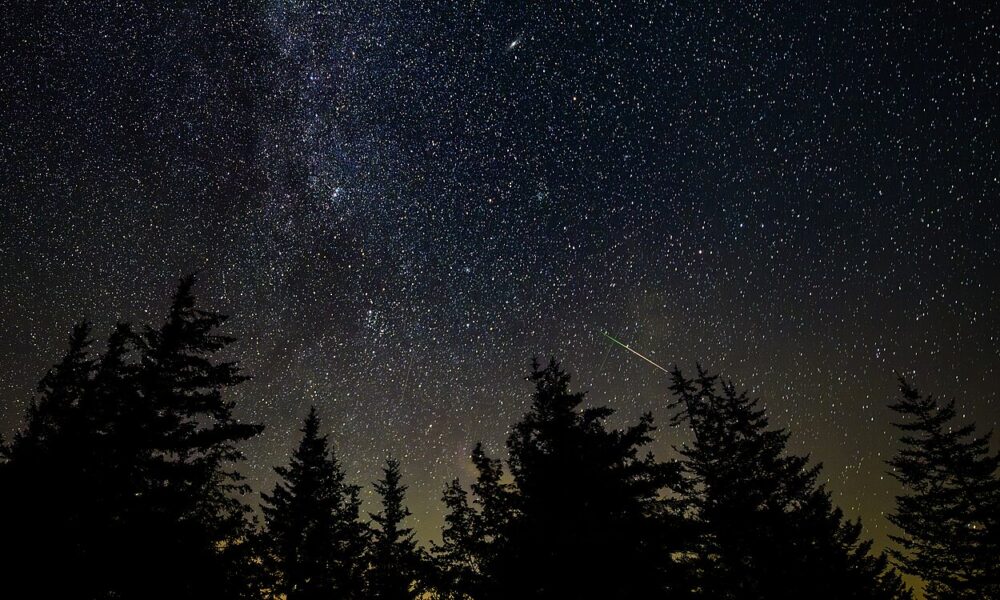
The featured image accompanying this article is an archival NASA photograph of a meteor from August 2025 during other showers, not a photograph of the October 2026 Draconids. It is included to illustrate what a meteor trail can look like, not to claim a recorded 2026 sighting. Photo credit: NASA/Bill Ingalls; public-domain source and caption.
What is the next meteor shower after the Draconids?
The Orionids, sourced from debris associated with Halley’s Comet, become the next prominent October shower to plan around. NASA identifies October 21 as the Orionid peak, noting that the best dark-sky interval arrives after the Moon sets in the early hours. This is a different shower: a missed Draconid peak does not mean the next chance for shooting stars is a year away.
For more science coverage, see AVARIXO’s World Space Week 2026 explainer and its report on NASA’s Artemis II science data release. These are separate astronomy and space topics, not sources of live meteor counts.
Frequently asked questions
Is the meteor shower tonight, October 9?
The 2026 Draconid peak occurred October 8 in U.S. evening hours, which was October 9 UTC. A small number of meteors may remain visible Friday night, but the strongest predicted activity has passed.
Is it still worth going outside Friday evening?
It can be if your sky is clear and dark and you enjoy casual stargazing. Expect few meteors; do not plan around an advertised meteor storm.
What time should I look?
After local darkness falls in early evening, rather than relying on a universal start time. The predicted maximum was Thursday evening in U.S. time zones.
Can the Draconids be seen from New York, California or Texas?
Potentially, weather and darkness permitting, although northern locations generally favor the Draco radiant. City lights, horizon obstruction and timing can limit actual visibility.
Do I need binoculars or a telescope?
No. Meteors can cross a wide section of sky quickly, so looking with the naked eye is better.
Is a giant Draconid meteor storm expected this year?
No. Historical storm years do not imply one in 2026; typical forecasts call for a modest display of a few meteors under ideal conditions.
Sources and verification: NASA October 2026 sky events; 2026 Draconid peak and visibility forecast; American Meteor Society’s 2026 meteor-shower list; NASA photographic source. Updated October 9, 2026, after the predicted maximum; this guide does not claim real-time sighting measurements.