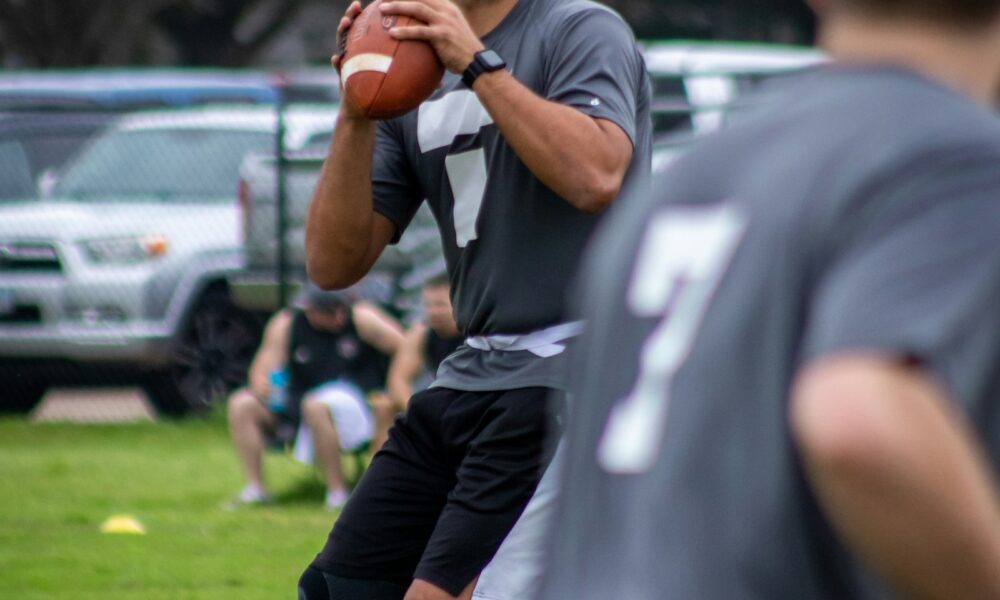

Quick answer: The most useful flag football drills for beginners develop five skills: catching, throwing, changing direction, running routes and pulling a flag without tackling. You can teach them with a football, several cones or markers, flag belts and a clear practice area. Start with stationary or walk-through repetitions, then add movement and game-like decisions. Below are nine non-contact drills, followed by a realistic 45-minute practice plan and ways to adapt the activities for different ages.
Reviewed October 13, 2026. This is an educational practice template, not an officially certified coaching curriculum. Check the age, safety and gameplay rules of your actual league.
Before practice: what equipment do you need?
- An age-appropriate football; a softer or smaller ball may be easier for new catchers.
- Four to twelve cones or clearly visible markers.
- Flag belts with flags fitted according to the league’s rules.
- A safe, flat playing area with no holes, obstacles or moving traffic.
- Water, a first-aid contact and enough adult supervision for the group’s age and size.
Keep drills non-contact. Flag football is designed around removing flags rather than driving into an opponent. Avoid tackling, blocking, shoving, dangerous dives and collision-based competitions. USA Football recommends age-appropriate practice loads and removing unnecessary high-risk contact drills; see its youth practice guidelines. Stop an activity if the field becomes slippery, conditions are unsafe, or a player reports pain or dizziness.
9 flag football drills that teach real game skills
1. Mirror steps: defending without contact
Setup: Place two parallel marker lines about 4 to 6 yards apart. Pair players facing each other, with comfortable separation. How: One player moves left and right between the markers; the other mirrors the movement with small, balanced steps. Swap the leader after 20 to 30 seconds. Coach cue: Stay low enough to change direction, keep your eyes on the ball carrier’s hips, and do not grab clothing or collide. Progression: The leader makes a final controlled forward move toward an open cone.
2. Two-cone burst: accelerate, brake, change direction
Setup: Put two cones roughly 5 to 8 yards apart, adjusting to age and available space. How: The player starts at one cone, accelerates to the next, slows under control, pivots and returns. Coach cue: Plant with balance and look toward the new running lane. Variation: Have the coach point to the destination cone at the start of the rep to train decision-making. Avoid all-out sprints on slippery surfaces.
3. Partner catch ladder: build reliable hands
Setup: Partners begin only a few yards apart. How: Throw five comfortable chest-height passes, then take a small step back if catches are clean. Include passes to the left and right, with enough space to avoid other groups. Coach cue: Track the ball, show the hands early and secure it before running. Progression: Add a two-step move before the catch, not a defender who makes contact.
4. Target passing: accuracy before power
Setup: Set a large, safe target zone between cones. How: Quarterbacks or any players who want to throw attempt several short passes to a receiver standing or jogging into the zone. Change the distance based on successful accuracy. Coach cue: Align feet, step toward the intended target and prioritize a controllable ball. New throwers can use two hands initially or shorten the target distance. Our football throwing mechanics guide explains grip, footwork and beginner passing practice in more detail.
5. Three-route tree: slant, out and go
Setup: Use cones to show three routes and a starting point. How: Receivers practice a short inside slant, a short outside-breaking out, then a straight go route. Run each first at walking speed, then at a controlled jog. The coach signals the route and, where possible, pairs it with a pass. Coach cue: Sell the initial direction, change speed smoothly and look for the ball at the appropriate moment. Variation: Ask receivers to identify open space rather than memorizing complicated patterns.
6. Flag pull from a stationary stance
Setup: One player wears a fitted belt and remains still; a defender approaches at walking speed. How: Practice reaching for a free-hanging flag and removing it cleanly without grabbing the belt, jersey or body. Exchange roles. Coach cue: Keep the head up and aim for the flag, not the player. Progression: The runner walks slowly along a marked lane. Keep the speed low until the technique and spacing are consistently safe.
7. Angle pursuit: intercept the route, not the person
Setup: A runner travels between two cones with a flag belt. The defender starts a few yards to the side. How: On the coach’s signal, the runner follows a predictable lane while the defender takes a controlled angle to get close enough to remove the flag. Coach cue: Run to the interception point instead of chasing directly from behind. Safety adjustment: Use a walking pace first; stop and reset any rep likely to cause contact.

8. Center-to-quarterback exchange
Setup: Pair a center and a quarterback with ample space behind them. How: Practice a league-legal snap and secure exchange while both players stand still. Then follow with one short step and a handoff or a simulated pass, depending on local rules. Coach cue: Smooth timing and secure hands come before speed. Important: Different flag leagues specify how the center and quarterback can advance or receive the ball; verify your league’s rulebook before adding a live defense.
9. Two-choice receiver read: make decisions
Setup: Two receivers line up several yards apart, one quarterback stands behind a start marker and a shadow defender watches from a safe distance. How: On the signal, receivers jog toward distinct open target zones. The defender steps toward one zone without contact. The quarterback identifies the uncovered receiver and passes. Coach cue: Read first, then throw; receivers keep routes far enough apart to avoid collisions. Progression: Rotate the decision-maker and adjust timing instead of adding physical pressure.
Quick comparison: which drill fixes which problem?
| Skill problem | Start with | Observe this outcome |
|---|---|---|
| Defenders overrun the ball carrier | Mirror steps + angle pursuit | Controlled change of direction and fewer missed angles |
| Players drop easy passes | Partner catch ladder | Eyes stay on the ball and hands secure the catch |
| Throws are too difficult to catch | Target passing | Ball reaches a comfortable target zone |
| Receivers crowd the same space | Three-route tree + two-choice read | Different, clearly defined running lanes |
| Flag pulls become rough | Stationary flag pull | Flags removed without grabbing clothing or contact |
| Offense drops the ball at the start | Center-to-quarterback exchange | Clean, calm handoffs and snaps |
A realistic 45-minute flag football practice plan
Trying all nine drills in one short practice would create long lines and little useful repetition. Choose three or four drills that match the team’s biggest needs, and reserve time for a small non-contact game. Here is one example for a new group; adjust to age, energy, weather and your league’s expectations.
| Time | Activity | Coach’s priority |
|---|---|---|
| 0:00–0:07 (7 min) | Warm-up and simple movement games | Check space, movement and readiness |
| 0:07–0:14 (7 min) | Partner catch ladder | High number of comfortable catches |
| 0:14–0:22 (8 min) | Stationary flag pull → walking flag pull | Remove the flag without contact |
| 0:22–0:30 (8 min) | Three-route tree + target pass | Route spacing and accurate short throws |
| 0:30–0:40 (10 min) | Controlled two-choice game or small-sided flag play | Use the skills under simple decisions |
| 0:40–0:45 (5 min) | Water, cool-down and recap | Name one skill improved and one to revisit |
Timing check: 7 + 7 + 8 + 8 + 10 + 5 = 45 minutes. Hydration should remain available throughout practice, not only in the final block; pause or shorten the schedule when conditions require it.
How to adapt drills by experience
New players
Shorten distances, use larger target zones and run more catches and flag pulls at a walking pace. Explain one rule or skill at a time. Make participation and safe control the measure of success.
Players with some experience
Add a moving target, make receivers choose between two routes and gradually reduce the time between a quarterback’s read and throw. Keep all contact prohibited in the drill.
Mixed-age or mixed-skill groups
Pair players by appropriate skill and physical development rather than simply sending the fastest players against the slowest. Rotate positions so everyone gets throwing, receiving and flag-pulling repetitions. Do not require exhausted or injured players to complete a final sprint.
Common coaching mistakes to avoid
- Too many drills: Less equipment and more repeated touches usually beat constant transitions.
- Long waiting lines: Create two identical stations if another adult can supervise.
- Using tackle drills: Avoid blocking and collision practices; they do not belong in a basic non-contact flag lesson.
- Only coaching the quarterback: Receivers, flag pullers and centers need meaningful attention too.
- Ignoring the league’s rules: Contact limits, rush lanes, handoffs, quarterback runs and no-run zones vary by competition. For the game basics, see our flag football rules guide.
Frequently asked questions
What are the best three flag football drills for complete beginners?
Partner catch ladder, stationary flag pulling and a short two-cone change-of-direction drill. Together they cover catching, safe defense and body control with little setup.
How long should a beginner flag football practice be?
That depends on the age, conditions and league. A 45-minute session can work for a simple beginner practice, but it is not a universal official requirement. For structured youth training considerations, review USA Football’s age-based practice recommendations.
Can you teach flag football with only two players?
Yes. Catching, throwing, mirroring, stationary flag pulls and route running can all be practiced in pairs. Keep throwing lanes clear and avoid contested catches when space is limited.
Do beginners need to practice tackling?
No. Flag football stops runners by removing flags under league rules. Beginners should train controlled positioning, pursuit and safe flag removal rather than tackling.
What is a good drill for players who miss flags?
Start with a stationary flag pull, then a walking runner. Make sure belts fit securely and teach the defender to target the flag without grabbing the player’s clothing or body. Add speed only when the technique stays controlled.
Are these drills official NFL FLAG rules?
No. They are a general educational coaching plan. For competition rules and sanctioned formats, use your league’s current rulebook; game formats and restrictions differ.
Takeaway: Use short stations, frequent ball touches and non-contact decision drills. A player who learns to catch, find space and pull a flag safely has a stronger foundation than one who simply completes a fast-looking workout.
Official references: USA Football Youth Football Practice Guidelines · USA Football Age-Based Practice Recommendations.

Other Articles

Untitled Boxing Game Codes (October 2026): Free Spins