
What is the Englund Gambit?
The Englund Gambit is an offbeat chess opening for Black that starts 1. d4 e5. Black immediately offers the e-pawn to tempt White into a tactical battle instead of a conventional queen-pawn opening. White can capture with 2. dxe5, and Black then tries to generate activity and regain the pawn.
The opening is often used as a surprise weapon in fast games. It is not generally regarded as one of Black’s most reliable defenses to 1.d4, so beginners should learn how to respond calmly rather than assuming the gambit guarantees a quick trap.
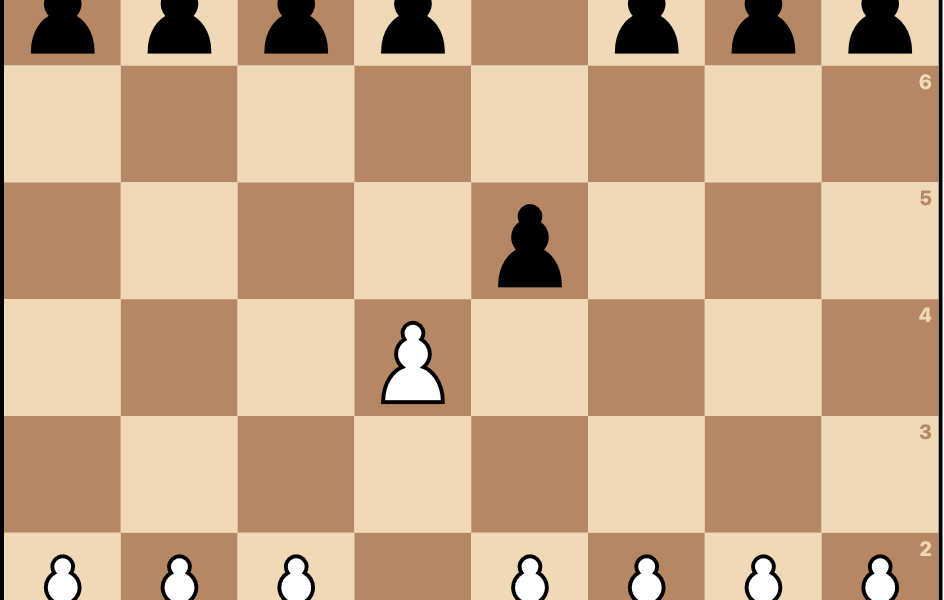
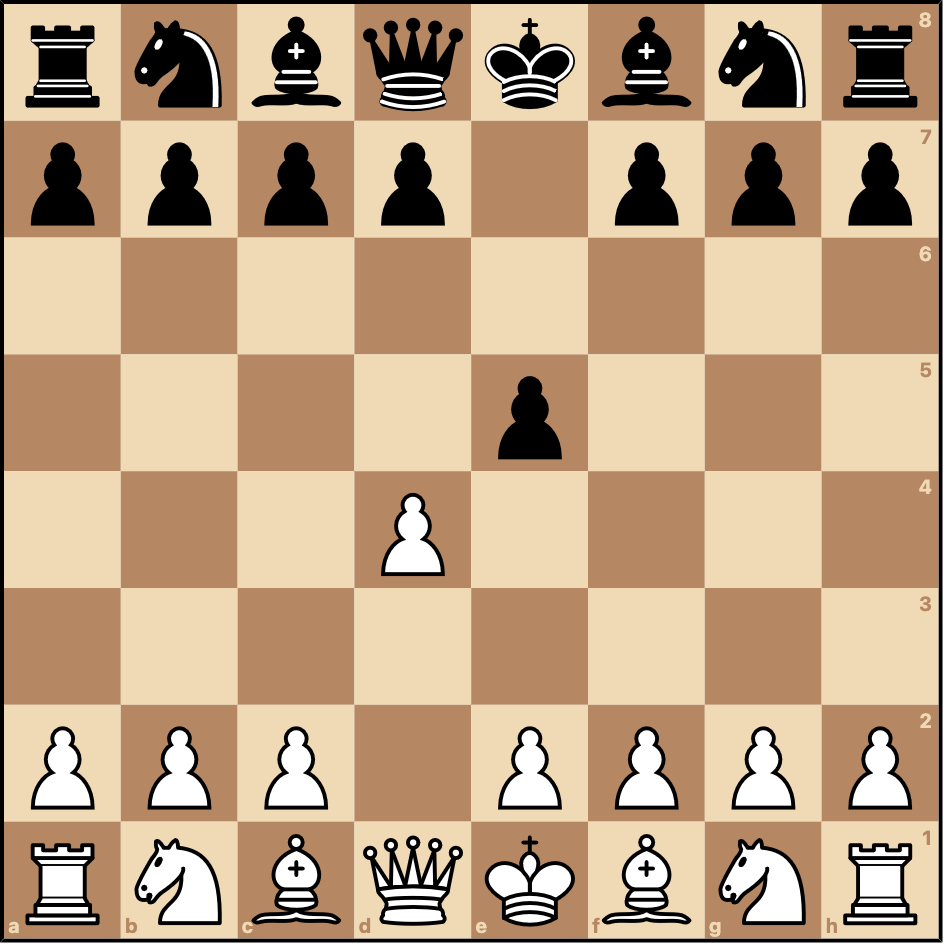
The starting position after 1.d4 e5
1. d4 e5
2. dxe5
White’s d-pawn advances to d4 and Black immediately plays …e5, placing the pawn where White can capture it. After 2.dxe5, Black has several ways to challenge the pawn, including …Nc6. White’s main practical task is to develop pieces while avoiding tricks against the queen and king.
A common Englund Gambit trap line
One popular trick follows 1.d4 e5 2.dxe5 Nc6 3.Nf3 Qe7 4.Bf4 Qb4+. Black attacks the b2 pawn while checking the king, trying to force White into awkward development. In some trap variations, an unprepared White player can lose material quickly.
However, the trap is not forced. White has sound defensive choices and can often keep the extra pawn or return it to finish development. The lesson is to calculate checks and threats rather than blindly copy a remembered line.
Why the Englund Gambit is risky for Black
Black spends a central pawn to gain activity, but White has not made an obvious weakness with 1.d4. If White develops naturally and avoids tactical tricks, Black may struggle to justify the pawn investment. Early queen moves such as …Qe7 and …Qb4+ can also give White targets for development.
That does not make the opening an automatic loss. In practical play, especially at faster time controls, surprise and unfamiliarity can create chances. But a player choosing it should understand that its objective opening reputation is less secure than mainstream defenses such as …d5 or …Nf6.
How White can respond to the Englund Gambit
- Recognize that 1…e5 offers a pawn.
- Consider 2.dxe5 and prepare for Black’s attempts to recover it.
- Develop knights and bishops while watching checks against your king.
- Do not move the queen to a vulnerable square just to defend a pawn.
- Calculate threats against b2, f2 and the central files.
- Return the extra pawn if doing so allows a clearly safer and better-developed position.
The best move depends on the exact position. A solid response should prioritize development and king safety over grabbing more material.
What Black is trying to achieve
Black typically wants rapid development, pressure on White’s center and tactical threats that compensate for the pawn. Moves such as …Nc6 and …Qe7 are designed to attack e5 and create concrete problems. If White becomes distracted by pawn defense, Black may gain time and activate pieces.
The danger for Black is that premature queen activity can become a liability. If White meets the threats accurately, the queen may be chased while White develops pieces and keeps a healthier position.
Englund Gambit versus the Budapest Gambit
Both openings involve Black offering a pawn in response to a queen-pawn setup, but they begin differently. The Englund Gambit starts immediately with 1.d4 e5. The Budapest Gambit typically begins 1.d4 Nf6 2.c4 e5, after Black has already developed a knight and White has played c4.
These distinctions affect the center, piece activity and theoretical evaluation. Do not treat the two gambits as interchangeable just because both feature …e5.
Should beginners play the Englund Gambit?
It can be a fun tactical exercise and a surprise choice, but it should not replace learning sound opening principles. Beginners who rely only on traps may win some quick games yet struggle when opponents respond accurately. A more balanced training plan includes mainstream responses to 1.d4, basic tactics and endgames.
If you choose the Englund, learn not only the trap lines but also what to do when White declines the bait or neutralizes the queen checks. For White, practice one reliable setup so you can respond confidently without memorizing every trick.
Common mistakes on both sides
- White: ignoring a check: The gambit often creates forcing queen moves, so calculate them first.
- White: holding the pawn at any cost: Development may be more important than material.
- Black: assuming the trap is forced: Accurate defense can leave Black a pawn down.
- Black: bringing the queen out too early: White may gain tempi by attacking it.
- Both: neglecting the center: Pawn breaks and piece activity matter after the opening trick ends.
Englund Gambit FAQs
What are the first moves of the Englund Gambit?
1.d4 e5. White can accept the pawn with 2.dxe5.
Is the Englund Gambit sound?
It is generally considered a dubious surprise weapon compared with mainstream defenses, although it can create practical tactical chances.
Does the Englund Gambit guarantee a trap?
No. The traps rely on inaccurate replies from White.
What is Black’s goal?
Black sacrifices or offers the e-pawn to gain activity and tactical pressure against White’s development.
Can White decline the gambit?
Yes. White is not forced to capture on e5, though accepting it is a principled option.
Takeaway
The Englund Gambit begins with 1.d4 e5 and invites immediate tactical play. Black needs compensation for the offered pawn, while White should develop calmly and check forcing moves before defending material. Learning the trap is useful, but understanding why it works—or fails—is the real skill. Review our chess notation guide if the move symbols are unfamiliar.

Other Articles

English Opening in Chess: 1.c4 Moves, Main Variations and Plans