
Quick answer, updated October 15, 2026: In discus track and field, an athlete tries to throw a weighted, round disc as far as possible into a marked landing area. At senior international level, the men’s discus weighs 2 kilograms (about 4.4 pounds) and the women’s weighs 1 kilogram (about 2.2 pounds). The standard throwing circle is 2.50 meters in diameter; the discus must land inside the 34.92-degree sector, and the athlete must remain in the ring until it lands and then leave via the rear half. The farthest legal throw wins—not the longest throw that happens to fly anywhere.
This practical guide explains official World Athletics rules, school-age implement weights, what judges measure, why throws are disqualified, and how beginners can practice safely. It also distinguishes the usual standing event from seated adaptive discus, which uses separate classification and competition rules.
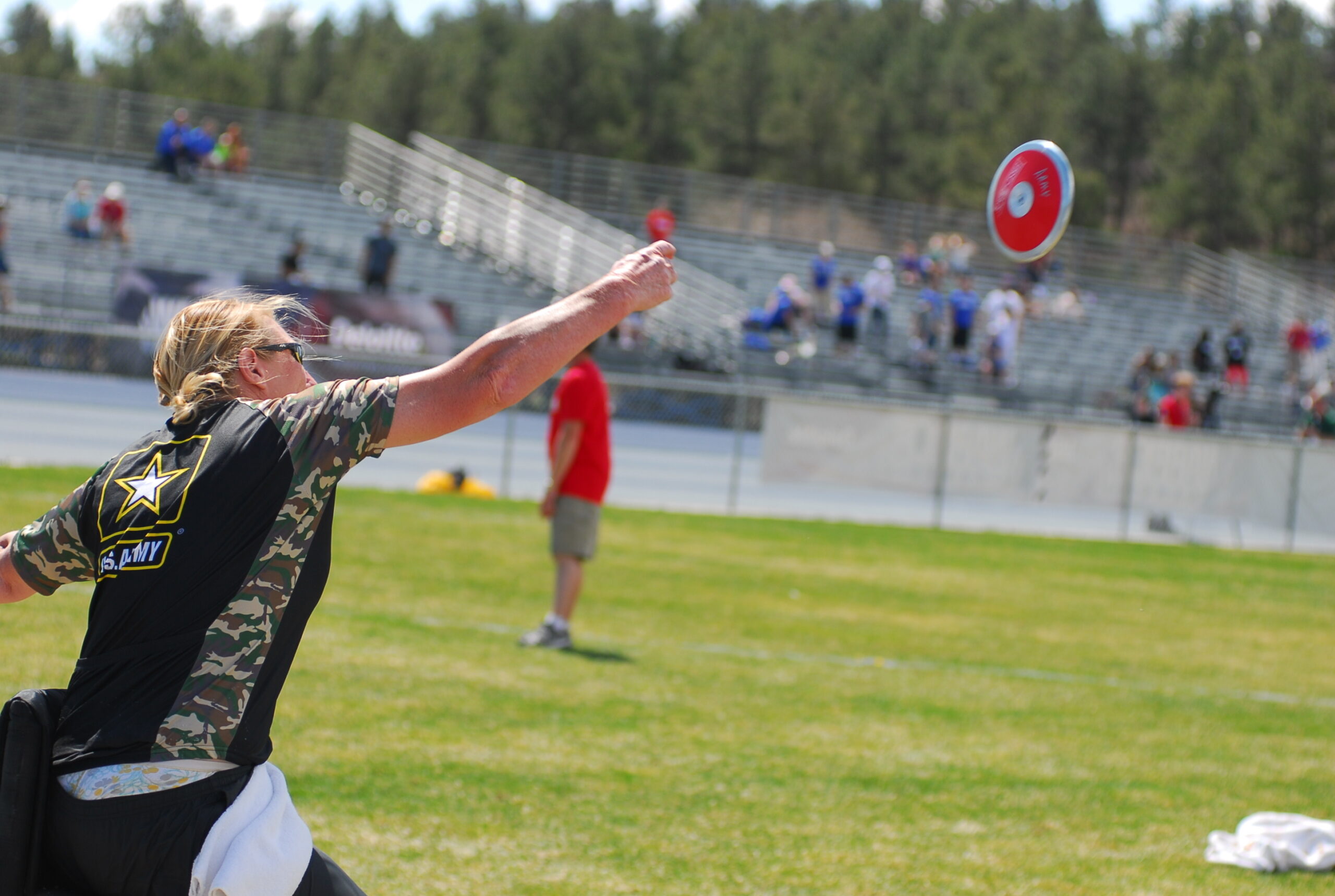
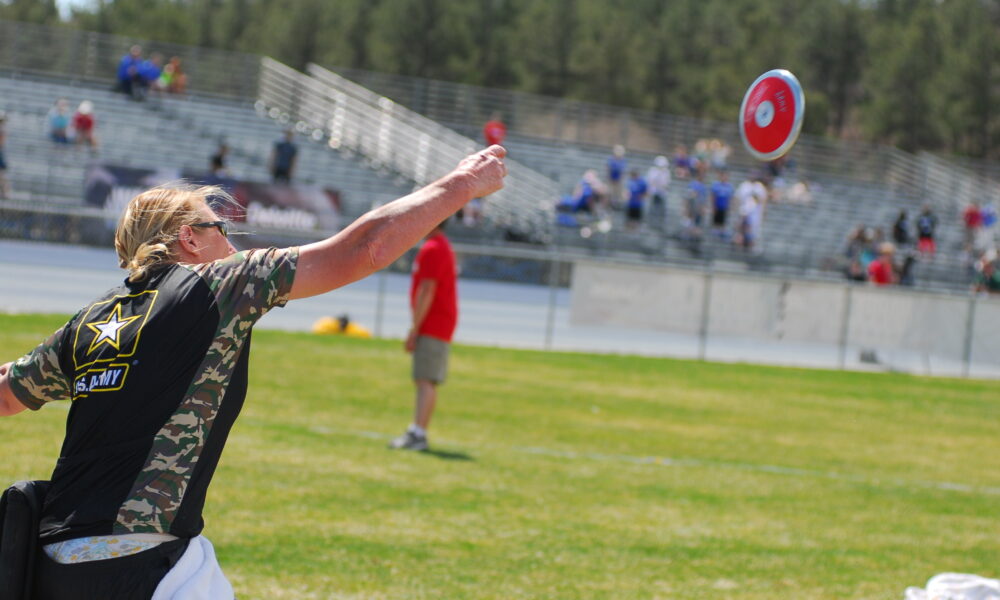
About the photograph: It shows U.S. Army veteran Chanda Gaeth competing in the seated adaptive discus at the 2013 Warrior Games. This is genuine discus throwing, but the photograph does not illustrate the standard standing Olympic throwing circle, so it should not be used to infer that both formats have identical rules.
Discus in track and field: important facts
| Rule or dimension | Standard senior event | Important qualification |
|---|---|---|
| Men’s implement | 2.00 kg (4.4 lb), about 22 cm across | Senior men; junior age groups use different weights |
| Women’s implement | 1.00 kg (2.2 lb), about 18 cm across | Senior women |
| Throwing circle | 2.50 m diameter | Different from the shot put’s smaller circle |
| Landing sector | 34.92 degrees | Discus must land fully within the marked legal sector |
| Hand used | Discus released from one hand | No ordinary gloves or mechanical throwing grips |
| Legal exit | From rear half of circle, after the discus lands | Leaving early or incorrectly causes a foul |
| Winner | Longest valid distance | Second-best distance breaks many ties |
| Typical championship format | Three trials, then three extra for leading eight | Exact competition format can differ by meet |
These figures follow World Athletics’ official discus overview and the 2026 technical rules. The latter should take precedence over summaries if a meet uses the official international rulebook; local school and youth associations may apply their own event-specific modifications.
What does the discus look like, and how much does it weigh?
A competition discus is round, with a circular rim and plates surrounding its core. It is built to spin through the air after release. The disc used at a major men’s senior championship is generally heavier and larger than the corresponding women’s implement, and its exact dimensions have tolerances covered in competition specifications.
For learning the rules, the numbers to remember are 2 kg for senior men and 1 kg for senior women. Those are not universal weights for every athlete. A student learning at a school meet should ask the coach or check the governing association’s age-group event specification before competing.
What are the official discus weights for junior athletes in 2026?
The World Athletics 2026 implement table sets out different categories. This is a more reliable reference than simply saying every male discus thrower uses a two-kilogram disc.
| Age/sex category | World Athletics discus weight | Meaning |
|---|---|---|
| Women U18 | 1.00 kg | Under-18 international category |
| Women U20 and senior | 1.00 kg | Senior international women’s standard |
| Men U18 | 1.50 kg | Lighter than the senior men’s discus |
| Men U20 | 1.75 kg | Intermediate implement |
| Men senior | 2.00 kg | Senior international men’s standard |
The chart is based on World Athletics 2026 Technical Rules. U.S. scholastic meets may differ from international U18/U20 standards, so never assume that one international age-group table replaces a school’s own handbook.
Is a heavier discus always better?
No. The legally required implement is chosen by event category, not personal preference. A heavier disc may reduce an athlete’s throwing distance and change technique. Competitive equipment also differs in rim weight and distribution, which can affect spin and handling for experienced throwers, but none of those variations override the weight and dimensions required by the meet.
How big is the discus circle and landing sector?
The discus circle has an inside diameter of 2.50 meters, measured according to official specifications. The athlete must start a trial from a stationary position inside it and cannot step on the prohibited parts of the rim or ground beyond the circle during a throw. A competition also uses a protective cage and a landing sector, helping keep spectators and neighboring events safe.
The 34.92-degree sector is marked by lines that radiate away from the throwing area. Imagine two straight boundaries creating a wedge across the field. A discus that first touches outside the legal sector is a foul. The lines themselves are boundaries and do not become a free landing area merely because the disc was otherwise thrown cleanly.
Does discus use the same circle as shot put?
No. Discus uses a 2.50-meter circle, whereas international shot put uses a 2.135-meter circle and has a stop board near the front. Javelin is different again, as athletes accelerate along a runway rather than making a discus-style rotational throw inside a circle.
For another event where an incorrect measurement or failed attempt can change the result, see our published high jump rules guide. Both are track-and-field disciplines, but their competition equipment and legal attempts differ.
What counts as a foul in discus?
A foul is a throw that cannot be counted as a valid performance because the athlete or implement broke a competition rule. For beginners, the distinction between a legal throw and a long but invalid throw is the most important point to learn.
| Situation | Result | Reason |
|---|---|---|
| Discus lands beyond the sector line | Foul | Landing outside marked legal area |
| Athlete steps outside circle during delivery | Foul | Breaking the circle boundary rule |
| Athlete leaves before discus lands | Foul | Early exit |
| Athlete leaves through the front half after throw | Foul | Incorrect exit route |
| Athlete starts properly, throws within sector and exits rear after landing | Potential valid trial | Subject to all other competition rules |
| Discus lands much farther than others but outside sector | Foul | Distance cannot rescue an illegal landing |
World Athletics additionally has detailed regulations about the start position, rim contact, timing of trials, the cage and equipment. Consult the official event overview and current technical rulebook if officiating rather than merely learning the basics.
Can your foot touch the inside of the circle’s rim?
Rules distinguish between touching the inside of the metal ring and stepping onto its top or outside during delivery. The latter can invalidate a trial; touching permissible areas on the inside is not automatically a foul. This nuance matters because casual summaries that say “never touch any part of the ring” are too broad.
Why must you leave from the back?
The rear-half exit rule confirms that the athlete finished the action under control and avoids treating an uncontrolled move forward beyond the circle as a valid completion. Officials watch both the discus’s landing and the athlete’s final movement. Leaving before the disc lands is a foul even if the implement lands squarely in the legal sector.
How is a discus throw measured?
After a legal throw, officials identify the nearest point of the initial mark left by the discus in the landing sector. A measurement is taken from that mark toward the designated center-related measuring point of the circle, following the technical rules. A discus may bounce or slide after initial impact, but a long slide is not added to the recorded distance.
The winning performance is the athlete’s longest valid throw. Where two competitors have an identical best distance, officials examine the next-best valid marks under the event’s tie procedures. A long foul attempt never counts as a tie-breaker.
How many attempts do athletes receive?
World Athletics describes a common final format in which each competitor receives three attempts; then the eight leading athletes receive three additional throws. Some meets use qualifying rounds, different participant counts or adapted competition arrangements. Check the event instructions rather than assuming six throws are guaranteed to every entrant.
What happens when you scratch?
In track and field, a “scratch” can mean a foul attempt or a missed/withdrawn trial depending on local usage. At a discus meet, a foul is not a measured legal distance. If an athlete uses up all allowed trials without a legal throw, there may be no recorded valid distance for that stage. Do not confuse a foul with a shorter but valid mark.
How to throw a discus: beginner progression
The safest approach is to practice with a qualified coach in a permitted throwing area. Discs can travel far, curve unpredictably and injure people outside the nominal landing wedge. The steps below are an educational overview, not personalized training advice or a claim of firsthand testing.
1. Learn the grip and release before spinning
Hold the discus with the throwing hand so the rim rests against the extended fingers rather than being squeezed like a ball. Start with controlled, low-intensity release practice under supervision in an empty, closed landing sector. The goal is to let the discus spin smoothly instead of wobbling or dropping flat.
2. Practice from a balanced standing position
Beginners often improve direction control by first learning a standing throw. Focus on stable feet, a coordinated trunk turn and a smooth arm path. Only increase distance when the implement is consistently released into the safe legal area. Do not practice throws toward teammates, buildings or a shared playing field.
3. Build rhythm before adding a full rotation
Experienced throwers commonly complete about one and a half rotations from the back of the ring. This is not an arbitrary spin: the feet and hips move in sequence to generate momentum while keeping balance. Rushing rotational drills can reduce control and increase the risk of throwing outside the sector.
4. Work on the delivery and follow-through
As the thrower reaches the delivery position, the lower body, trunk and throwing arm need to act together. Coaches can help identify whether the hips lead, the arm remains relaxed and release timing is appropriate. The athlete then decelerates while remaining inside the circle until the discus lands and the trial can be completed legally.
5. Add a rules check to each practice attempt
Ask: Was the throw made from the correct circle? Did the discus remain within the legal sector? Did I maintain balance and exit from the rear after it landed? Technique only produces a competition result when the throw is legal. This integrated approach is more useful than training only for raw distance.
For additional structured educational material, World Athletics provides its Kids’ Athletics teaching cards, which emphasize grip, control and a carefully organized practice area.
Standing discus vs seated adaptive discus
Discus exists in both traditional track and field and Para athletics. The photo on this page is documentary footage of a real athlete in a seated discus event at the 2013 Warrior Games. In seated competition, athletes may use a secured throwing frame and rules specific to their sport class. They do not simply perform the same one-and-a-half standing spin while sitting.
World Para Athletics distinguishes standing throwing classifications from seated throwing classifications, including F31–34 and F51–57 groups for particular impairment types. These classifications and equipment rules are distinct from the ordinary senior men’s or women’s World Athletics specifications summarized above.
Why that matters for photos: it would be misleading to label a seated adaptive athlete as a competitor demonstrating the exact standing Olympic rotation. Both are legitimate sporting disciplines, but good photo captions and alt text must respect the actual subject.
Are Para discus implements always the same weight?
No. Weights and specifications vary by classification and event. Check the current World Para Athletics regulations for the specific athlete category before quoting a competition weight. Do not transfer the 2 kg senior men’s standard to every seated adaptive discus category.
Discus versus shot put, hammer and javelin
| Event | Implement | Distinct competition method |
|---|---|---|
| Discus | Weighted round disc | Usually rotational delivery inside 2.50 m circle |
| Shot put | Heavy spherical metal shot | Pushed from shoulder; 2.135 m circle and stop board |
| Hammer throw | Ball linked by wire to handle | Specialized rotations within 2.135 m circle |
| Javelin throw | Spear-like javelin | Approach run and release on runway |
All four are field events in athletics, but their dimensions, throwing motions, legal sectors and safety structures differ. That is why a diagram of shot put or a photograph of someone tossing a medicine ball is not an adequate image for an article specifically about discus.
Frequently asked questions
What is discus in track and field?
It is a throwing event in which athletes launch a weighted round disc from a legal circle into a marked sector. The greatest valid distance wins.
How much does a high school discus weigh?
It depends on sex, age, country and the meet’s governing association. Senior international implements are 2 kg for men and 1 kg for women, but the World Athletics U18 and U20 men’s weights differ, and U.S. scholastic rules must be checked separately.
What is the discus circle diameter?
2.50 meters for standard international discus throw, about 8 feet 2.4 inches.
What angle is the discus landing sector?
34.92 degrees under World Athletics rules, marked as a wedge extending outward from the circle.
Does the discus need to land flat?
The key requirements are that the implement lands inside the legal sector and the athlete completes the attempt legally. Judges record the first mark made by the discus, not the additional distance traveled after a bounce or slide.
Can you step out before the discus lands?
No. An athlete must remain in the circle until the implement lands and exit properly from the rear half.
How many discus throws do you get?
A common championship format gives three trials to each athlete and three more to the leading eight. Individual meets can use other formats, so read that meet’s regulations.
Is the photo in this article a standard Olympic discus spin?
No. It is a genuine U.S. Army photograph of the seated adaptive discus event at the 2013 Warrior Games. The ordinary standing event follows different competition movement rules.
Reliable rules and historical references
- World Athletics: Discus Throw — senior equipment, circle, sector, faults, basic technique and competition format.
- World Athletics: Current Competition and Technical Rules — 2026 implement weight matrix, technical standards and official definitions.
- World Para Athletics: Classification — seated versus standing throwing events and classes.
- World Para Athletics: Rules — current regulatory documents for adaptive discus competitions.
- U.S. Army original photograph record — public-domain photograph of Chanda Gaeth throwing the discus at the 2013 Warrior Games.
Editorial revision: October 15, 2026. This page summarizes verified rules from governing bodies; it does not claim a live competition result, original athletic tests or identical regulations across all school and adaptive disciplines.