
Quick answer (checked October 14, 2026): Booker T. Washington National Monument in Hardy, Virginia, is free to enter. The grounds and restrooms are normally open daily from 9 a.m. to 5 p.m.; the visitor center is open Wednesday through Sunday, 10 a.m. to 4 p.m. The self-guided Plantation Trail is approximately 0.55 mile. Unlike a recreation-only park, this is a historic site where visitors can learn about Washington’s childhood in slavery and emancipation in 1865.
For most first-time visitors, allow 60–90 minutes for the introductory exhibits and the historic core. Add time for the longer woodland walk, a seasonal program, or a school group.
Booker T. Washington National Monument: fees, hours and address
| Visit detail | Current information | Planning note |
|---|---|---|
| Admission | Free; no entrance pass required | Not a ticketed guided attraction |
| Park grounds and restrooms | 9 a.m.–5 p.m., seven days a week | Weather can affect access |
| Visitor center | 10 a.m.–4 p.m., Wednesday–Sunday | Closed Monday and Tuesday |
| Address | 12130 Booker T. Washington Highway, Hardy, VA 24101 | About 22 miles southeast of Roanoke |
| Plantation Trail | 0.55-mile historic core loop | Allow approximately 30–60 minutes |
| Regular summer ranger tours | 2026 seasonal series ended September 30 | Ask staff about current activities |
The park’s official operating-hours page and fees page are the best final checks before traveling. Visitor-center closures are not the same as grounds closures: you may be able to follow the outdoor trail on a Monday even though the museum building is closed. Buildings close on major holidays such as Thanksgiving, Christmas Day and New Year’s Day, and winter weather can force short-notice changes.
What is preserved here?
The monument marks the birthplace and emancipation site of educator Booker T. Washington (1856–1915). Washington was born into slavery on the Burroughs family tobacco farm, not at Tuskegee University. The surviving landscape and interpretive buildings help tell the stories of Washington, his mother Jane, and other enslaved people whose labor sustained the farm. The park is also an opportunity to understand how memory, archaeological evidence and historical reconstruction differ.
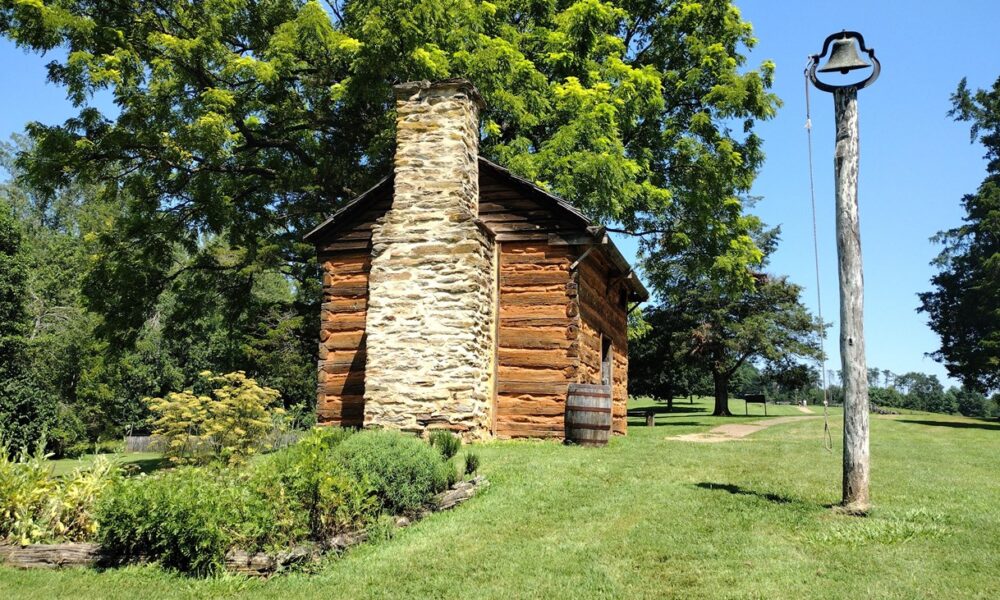
Important distinction: the reconstructed kitchen cabin is an interpretation of a nineteenth-century structure, not the original cabin preserved intact since Washington’s birth. The National Park Service identifies the 1894 tobacco barn as the oldest remaining historic structure. Even the assumed positions of some long-lost buildings have been revisited as research develops. That nuance matters: an accurate visit should not treat every visible structure as an untouched relic from 1856.
Follow the Plantation Trail in the right order
Start at the visitor center when it is open, then walk to the trailhead behind the building. The NPS Plantation Trail guide describes a 0.55-mile loop, primarily paved, that passes the cabin area, smokehouse, blacksmith shop, barn and other reconstructed outbuildings. The suggested trail duration is 30–60 minutes.
Stop 1: kitchen cabin and historic core
Look carefully at the reconstructed kitchen cabin and nearby household spaces. Rather than presenting them as picturesque farm buildings, imagine the unequal relationships of power and labor that shaped daily life in this place. Interpretive signs provide the necessary history.
Stop 2: original tobacco barn and agricultural landscape
Continue toward the tobacco barn, built in 1894, and consider the farming economy of the larger property. The trail becomes grassy and sloped near parts of this area; comfortable footwear helps. The NPS describes an incline reaching approximately 14 percent near the barn and pig-pen area, so visitors with limited mobility should ask a ranger about the most suitable route.
Stop 3: cemetery and return route
The Burroughs family cemetery lies just north of the historic loop across the parking area. Read signs respectfully and remain on marked paths. This stop adds context about the people who owned the property and how their histories intersect with Washington’s childhood.

Visitor center, museum and heritage garden
The visitor center offers orientation materials, historical displays and opportunities to ask about ranger-led programs. A park film about Washington’s life is available according to the NPS. The heritage garden, maintained as a historical interpretation, is especially useful for seeing the plants associated with nineteenth-century agricultural life. Its seasonal condition varies: do not expect summer crops in every month.
Are ranger-led tours offered in October 2026?
The park’s published 2026 Born Here, Freed Here public walking tour series was scheduled for Wednesdays through Sundays at 11 a.m. and 2 p.m. from May 1 through September 30, 2026. That calendar does not establish an automatic 11 a.m. tour in October. Visitors in October should use the self-guided itinerary unless park staff confirm a current program. Separately, school programs can sometimes be arranged by contacting the park in advance; their availability depends on staffing and weather.
Practical 75-minute itinerary
| Time | Activity | Why it matters |
|---|---|---|
| 0–15 min | Begin at visitor center if open | Orient yourself with historical exhibits |
| 15–50 min | Walk the historic Plantation Trail | See cabin, farm buildings, barn and landscape |
| 50–65 min | Explore the heritage garden and interpretation | Connect crop history to daily labor |
| 65–75 min | Return to maps or ask staff questions | Clarify what is historic and what is reconstructed |
This is a suggested itinerary, not a published official tour with a reserved start time. Families, photographers and visitors with mobility needs may need longer.
Travel tips and accessibility
- Plan for two sets of hours: grounds and restrooms are normally open earlier and on more days than the visitor center.
- Wear suitable shoes: although much of the short loop is paved, a steeper portion and grassy ground may present challenges.
- Check weather: the NPS recommends calling 540-682-0173 during inclement weather.
- Plan without public Wi-Fi: the park reports that public Wi-Fi is not available, so save maps or directions before arrival.
- Keep historical context: reconstructed buildings do not mean the site is a complete original plantation village.
For another educational U.S. National Park Service site, compare AVARIXO’s George Washington Carver National Monument visit guide. The two sites commemorate different people and histories, despite the similar names.
FAQ
Is Booker T. Washington National Monument free?
Yes. The National Park Service lists no entrance fee and no required entrance pass.
Is the monument open on Monday?
The grounds and restrooms are usually open 9 a.m.–5 p.m. on Mondays; the visitor center is normally closed on Monday and Tuesday.
How long is the Plantation Trail?
The historic-core Plantation Trail is about 0.55 mile. Budget at least 30–60 minutes for interpretation and walking.
Can I get a ranger-led tour in October?
Do not assume a scheduled walk. The regular 2026 seasonal series ended September 30; ask the park about special October programs.
Is the kitchen cabin Washington’s original birthplace?
No. It is a reconstruction associated with the interpreted plantation homesite; the park distinguishes surviving structures from reconstructions and archaeological interpretation.
Last fact check: October 14, 2026. Reconfirm current closures and event schedules directly with the National Park Service before traveling.