Quick answer: The most useful basketball workouts for an improving beginner balance four skills: ball control, finishing, shooting, and game-speed movement. Rather than taking hundreds of rushed shots in one session, use three focused court sessions per week, record a small set of repeatable results, and give yourself recovery days. The four-week plan below starts with a technique baseline, builds repetitions gradually, and ends with a controlled skills retest. It is a suggested routine, not a professional medical or athletic prescription.
You do not need expensive equipment to begin. A basketball, hoop, a safe playing surface, water and two or three cones or water bottles are enough. Solo players can substitute a self-toss for passes; partners can add light defensive pressure once form is consistent.
Basketball workouts: choose your starting plan
| Experience | Time per session | Priority | Weekly approach |
|---|---|---|---|
| New player | 20–30 minutes | Control, footwork, close-range form | 2–3 sessions with recovery days |
| Comfortable beginner | 35–45 minutes | Both-hand dribbling, layups, catch-and-shoot | 3 nonconsecutive court workouts |
| Developing intermediate | 45–60 minutes | Movement, decision-making, shots after dribble | 3–4 sessions adjusted to team commitments |
The minutes here are general examples for an individual skills session, not a directive for children to train extra on top of team practices. Coaches and parents should consult USA Basketball’s youth participation guidelines for age-appropriate weekly limits, recommended rest and competition load. For younger children in particular, total weekly activity and enjoyment matter more than adding sessions.
A 40-minute solo basketball workout
Minutes 0–5: warm up and athletic stance
Begin with brisk walking or easy jogging, gentle lateral shuffles, ankle and hip mobility, then short stops and pivots. The goal is to move confidently before increasing speed. Avoid forcing painful movements or jumping at full intensity while cold.
Minutes 5–13: ball-handling control
Use 60 seconds each of right-hand low dribbles, left-hand low dribbles, waist-high control and crossovers. Repeat once while looking ahead instead of down at the ball. Leave enough room so no one is struck by an uncontrolled dribble. End with controlled retreat dribbles, keeping your body between an imagined defender and the ball.
What to track: count losses of control or times you must chase the ball. Fewer losses with your eyes up is more useful than simply dribbling faster.
Minutes 13–21: finishing at the basket
Start with simple right-side and left-side layups, stepping from a comfortable distance. Make five on each side, then repeat with a gentle approach from a different angle. Keep the ball high and finish off the backboard when appropriate. If you struggle with footwork, return to standing finishes before adding a dribble.
For a focused extension, our Mikan Drill guide teaches alternating finishes and rebound positioning. Use it as one component of a workout rather than replacing all other skill work with layups.
Minutes 21–32: form shooting and five spots
Take ten close-range form shots from a distance where your release is comfortable. Then choose five spots around the key and attempt four shots at each. Write down makes out of 20; compare the same spots and distance across sessions. Avoid extending to three-point range until your mechanics stay consistent without extra heaving or a painful release.
Minutes 32–37: movement into a shot
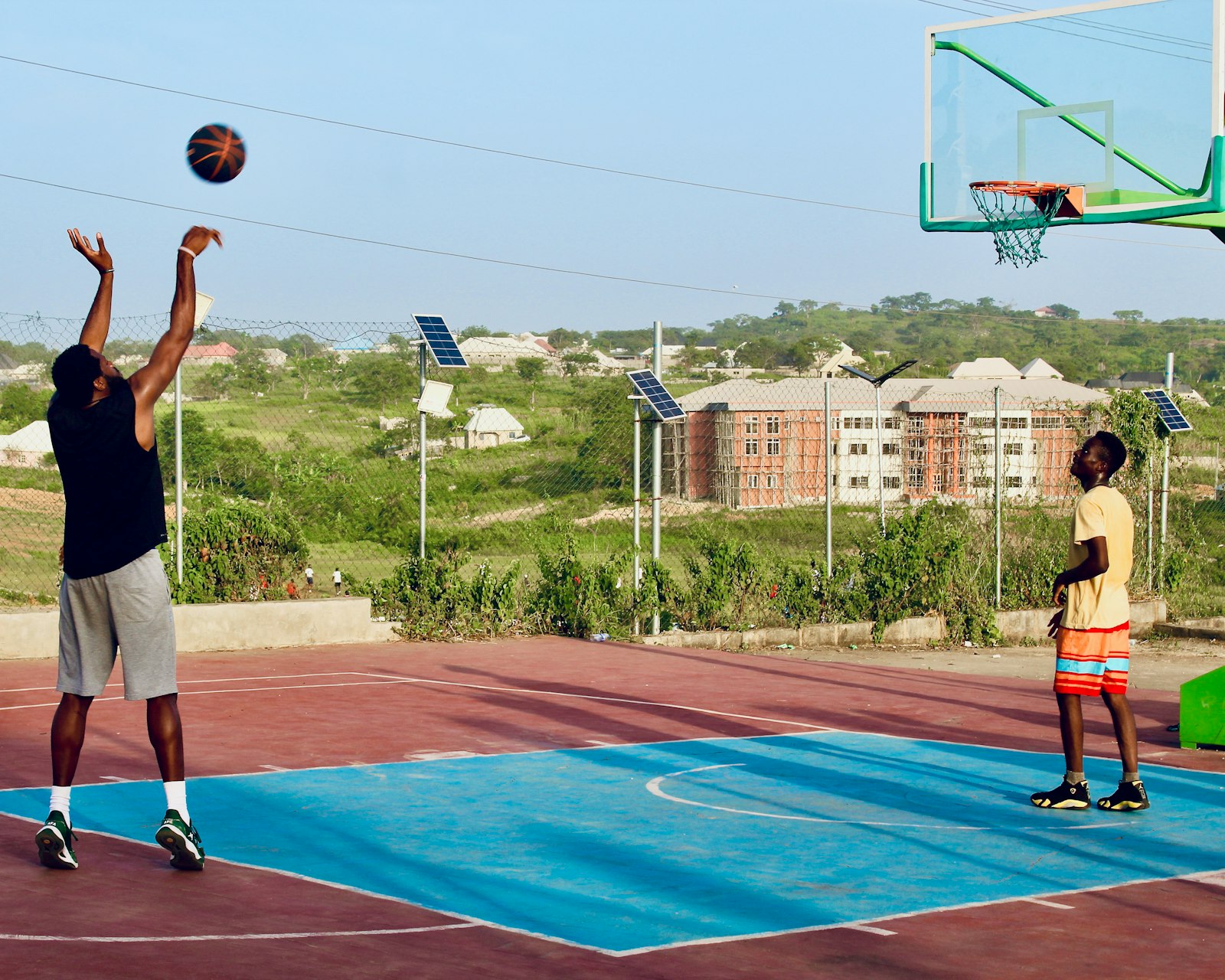
Start on one side, shuffle or move to a marked spot, catch a self-toss or partner pass, square your feet and take a balanced shot. Alternate directions. If no rebounder or passer is available, move the ball to the spot yourself and pause to establish balance. The goal is not exhaustion; it is a stable shot after controlled movement.
Minutes 37–40: free throws and a short cooldown
Attempt ten free throws while using the same breathing and pre-shot routine. Record makes out of ten. Finish with slow walking and gentle recovery. If you feel dizziness, chest pain or unusual discomfort, stop exercising and seek appropriate medical advice.
A four-week basketball workouts plan
Choose three nonconsecutive days, such as Monday, Wednesday and Saturday, leaving days without an extra organized court workout between sessions. Adapt to existing team training and fatigue. If you are a youth player, stay within the age-appropriate total workload in the USA Basketball guidelines.
| Week | Day A | Day B | Day C | Progress check |
|---|---|---|---|---|
| 1: establish baseline | Dribble control and stationary finishes | Close-range shooting, footwork | Full balanced 40-minute routine | Record 20 five-spot shots and 10 free throws |
| 2: consistent technique | Both hands, change of speed | Layups from two angles, set shots | Repeat full workout | Compare control mistakes, not just makes |
| 3: add movement | Retreat dribble into drive | Catch-and-shoot after shuffle | Short partner 1v1s, if available | Same baseline tests under manageable fatigue |
| 4: make decisions | Respond to a cone/partner cue | Choose layup or pass after a drive | Repeat baseline workout exactly | Check improvement on matched test conditions |
Do not automatically increase volume if your joints are sore or school, games and other sports already create a heavy load. Quality of movement beats the total number of attempts. Review the basics before moving to speed or contact drills.
Solo workouts versus partner workouts
Solo training makes it easy to repeat identical shooting spots and practice with either hand. Its limitation is that cones cannot contest a shot or read a fake. Partner training allows realistic passes, defensive closeouts and decision-making, but an experienced partner should keep contact light and technique appropriate to the learner.
Try this progression: static form → movement without defense → passive defender → live one-on-one → small-sided play. The Jr. NBA’s official starter practice plans also organize basketball development around dribbling, passing, footwork, shooting and enjoyable games. You can borrow that balanced philosophy even if you train alone.
How to measure progress without guessing
| Metric | Simple repeatable test | What improvement means |
|---|---|---|
| Ball security | 60 seconds of controlled two-hand alternation at the same pace | Fewer lost dribbles while looking up |
| Close finishing | 10 right-hand + 10 left-hand layup attempts | More controlled makes on both sides |
| Set shooting | 20 attempts from the same five locations | Higher makes with consistent form |
| Free throws | 10 attempts with the same routine | Gradual consistency over several sessions |
| Decision-making | Small-sided game or live 1v1 | More good passes and shot choices, fewer forced attempts |
Write down your starting date, court, ball size and shooting distance to keep comparisons fair. A five-for-ten session followed by a four-for-ten session does not necessarily mean you regressed: small samples fluctuate. Look at trends across several workouts.
Common workout mistakes
- All shooting, no handles: a player who cannot protect the ball may never create a clean shot.
- Only right-handed layups: train both directions even if one side feels awkward.
- Too much distance too soon: maintain a smooth shot before increasing range.
- Skipping recovery: fatigue and excessive extra sessions reduce movement quality and may increase injury risk.
- Measuring only makes: monitor form, control and choices, not just scoreboard-style numbers.
- Using a generic plan despite pain: a coach or clinician can adapt activity when needed.
Basketball workouts FAQ
Can I improve basketball skills in 30 minutes a day?
A focused 30-minute session can build useful skills, especially for beginners. However, daily extra sessions may not be appropriate if you also play for a team or need age-specific recovery. Consistency and good movement matter more than exercising every day.
What basketball workout is best without a gym?
If you have a safe hoop, practise ball handling, both-side layups, five-spot shooting and free throws. If you do not have a hoop, you can practise dribbling, stops, pivots and safe footwork; shooting outcomes require access to a basket.
Should beginners shoot 100 three-pointers?
Not as a default goal. Establish comfortable close-range form and accurate mechanics before adding shooting distance or high-volume attempts.
Is weightlifting required?
No. Basketball technique can improve through skill work, coordination and gradually controlled movement. Strength work, if added, should be age-appropriate and supervised where necessary.
Bottom line: Balanced basketball workouts combine handling, finishes, shooting, movement and recovery. Repeat a measurable baseline, increase complexity only when technique holds, and use official youth participation guidance to keep total activity appropriate for your age and schedule.