
Quick answer: The Mikan drill is a simple basketball finishing exercise named after Hall of Fame center George Mikan. Stand close to the basket and alternate right- and left-handed layups, recovering each rebound before switching sides. The goal is soft touches off the backboard, efficient feet, and finishing comfortably with either hand—not making a long run-up or throwing the ball hard against the glass.
Beginners need only a basketball, a regulation or age-appropriate hoop, and a safe floor. Start without defenders and count made baskets while keeping correct footwork. The drill remains useful for more experienced players as a warm-up before harder layups and contact finishes.
What is the Mikan drill?
It’s a near-basket drill in which a player finishes from one side of the rim, catches or gathers the ball after the shot, and immediately finishes on the other side. That repeated side-to-side rhythm trains touch, body balance, rebounding, hand coordination and rhythm around the basket. It differs from a traditional full-court layup line: most of the work stays within a few feet of the hoop, so you can fit many quality repetitions into a short session.
| Element | Standard Mikan approach |
|---|---|
| Space | Directly below or a step in front of the basket |
| Equipment | One basketball and one hoop |
| Hands | Alternate right and left |
| Target | Soft high finish near the square on the backboard |
| Rebound | Collect each attempt quickly but under control |
| Training priority | Correct form and makes before speed |
How to do the Mikan drill step by step
- Start under the basket. Stand slightly to the right of the rim with a ball. Keep the knees flexed and eyes on a small aiming point high on the backboard.
- Finish on the right. Bring the ball up with your right hand toward the backboard; for a conventional right-handed layup, rise primarily from your left foot and lift the right knee naturally. At very close range, keep foot movement compact.
- Recover the ball. Land safely, gather the rebound from the net or floor and turn your body toward the left side without carrying or repeatedly shuffling your pivot foot.
- Finish on the left. Use the left hand for a soft layup off the other side of the backboard. For conventional left-hand layup footwork, push primarily from the right foot.
- Repeat in rhythm. Continue alternating. Start with 10 successful finishes each side or a manageable 30-second set, then rest and repeat.
Important: Coaches teach slightly different close-range footwork variations, and some Mikan routines use a two-foot power finish. For beginners, do not force an awkward leap every repetition. Use a controlled footwork pattern that would be legal in live play, and get feedback from a qualified coach if you are practicing for competition.
Three coaching cues that improve your layups
1. Use the backboard softly
At close range, a gentle touch is more repeatable than a flat hard throw. Aim near the upper corners of the painted square as an initial reference, then adjust to your angle and hoop design. If the ball often rebounds too far, reduce force before worrying about speed.
2. Finish with both hands
Many players instinctively switch the ball back to their stronger hand even when approaching from the weak side. Avoid that shortcut in the foundational drill. A defender can force you to finish from either side; the point is to become comfortable with each hand in a compact area.
3. Jump up before drifting forward
The basket is nearly above you. A controlled upward movement helps prevent a collision with the pole or an uncontrolled landing. Keep other players out of the space below the rim, and never start a repetition if another player’s feet are still under you.
How many Mikan drill reps should you do?
For a beginner, the following 10-minute practice example is enough to develop a repeatable rhythm. Because age, fitness and hoop height vary, reduce the total reps when technique deteriorates.
| Time | Work | Goal |
|---|---|---|
| 0:00–2:00 | Easy form shooting from both sides | Learn the target and grip |
| 2:00–4:00 | Standard Mikan, controlled pace | Alternate 10 makes per side |
| 4:00–5:00 | Rest and check footwork | Quality over fatigue |
| 5:00–7:00 | Standard Mikan, shorter recovery | Keep both hands honest |
| 7:00–9:00 | Weak-hand emphasis | One extra set on the less comfortable side |
| 9:00–10:00 | Slow finishing and quick notes | Track makes and missed spots |
Reverse Mikan drill: next step for experienced finishers
Once the basic version feels easy, try reverse finishes. Start near one side of the basket, move under the rim and use the backboard from the opposite side of the hoop, then rebound and repeat in the other direction. The backboard target, approach angle and body orientation change. Begin slowly because jumping beneath and around the rim makes collisions more likely. Do not attempt reverse variations if you cannot consistently control the standard finish.
Power Mikan drill and other variations
Power Mikan: Use a compact two-foot jump stop and rise with balance rather than relying only on a one-foot layup. The emphasis is a stable base and safe vertical finish. Timed Mikan: Count made baskets in 30 seconds, then repeat only if accuracy stays reasonable. Eyes-up Mikan: Use a coach’s visual cue after each rebound to train awareness. Light-contest Mikan: A coach can hold a pad or extend a hand to simulate defensive pressure after the player consistently masters footwork; contact is optional and should match the player’s age and skill.
Five common mistakes and how to correct them
- Only using the strong hand: require alternating hands, even if weak-hand makes are slower.
- Throwing too hard: shoot softer and move closer to the rim until the release is repeatable.
- Taking too many rushed steps: practice individual left- and right-side finishes first, then add the rebound-to-finish transition.
- Looking only at the ball: pick a backboard target before rising and regain awareness after landing.
- Counting attempts instead of makes: record both. A faster miss-heavy set may be less useful than a slower accurate one.
How this drill fits into a complete workout
The Mikan drill improves close-range finishing but does not replace ball-handling, shooting from distance, passing or defense. Combine it with a basic dribbling warm-up, form shooting on both sides, and a few realistic drives that end near the basket. If you are preparing athletes for an organized game, our basketball game-length explainer compares age and competition formats so you can structure warm-ups and recovery. Prioritize on-court repetition and ball-control progressions suited to your group.
Frequently asked questions
Do Mikan drill layups need to be fast?
No. Build coordination and accuracy at a manageable pace; add speed gradually once you can make shots consistently from both sides.
Do you jump off one foot or two?
The classic alternating layup variation commonly uses one-foot finishes; a power Mikan variation uses compact two-foot finishes. A coach may adapt footwork to a player’s age and purpose.
Can kids do the Mikan drill?
Yes, with an age-appropriate ball and hoop, safe spacing and a reduced repetition count. Focus on smooth mechanics rather than difficult time targets.
Why is it called the Mikan drill?
The name refers to George Mikan, the pioneering professional center whose close-range practice is associated with the routine. It’s a longstanding coaching exercise rather than a brand of equipment.
Photo credit
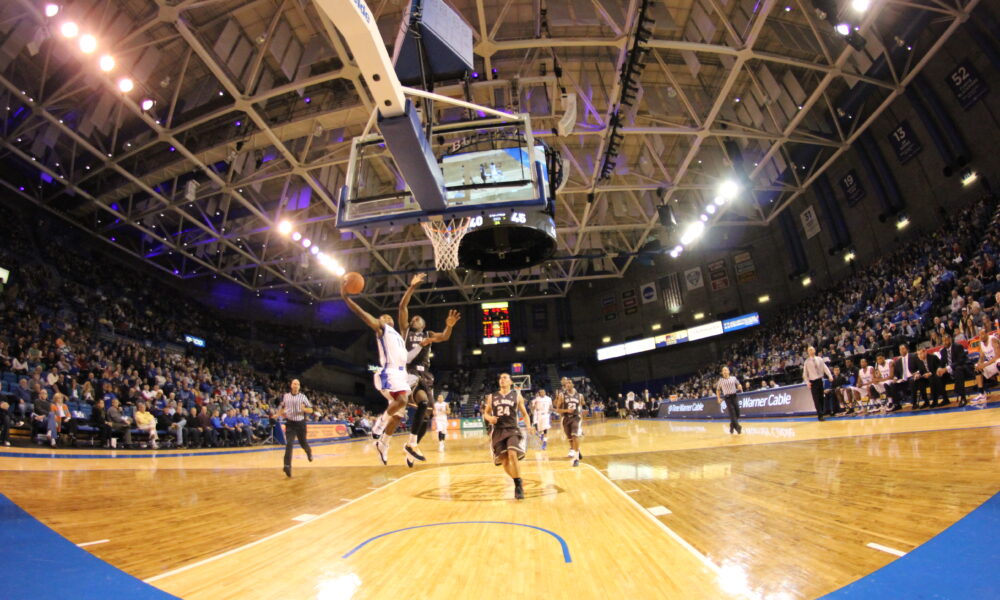
Featured illustrative basketball layup photograph: Buffalo layup by Chad Cooper, Wikimedia Commons, CC BY 2.0. This image shows a game layup, not a documented Mikan drill demonstration.

Other Articles

7 Soccer Dribbling Drills for Better Close Control, Turns and 1v1s
Minecraft Mod Maker Guide: MCreator, Blockbench and No-Code Limits
