

Quick answer: The most useful beginner basketball ball-handling drills teach you to keep your eyes up, use both hands, change dribble height, and protect the ball before trying showy combinations. Practice 25 minutes using stationary control, V-dribbles, crossovers, retreat dribbles and short moving sequences. You need one basketball and a safe, clear area; a hoop and partner are optional.
These instructions are a practical training plan, not a claim that AVARIXO has personally tested a specific athlete or program. The skills progress from simple to difficult, and you can slow any drill down.
What good ball handling actually means
Ball handling is the ability to receive, control, move and protect the basketball under realistic pressure. Fancy between-the-legs moves are not the starting point. Effective players can dribble with either hand without staring at the floor and can change direction without losing balance. Your off-ball arm may help guard space, but it must not push a defender.
The Jr. NBA starter curriculum emphasizes low-to-high crossovers, an athletic stance, eyes up, and control with the fingertips. This guide converts those principles into a solo routine and records progress without pretending that a set number of repetitions guarantees results.
Equipment and setup
- Essential: one properly inflated basketball, athletic shoes and a level, non-slip area with enough clearance.
- Helpful: three to five cones or soft markers and a timer.
- Optional: a second basketball, a partner or a hoop.
For a new player, use a ball suitable for their age and league; governing bodies and competitions may set different sizes. Begin slowly on a surface where you can stop safely, take water breaks and leave room around other people.
Eight ball-handling drills in the right order
1. Strong-hand and weak-hand pound dribbles
Stand with feet approximately shoulder-width apart and soften your knees. Bounce the ball to just below waist height with your right hand for 30 seconds, then your left. Repeat at knee height while maintaining a steady rhythm. Push with the fingertips rather than slapping with a flat palm. If the ball escapes, slow down before trying to bounce it harder.
Progression: focus on a fixed object straight ahead instead of watching the ball. Repeat for two sets per hand.
2. Low, middle and high control ladder
Use a 20-second sequence for each height: below the knee, between knee and waist, and around waist height. Alternate hands between sets. Low dribbles are useful when protecting the ball; taller dribbles can assist movement into open space when appropriate. Neither height is right for every situation.
Check: your chest remains balanced and your shoulders do not swing wildly when the bounce changes.
3. Front-to-back V-dribbles
Keep one hand on the ball. Direct it slightly forward, then pull it back toward your hip so the bounce path resembles a narrow V. Do 30 seconds on each side. This improves directional control without requiring a full crossover. Build accuracy first, then reduce the pause between changes.
4. Side-to-side V-dribbles
Without transferring the ball to the other hand, move the bounce inward and outward in front of one knee. Work 30 seconds per hand. Keep the non-dribbling arm in a natural, legal position; do not elbow a real defender away.
5. Stationary crossover at three heights
Shift the ball from right hand to left across your body. Try 20 seconds low, 20 seconds at knee height and 20 seconds higher while standing balanced. Transfer weight gently from foot to foot. A crossover counts only when you regain clean control on the other side. Jr. NBA uses height variations as a teaching progression in its starter drills.
6. Retreat dribble and re-attack
Set a floor marker as an imaginary defender. Approach with three controlled dribbles, take two retreat steps while keeping the ball on the side away from the marker, then change angle and move forward. Alternate left and right approaches for two minutes. The goal is to create room, not to travel as fast as possible.
7. Five-marker zigzag
Place five soft markers several feet apart in a safe straight lane. Dribble toward one, turn around it with an outside-hand bounce or simple crossover, and move toward the next. Walk before jogging. Keep the ball below your waist through tight turns and look ahead whenever control allows. With only one marker, alternate between that marker and your starting line.
8. Eyes-up decision drill
Have a partner call “left,” “right” or “retreat” as you dribble in place. Respond with a controlled change instead of looking at your hands. Alone, set a timer that changes its beep pattern or call a new direction aloud at random intervals. The point is to practice deciding while controlling the ball, not to memorize a flashy sequence.
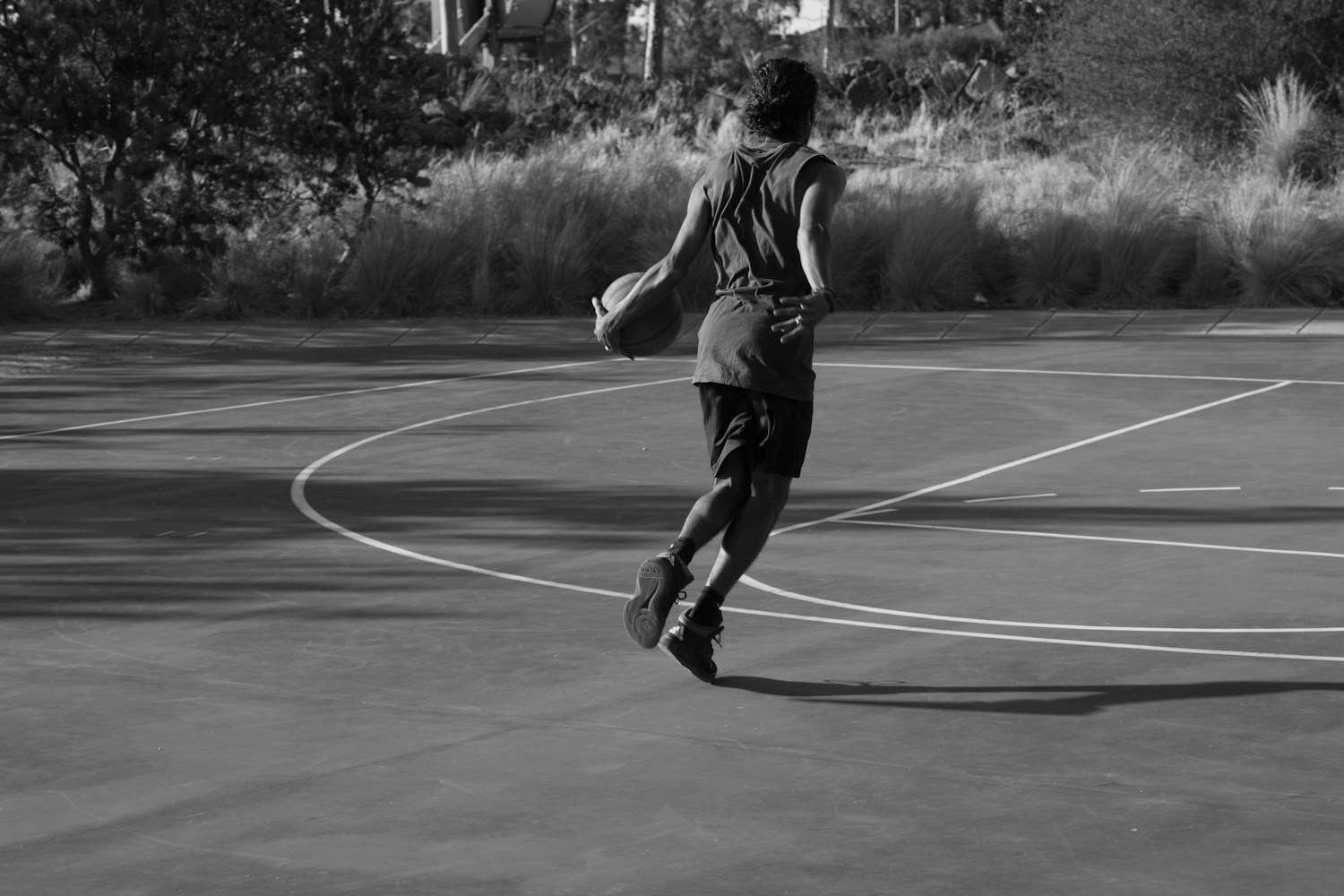
25-minute beginner ball-handling workout
| Time | Work | What to check |
|---|---|---|
| 0–3 min | Light movement and ball familiarization | Safe stance, clear space |
| 3–7 min | Drills 1–2 | Left-right control |
| 7–11 min | Drills 3–4 | V-direction accuracy |
| 11–15 min | Drill 5, alternating heights | Clean hand transfers |
| 15–19 min | Drills 6–7 | Balance on changes |
| 19–23 min | Drill 8 with rest as needed | Eyes-up decisions |
| 23–25 min | Easy cooldown and record score | One measurable goal |
The time blocks total 25 minutes. Treat this as a flexible sample routine, not a medically prescribed training load. Younger players may use shorter work periods and more breaks.
How to measure improvement without guessing
Choose one 30-second drill each session. Count clean transfers or changes, and count fumbles separately. Record both figures with the hand used and drill height. For the zigzag, measure the number of clean completed passes through the same markers rather than racing against a different course every day. Comparing a consistent setup matters more than a headline number.
| Session | Weak-hand clean bounces / 30 sec | Losses of control | Eyes-up attempt |
|---|---|---|---|
| Baseline | Record yours | Record yours | Yes / partly / no |
| Next session | Record yours | Record yours | Yes / partly / no |
| After 2 weeks | Record yours | Record yours | Yes / partly / no |
Common mistakes and corrections
- Watching every bounce: look at a wall target for a few seconds, then extend the eyes-up time gradually.
- Only using the dominant hand: give the weaker hand equal controlled practice rather than rushing difficult crossovers.
- Standing straight: lower the center of gravity slightly and keep your back in a comfortable, balanced posture.
- Racing and losing control: reduce speed until you can finish multiple clean repetitions.
- Ignoring game decisions: add a retreat, directional cue or partner after you own the stationary versions.
What to practice after ball handling
Pair control work with shooting, passing and defense rather than spending the entire session on tricks. For a position-based overview, see the five basketball positions and responsibilities. If you play with a partner, add possession and rebounding work; our box-out guide explains how to establish position safely after a shot.
FAQ
What is the best basketball ball-handling drill for beginners?
Start with steady weak-hand pound dribbles, then add crossovers at multiple heights. The best drill is the one you can repeat under control while gradually looking away from the ball.
Can I do ball-handling drills without a basketball hoop?
Yes. Stationary dribbles, V-dribbles, retreat changes and marker zigzags require no basket.
Are two basketballs required?
No. One ball is enough for foundational control. Two-ball drills can be added later as an optional challenge.
How often should a new player practice?
Short, regular sessions with rest and gradually increased demands are generally more practical than exhausting one-off workouts. Frequency depends on the player’s age, conditioning and other activity.
Will drills automatically improve performance in games?
No. Ball control must transfer to decisions under pressure. Use small-sided play or a partner once technique is consistent.
Editorial basis: This practice plan is an original instructional adaptation informed by the official Jr. NBA starter skills and the Jr. NBA at Home drill library. No original testing or guaranteed performance outcome is claimed.


