
Quick answer: Apollo 11 was the first mission to land humans on the Moon. Launched on July 16, 1969, it carried Neil Armstrong, Buzz Aldrin and Michael Collins. Armstrong and Aldrin landed in the lunar module Eagle on July 20 while Collins remained in lunar orbit, and the crew returned safely to Earth on July 24.

Who flew on Apollo 11
Neil Armstrong was the commander, Buzz Aldrin the lunar module pilot and Michael Collins the command module pilot. Each had a distinct role during the descent, surface stay and return.
What happened during the landing
Eagle separated from the command and service module, descended toward the Sea of Tranquility and landed after Armstrong took manual control to avoid a hazardous area. The descent required close coordination with Mission Control in Houston.
Why Collins stayed in orbit
The command module Columbia remained in lunar orbit to provide the return spacecraft. Collins piloted it while Armstrong and Aldrin explored the surface in Eagle.
What the astronauts did on the Moon
They deployed scientific experiments, collected lunar rock and soil samples, photographed the landscape and planted a flag. The surface activities were limited by available time and equipment.
How they returned home
Eagle’s ascent stage lifted off from the Moon and rendezvoused with Columbia. The crew transferred back to the command module, left lunar orbit and returned through Earth’s atmosphere to splash down in the Pacific Ocean.
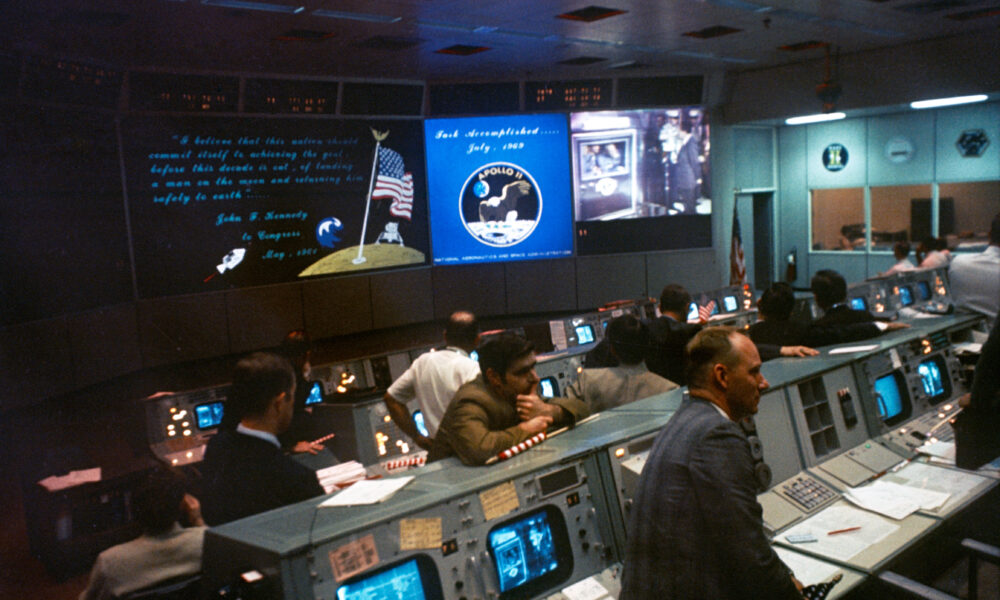
What Mission Control photographs show
Historic photos of Houston’s control room capture the human infrastructure behind the landing: flight controllers, communications and decision-making. These are not pictures of the lunar surface.
At a glance: what to remember
- Who flew on Apollo 11: Neil Armstrong was the commander, Buzz Aldrin the lunar module pilot and Michael Collins the command module pilot.
- What happened during the landing: Eagle separated from the command and service module, descended toward the Sea of Tranquility and landed after Armstrong took manual control to avoid a hazardous area.
- Why Collins stayed in orbit: The command module Columbia remained in lunar orbit to provide the return spacecraft.
- What the astronauts did on the Moon: They deployed scientific experiments, collected lunar rock and soil samples, photographed the landscape and planted a flag.
Frequently asked questions
Who was the first person on the Moon?
Neil Armstrong, followed by Buzz Aldrin.
Did Michael Collins walk on the Moon?
No. He remained in lunar orbit piloting the command module.
Bottom line
Apollo 11 was the first mission to land humans on the Moon. Launched on July 16, 1969, it carried Neil Armstrong, Buzz Aldrin and Michael Collins. Armstrong and Aldrin landed in the lunar module Eagle on July 20 while Collins remained in lunar orbit, and the crew returned safely to Earth on July 24. For mission milestones and updated findings, refer to the original space agency rather than treating an old timeline as a current announcement.
Primary source: NASA official mission and science documentation.