
What is the English Opening?
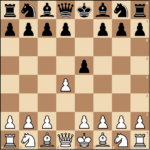
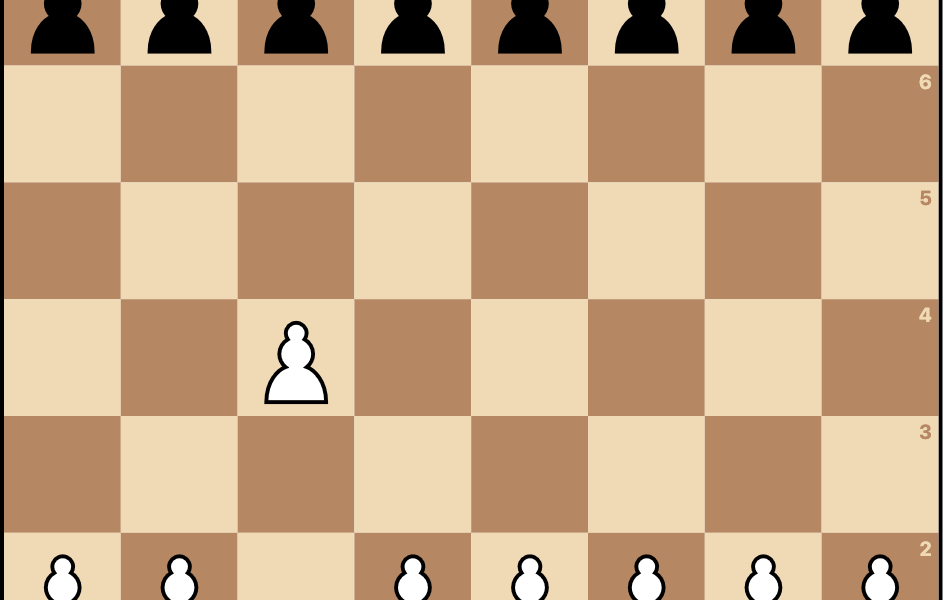
The English Opening begins with 1. c4. Instead of placing a pawn directly on d4 or e4, White uses the c-pawn to influence the central d5 square from the side. The opening is flexible: White can build a queenside initiative, fianchetto the king’s bishop, or transpose into structures normally associated with other queen-pawn openings.
The English is not one rigid set of moves. Black can reply with …e5, …c5, …Nf6, …e6 or other reasonable setups. Those choices affect White’s pawn structure and piece placement.
The starting move: 1. c4
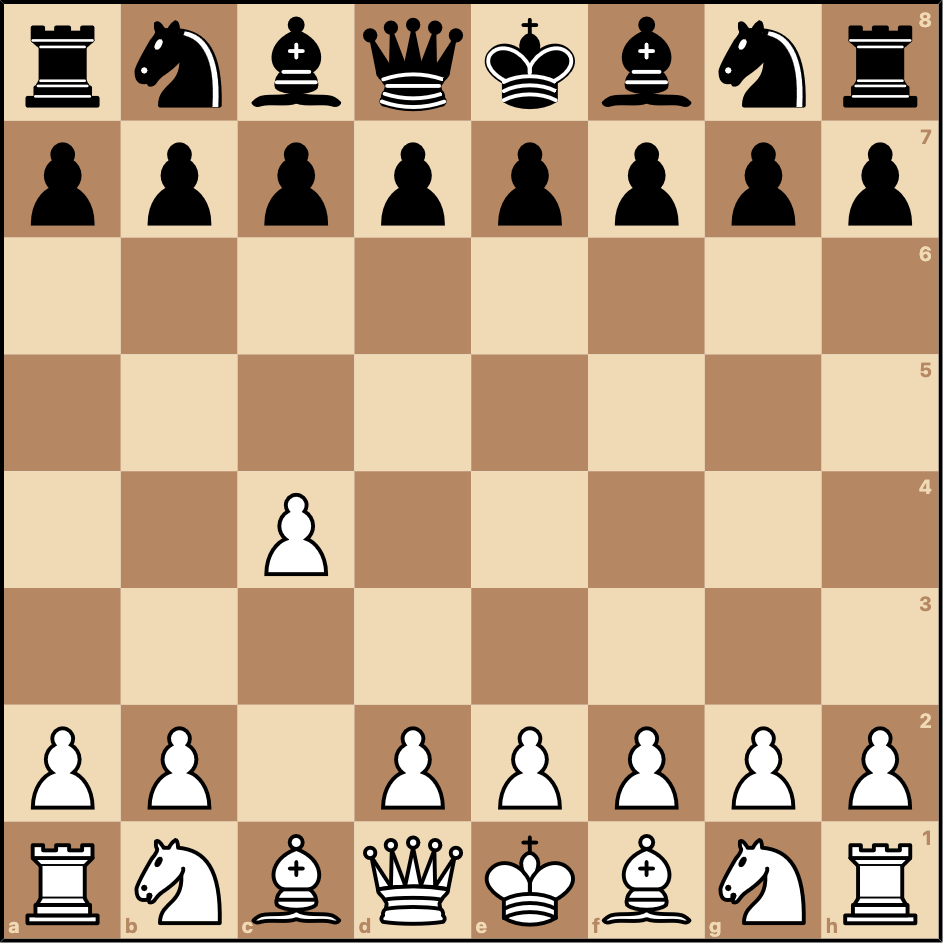
1. c4The c-pawn moves from c2 to c4 and attacks d5. White often follows with Nc3, g3, Bg2 and Nf3, but the order can change. One of the main advantages of 1.c4 is the ability to delay committing the d- and e-pawns while watching Black’s setup.
Three major responses to the English Opening
| Black reply | Common name | Typical character |
|---|---|---|
| 1…e5 | Reversed Sicilian / King’s English | Asymmetrical central fight with colors reversed from many Sicilian structures |
| 1…c5 | Symmetrical English | Both sides claim queenside space and contest the d4 and d5 squares |
| 1…Nf6 | Anglo-Indian setups | Flexible development that can transpose into Indian Defense structures |
These are broad families. A specific name may change after the next several moves, and some lines transpose to the Queen’s Gambit or Réti systems.
The Reversed Sicilian after 1…e5
After 1. c4 e5, Black occupies the center with the e-pawn while White’s c-pawn attacks d5. A sample development plan is 2. Nc3 Nf6 3. g3. White may place a bishop on g2 and develop the knight to f3, maintaining pressure on central and queenside squares.
It is often called a Reversed Sicilian because the pawn structure resembles some Sicilian Defense positions with colors switched. However, having an extra tempo changes the exact tactical details. Do not assume that every Sicilian variation can be copied move for move.
The Symmetrical English after 1…c5
After 1. c4 c5, both sides have advanced the c-pawn. The game can become positional, with each player maneuvering around the central d4 and d5 squares. White may develop with Nc3, Nf3 and g3, while Black chooses between …Nc6, …Nf6 and other setups.
Symmetry does not guarantee a draw. White’s move order and Black’s decisions about the center can create imbalances. A useful training exercise is to identify which side can achieve the d4 or …d5 break under favorable conditions.
Anglo-Indian and transposition possibilities
After 1. c4 Nf6, Black keeps several central plans available. If White follows with d4, the game may transpose into a queen-pawn or Indian Defense structure. If White instead uses g3 and Bg2 without d4, the resulting position may retain a distinctly English character.
This flexibility is useful, but it also means players need to understand pawn structures rather than memorize a single line. Before choosing a move, ask whether it changes the central pawn tension or commits your king to a particular side.
A beginner-friendly setup for White
- Start with 1.c4 and identify Black’s response.
- Develop the queen’s knight to c3 when safe and useful.
- Consider g3 and Bg2 to influence the long diagonal.
- Develop the king’s knight, often to f3.
- Castle once the king’s path is clear and the position supports it.
- Prepare d4 or e4 only when your pieces can support the central advance.
- Watch for Black’s …d5 break, which may challenge your c4 pawn directly.
This is a framework, not a forced move order. Against an unusual Black reply, calculation and basic opening principles come first.
Black’s practical plan against 1.c4
Black can choose active central occupation with …e5, symmetry with …c5 or flexible development with …Nf6. Each is a legitimate strategic approach. In many positions, Black aims to play …d5 under favorable circumstances, develop pieces efficiently and avoid allowing White to gain uncontested queenside space.
Beginners should not respond to the English by making random pawn moves on the wing. Focus on the center, complete development and check whether White threatens a central break or a pawn capture.
English Opening versus Queen’s Gambit
The English starts with 1.c4; the Queen’s Gambit typically begins 1.d4 d5 2.c4. In both cases, White’s c-pawn pressures d5, but the move order changes Black’s options. Starting with c4 allows White to delay d4 and choose a flexible structure.
Some English lines transpose into Queen’s Gambit positions. Others remain distinct, especially after …e5. For the standard queen-pawn setup, see our Queen’s Gambit guide.
Common mistakes to avoid
- Playing the same setup against every response: Black’s …e5 and …c5 lead to different central plans.
- Delaying development indefinitely: Flexibility is useful only if pieces reach active squares.
- Ignoring the d4 and d5 breaks: These central advances often define the middlegame.
- Confusing transpositions: A familiar-looking position may differ by a tempo or a pawn move.
- Moving the queen too early: Black can gain time by developing with attacks.
- Assuming the English is passive: It can lead to active queenside pressure and tactical play.
Frequently asked questions
What is the first move of the English Opening?
White plays 1.c4.
Is the English Opening good for beginners?
Yes, although its flexible move orders can be confusing at first. Learn a simple setup and focus on central control.
Is the English Opening aggressive?
It can be positional or tactical, depending on Black’s reply and both players’ pawn breaks.
Can the English become a Queen’s Gambit?
Yes. Some move orders transpose into queen-pawn openings when White later plays d4.
What is the Reversed Sicilian?
It is a common name for English Opening structures after 1.c4 e5, where the central pawn pattern resembles a Sicilian Defense with colors reversed.
Takeaway
The English Opening begins with 1.c4 and emphasizes flexible central control. Learn how to respond to …e5, …c5 and …Nf6, then study the pawn breaks that shape each structure. For help understanding the notation, read our chess notation guide.

Other Articles