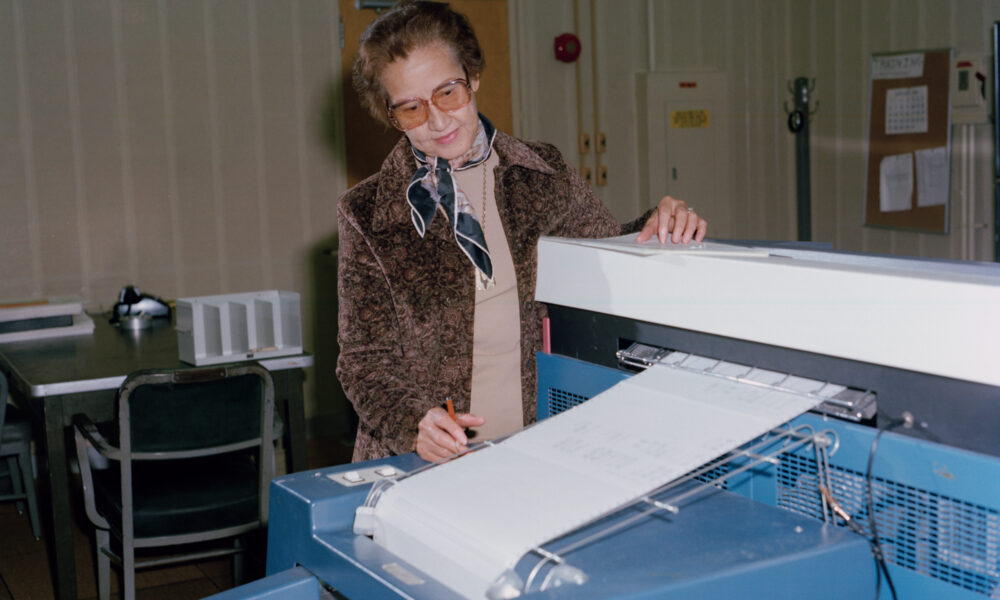

Katherine Goble and Katherine Johnson were the same pioneering NASA mathematician. Born Katherine Coleman in 1918, she used the surname Goble during her first marriage and later became widely known as Katherine Johnson. Her precise calculations supported America’s early human spaceflight program, including Alan Shepard’s 1961 mission, John Glenn’s 1962 orbital flight and crucial planning for Apollo’s lunar missions. She was a mathematician and research author—not an astronaut—and her work was part of a much larger engineering effort at NASA.
Who was Katherine Goble?
Katherine Goble is a name that appears in historical accounts of the woman later celebrated as Katherine Johnson. Her first husband was James Goble, whom she married before joining the National Advisory Committee for Aeronautics (NACA). He died in 1956; she subsequently married James Johnson in 1959. Biographies, archives and film discussions therefore sometimes use different surnames for the same person. Searching for Katherine Goble does not reveal a separate NASA astronaut or a different mathematician.
She was born Creola Katherine Coleman on August 26, 1918, in White Sulphur Springs, West Virginia. Exceptional ability in mathematics led her to accelerate through school. She graduated from West Virginia State College in 1937 with degrees in mathematics and French, later taught, and briefly attended graduate courses at West Virginia University. NASA’s own detailed biography of Katherine Johnson documents her education, family history and research career.
Timeline: from Katherine Coleman to a NASA research mathematician
| Year | Event | Why it matters |
|---|---|---|
| 1918 | Born Katherine Coleman in West Virginia | Her mathematical ability became evident in childhood. |
| 1937 | Graduates from West Virginia State College | Mathematics and French formed the foundation of her career. |
| 1953 | Joins NACA’s Langley laboratory | Begins working with the human-computing teams performing technical calculations. |
| 1956 | James Goble dies | Historical records from this period may call her Katherine Goble. |
| 1959 | Marries James Johnson | Her surname becomes Johnson. |
| 1960 | Coauthors an orbital mechanics research report | Receives formal authorship credit for significant technical work. |
| 1961 | Calculations support Alan Shepard’s flight | Trajectory planning for the first American in space. |
| 1962 | Checks John Glenn’s orbital calculations | Hand-verifies computer output before his Friendship 7 flight. |
| 1969 | Apollo 11 Moon landing | Her work contributed to Apollo mission trajectory and rendezvous planning. |
| 1986 | Retires from NASA | Concludes a 33-year career at Langley. |
| 2015 | Receives the Presidential Medal of Freedom | National recognition of her scientific contributions. |
| 2020 | Dies at age 101 | Her mathematical work remains part of spaceflight history. |
What did a NASA “human computer” actually do?
Before modern electronic systems became dependable, a “computer” could be a person whose job was to calculate, check and interpret numerical results. At Langley, these specialists worked with equations, tables and instruments to help researchers understand aircraft and spacecraft motion. The term described a job, not a mechanical machine.
When Katherine began at Langley in June 1953, NACA still operated the laboratory. NASA would be established in 1958. She was assigned to the West Area Computing group, led by Dorothy Vaughan, before moving to the Flight Research Division. According to NASA, early assignments involved analyzing aircraft flight-test data and investigating wake turbulence. She did not join an astronaut crew or pilot a spacecraft.
As the US space program expanded, she applied analytical geometry and numerical methods to new questions: how to send a spacecraft into a desired orbit, where it would be at a given moment and where a capsule could return safely to Earth.
Katherine Goble’s spaceflight mathematics: three landmark contributions
1. Calculations for Alan Shepard’s 1961 Freedom 7 mission
Alan Shepard became the first American to travel into space on May 5, 1961. His Freedom 7 flight was suborbital, meaning the craft rose above Earth and returned rather than completing a full orbit. Katherine Johnson performed trajectory analysis for the mission. That task connected flight geometry to an achievable launch profile and landing region. For background on the hardware used in the program, see our Mercury capsule guide.
2. Checking John Glenn’s orbital flight in February 1962
John Glenn orbited Earth aboard Friendship 7 on February 20, 1962. Unlike Shepard’s shorter suborbital flight, orbital travel required calculations for repeated motion around Earth, reliable tracking and a safe return path. Electronic IBM computers processed the programmed equations, but Glenn wanted a separate verification of the numbers. Johnson checked them using the same mathematical framework and a mechanical calculator. Her verification helped establish confidence in the results; it did not replace every flight controller, engineer or onboard system.
NASA’s profile of Katherine Johnson explains her role in the Mercury and Apollo programs and why the verification became so well known. A “human computer” performing independent calculations illustrates a familiar engineering principle: for a safety-critical decision, don’t rely on a single unchecked result.
3. Lunar orbital rendezvous and Apollo
A Moon landing required more than reaching lunar orbit. The lunar module had to descend while the command and service module remained in orbit; after the astronauts left the lunar surface, the two spacecraft had to meet again. That made orbital geometry, timing and rendezvous calculations especially important.
Johnson later described this lunar-module/command-module coordination as one of her major contributions. Her career also encompassed work related to the Space Shuttle and the Earth Resources Technology Satellite, later known through the Landsat program. See our Apollo 11 timeline and Apollo lunar module explainer for the spacecraft and mission sequence. Johnson should be credited as a major contributor, not incorrectly portrayed as the lone person who designed or controlled Apollo’s entire navigation system.
What did her 1960 research paper establish?
In 1960, Johnson and engineer Ted Skopinski published Determination of Azimuth Angle at Burnout for Placing a Satellite Over a Selected Earth Position. The report laid out mathematical relationships for a spacecraft trajectory when a specific landing position was part of the mission design. NASA identifies it as a milestone because Johnson received author credit on a Flight Research Division research report at a time when women in technical teams were often overlooked. The paper is preserved in NASA’s Technical Reports Server; readers interested in the original equations can search its exact title there.
In practical terms, the research connected spacecraft motion with Earth’s changing position as the vehicle traveled. The details require orbital mechanics, but the underlying question is simple: given a desired recovery location, which launch and flight parameters make that result possible?
Was she one of NASA’s Hidden Figures?
Yes. Johnson, Dorothy Vaughan and Mary Jackson are among the NASA women featured in the 2016 film Hidden Figures, based on Margot Lee Shetterly’s book. Taraji P. Henson portrays Katherine Johnson. The film brought broad attention to scientific work previously unfamiliar to many viewers, but dramatized scenes should not be treated as a substitute for historical records. Her actual achievements can be traced through NASA biographies and research reports.
The history also concerns employment and recognition. Black women at Langley faced segregation and institutional barriers, yet performed complex scientific and engineering work. Johnson’s visibility should draw attention to the entire group of colleagues rather than erase their contributions.
How to check the facts behind Katherine Goble’s story
- Confirm the name: Search official NASA biographies for Katherine Johnson and the account of her marriage to James Goble.
- Separate the missions: Shepard’s Freedom 7 flew in 1961; Glenn’s Friendship 7 orbited Earth in 1962; the Apollo 11 lunar landing occurred in 1969.
- Read primary research: Look for her and Ted Skopinski’s 1960 paper in NASA’s technical report archive rather than relying on a movie scene.
- Credit teams accurately: Johnson’s calculations and checks were important, but NASA missions relied on many people, computers, mission controllers and astronauts.
Frequently asked questions
Is Katherine Goble the same person as Katherine Johnson?
Yes. The NASA mathematician Katherine Coleman used the surname Goble during her first marriage and later became known as Katherine Johnson. The names refer to one person.
Did Katherine Johnson calculate John Glenn’s orbit?
She checked the computer-generated orbital calculations for Glenn’s 1962 Friendship 7 mission at his request. She had also worked on trajectory analysis for earlier Mercury missions.
Did Katherine Johnson go to space?
No. She was a research mathematician working on aircraft and spacecraft trajectories, not an astronaut.
What did she contribute to Apollo 11?
Johnson’s work contributed to the mathematics of lunar flight, including coordination and rendezvous of the lunar module and command module. Apollo navigation and flight execution were a large team effort.
When did Katherine Johnson die?
She died on February 24, 2020, at age 101, having retired from NASA in 1986.
Why her legacy still matters
Johnson’s story is not simply that a mathematician could outperform a machine. It shows why clear models, independent verification, careful teamwork and recognition of skilled researchers matter when errors have serious consequences. The details—her changing surnames, her technical papers and the distinct missions she supported—are more instructive than a simplified legend. NASA’s documented account preserves those distinctions.