

Uranus has 13 known rings that encircle the ice giant around its equator. Although Saturn’s rings are brighter and far more familiar, Uranus’s dark, narrow rings are real and were first discovered in 1977, when the planet briefly dimmed a distant star as the rings passed in front of it. NASA’s Voyager 2 spacecraft examined them during its 1986 flyby. In 2023, the James Webb Space Telescope produced striking new infrared images showing their delicate structure alongside Uranus’s bright polar cap.
The two images used below are real space observations rather than illustrations: a 2023 Webb NIRCam photograph of Uranus and its rings, and a separate 1986 Voyager 2 photograph of its ring system. Both are locally hosted in AVARIXO’s Media Library with NASA source credits. This guide explains why the rings appear vertical, what they are made of, how Webb can reveal such faint details, and why a picture’s color cannot be confused with the view seen by the unaided eye.

Uranus’s rings at a glance
| Question | Verified answer |
|---|---|
| Does Uranus have rings? | Yes; 13 known rings, narrow and generally dark |
| When were they discovered? | 1977, during observations of the occultation of a background star |
| What do they orbit? | Uranus, close to its equatorial plane |
| Planet’s axial tilt | Approximately 98 degrees, almost on its side |
| Most prominent dense ring | Epsilon ring |
| Faint diffuse inner ring | Zeta (ζ) ring |
| Outer rings | Mu (μ) and Nu (ν), discovered with Hubble observations |
| First close spacecraft look | NASA Voyager 2, January 1986 |
| Webb photos in this article | 2023 near-infrared science observations |
The ring count and telescope findings are documented in NASA’s Webb 2023 Uranus report. Uranus’s tilt of about 97.8 degrees is described in the NASA Uranus facts page. Ring numbers and classifications reflect what scientists knew when those resources were prepared and may change if new structures are confirmed.
Why do Uranus’s rings look upright or vertical?
Uranus’s spin axis is unusually tilted, nearly 98 degrees relative to its orbital plane. The planet essentially spins on its side as it travels around the Sun. Its rings follow the equator of the planet, so their orientation in a telescope image changes with the viewing angle and Uranus’s season. In the February 2023 Webb photograph, the rings appear roughly upright on the screen, unlike the familiar more horizontal portrayal of Saturn’s rings.
That is not a rule that Uranus’s rings are physically vertical in all reference frames. Space has no universal up or down. A ring system can look edge-on, wide open, diagonal or nearly upright from Earth at different stages of the planet’s 84-year orbit. The photographic orientation also depends on how astronomers rotate an image for presentation.
What are the Uranus rings made of?
The rings contain many small particles with dark surfaces. Astronomers study their color and reflectivity to infer possible mixtures of water ice, radiation-processed carbon-rich material and rocky components. Unlike Saturn’s brilliant icy rings, Uranus’s main narrow rings generally reflect little sunlight. Some dust-rich rings are very faint and diffuse, while the better-defined dense rings stand out more strongly in certain wavelengths.
It is misleading to claim every ring is made exclusively of either rock or pure pristine ice. The exact mixture can vary between rings and is difficult to determine because individual small particles are not resolved as separate objects in ordinary telescope images. Scientists use spectra, brightness and orbital dynamics to infer what the material may contain.
What did James Webb photograph in April 2023?
Webb’s Near-Infrared Camera NIRCam observed Uranus on February 6, 2023. NASA released the image on April 6, 2023, showing the ice giant in a representative blue tone, a striking white seasonal north polar cap, bright clouds and many nested rings. NASA says the image combines two infrared bands at 1.4 and 3.0 microns, mapped to visible hues so people can understand information invisible to our eyes.
This is not a “live image from 2026,” nor a color photograph made by a person standing next to Uranus. It is authentic scientific imaging with standard astronomical processing. The official NIRCam image record specifies the observing date, instrument filters and processing credits.
What is Uranus’s polar cap?
The bright polar cap visible in infrared observations is related to the unusual seasons produced by the planet’s extreme tilt. Webb’s 2023 image shows the north polar region facing the Sun, a different part of the planet from what Voyager saw during its January 1986 encounter. The image also reveals bright cloud formations that NASA associates with possible storm activity at infrared wavelengths.
It would be inaccurate to say Uranus has a polar ice cap identical to Earth’s glaciers. The observed brightness pattern belongs to the giant planet’s atmosphere, where haze, clouds and circulation create complex light-scattering behavior.
Which of Uranus’s rings is the brightest?
The outermost of the original dense ring system, called the epsilon ring (ε), is especially conspicuous in many observations. The Zeta (ζ) ring is much fainter and diffuse and lies closer to the planet, making it challenging for conventional visible-light imaging. Two wider, more distant dust rings called mu (μ) and nu (ν) were identified in images from Hubble and were later investigated in other data.
Naming and discovery history matter: saying Uranus has only nine rings is an outdated reference to the earliest ring detections. NASA’s more recent Webb account refers to 13 known rings and notes that the telescope can show elusive components missed by many earlier views.
What did Voyager 2 see in 1986?
NASA’s Voyager 2 spacecraft made the only close spacecraft flyby of Uranus in January 1986. Along with new information about the planet’s atmosphere, magnetic field and moons, it returned images of the faint ring system and helped resolve their structure. Some photographs used special viewing geometries to make tenuous material stand out against space.
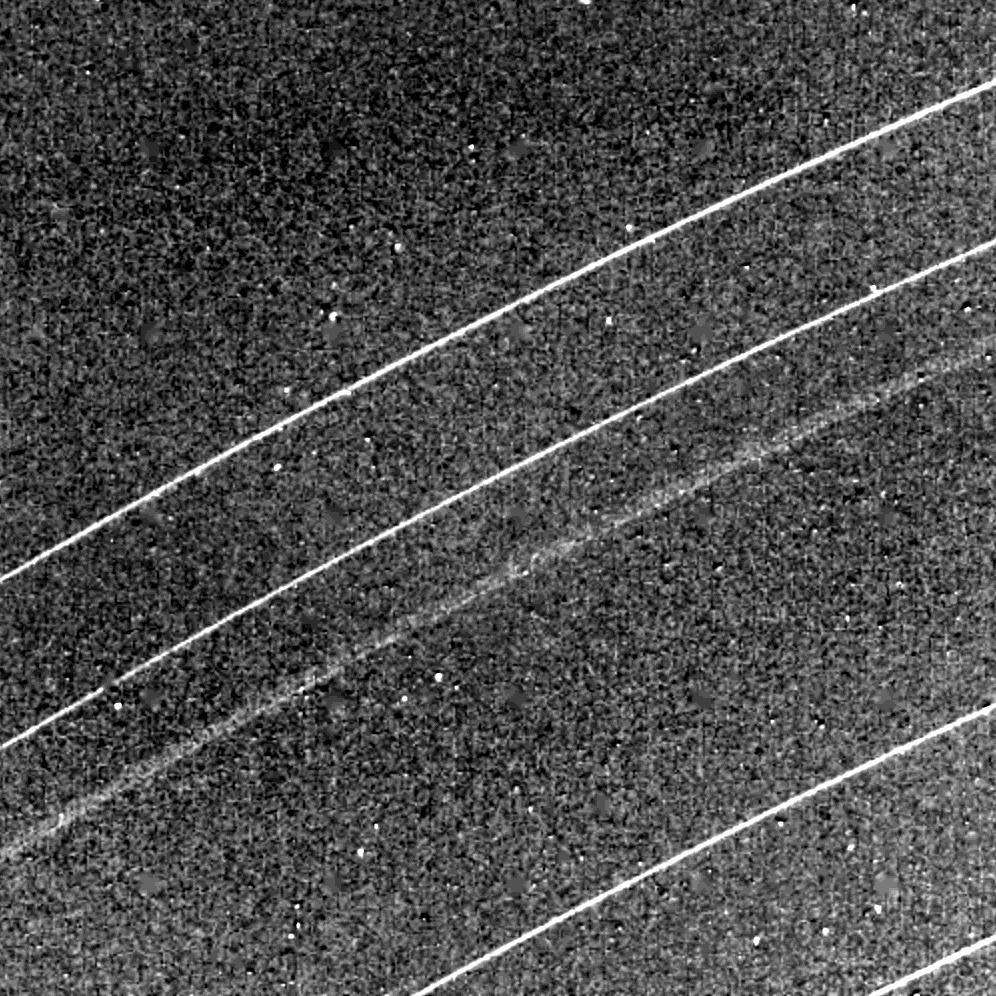
The second image comes from NASA’s original PIA01981 Rings of Uranus record. The viewing conditions and time are different from Webb’s 2023 near-infrared view. These are two separate observations from different missions, rather than one image recycled with a new filename.
How were the rings found before Voyager?
In 1977, ground-based astronomers watched Uranus pass in front of a background star. They observed that the star briefly dipped in brightness before and after the planet blocked it. The extra small dips indicated material around Uranus, leading to the discovery of the ring system. This method is called a stellar occultation, and it is powerful because even very faint rings can block some starlight.
It was not necessary to see a full bright circular ring in a photograph to identify the structure. The timing and pattern of dips allowed researchers to infer orbital positions of narrow belts of particles. Later spacecraft and space telescope observations refined the picture and found additional components.
Why are Uranus’s rings much less noticeable than Saturn’s?
Saturn’s rings contain extensive reflective ice particles and appear strikingly bright in many visible-light photographs. Uranus’s rings are generally darker, more narrowly confined and much less prominent in conventional views. Images often require careful exposure, wavelength selection or backlighting to reveal the rings without overwhelming the scene with the planet’s disk.
For comparisons among giant-planet exploration missions, our Juno spacecraft guide explains NASA’s direct investigations at Jupiter. Juno did not take the Voyager or Webb Uranus photographs; the internal link is broader context on studying the outer solar system with different kinds of instruments.
Do Uranus’s rings have moons?
Yes, many moons orbit the planet, and some small inner moons lie near the narrow rings. Gravitational interactions between moons and particles can influence the shapes of rings and may help confine edges. Researchers study the moon-ring system together rather than treating each ring as a perfectly unchanging circle floating independently.
The mu ring is linked to the small moon Mab in some NASA interpretations, and the dusty outer components show a different structure from the dense inner rings. These relationships are dynamic, and fine details continue to be studied.
Can you see Uranus’s rings through a home telescope?
For most backyard observers, no. Even Uranus itself usually appears as a tiny greenish or blue-green disk in moderate telescopes under good conditions. Its rings are extremely faint and small in angular size. The detailed structures visible in Webb and Voyager images rely on specialized instruments or close spacecraft geometry, not ordinary visual observing.
A large amateur telescope can show Uranus as a planetary disk, but expecting a vivid Saturn-style ring view will usually lead to disappointment. Photographs posted online may have been made with professional infrared detectors, strong processing or space telescopes; those choices should be disclosed.
Uranus rings frequently asked questions
How many rings does Uranus have?
NASA’s 2023 Webb documentation describes 13 known rings, including faint inner and outer dust components.
Are Uranus’s rings vertical?
No fixed orientation is intrinsically vertical. They lie around the planet’s equator; Uranus’s nearly 98-degree axial tilt makes them appear steeply oriented in some views.
When were the rings discovered?
1977, from dips in the light of a star passing behind Uranus and its surrounding particles.
Are Uranus’s rings made of ice?
They likely include ice and other material, but the particles tend to be much darker than bright Saturn ice; composition estimates vary by ring.
Did James Webb discover all the rings?
No. The original rings were discovered long before Webb. Webb’s 2023 images provided exceptionally clear infrared views of components already known, including difficult diffuse material.
What is the Zeta ring?
A very faint, diffuse inner ring near Uranus, challenging to observe in visible-light images.
Can I see the rings from Earth?
Not normally with a backyard telescope. Professional observatories can study them with specialized optics, infrared detectors and occultation measurements.
NASA science sources and real photo credits
The first original image is the unannotated Webb NIRCam Uranus photograph taken February 6, 2023 (NASA/ESA/CSA/STScI, processed by Joseph DePasquale). The second is NASA/JPL Voyager 2 PIA01981 taken January 23, 1986. Both real observations were uploaded to AVARIXO Media Library with ALT, credits and source references; NASA and ESA endorsement is not implied. Ring history and visibility are grounded in NASA’s Webb rings research and its Uranus facts guide.