Enceladus is a small, icy moon of Saturn with a global liquid-water ocean beneath its frozen surface. NASA’s Cassini spacecraft discovered that jets near the moon’s south pole eject water vapor, icy particles, salts and organic materials into space. The sprays emerge from long fractures nicknamed tiger stripes, and some particles help supply Saturn’s broad, faint E ring. Enceladus is about 313 miles (504 kilometers) across—tiny compared with Earth’s Moon, yet one of the most important places to study whether life could exist elsewhere.
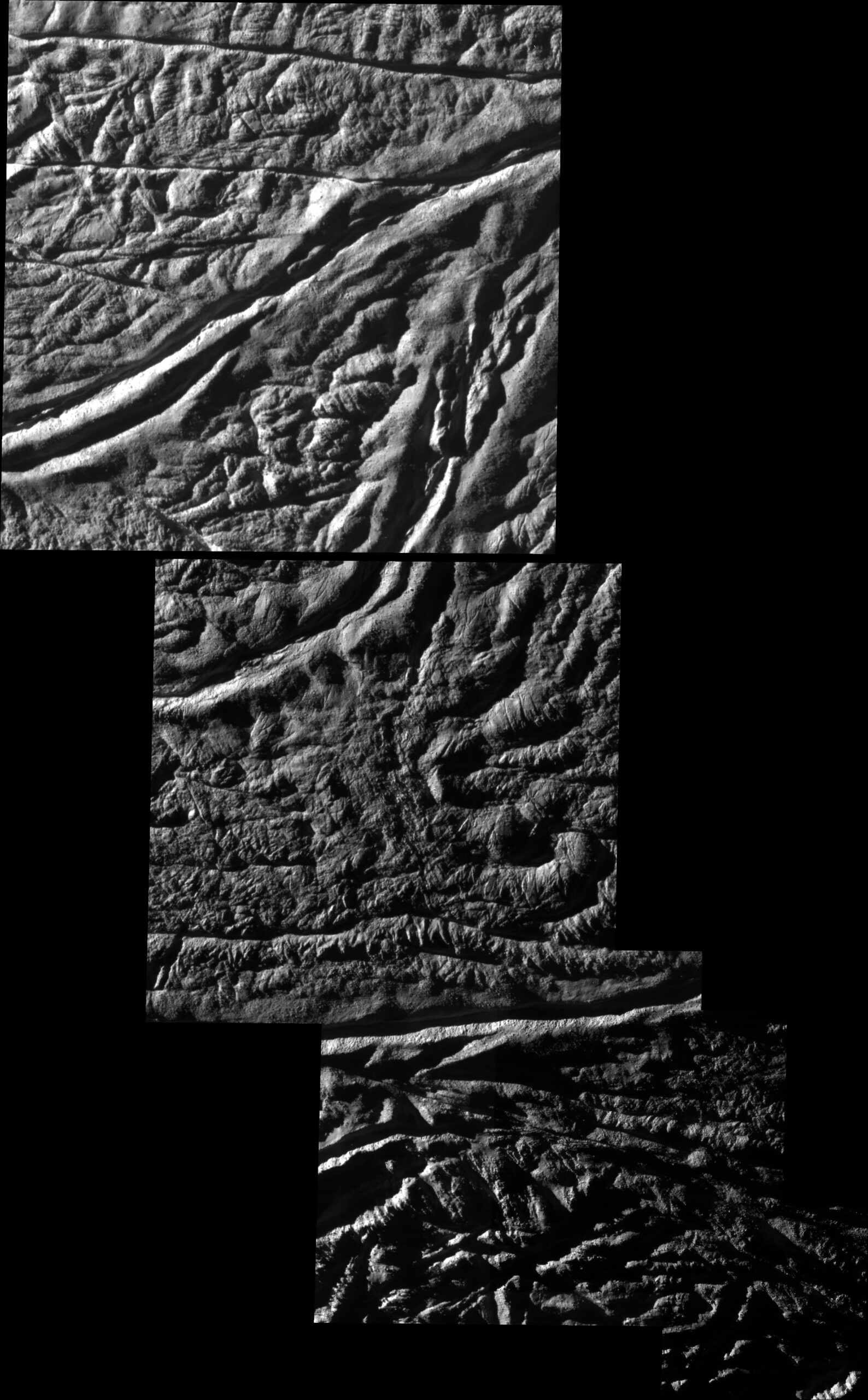
Two images here are real NASA Cassini spacecraft photographs, uploaded to AVARIXO with credits: a 2016 view of the bright icy world and a 2008 high-resolution mosaic of the south polar fractures. They are not artistic cutaway diagrams. The science explained below distinguishes strong evidence for an ocean, organic chemistry and potential habitability from something scientists have not confirmed: alien life.
Enceladus: essential facts
| Property | What scientists know |
|---|---|
| Planet it orbits | Saturn |
| Approximate diameter | 504 km / 313 miles |
| Surface | Extremely bright water ice, with young fractures and older cratered areas |
| Interior | Global subsurface salty ocean beneath an icy shell |
| Active south pole | Four major tiger-stripe fracture zones and geyser-like jets |
| Discovered | William Herschel, August 28, 1789 |
| Mission that investigated it | NASA/ESA/ASI Cassini-Huygens mission |
| Most important open question | Whether its environment has ever supported living organisms |
The NASA Enceladus overview and Cassini mission’s Enceladus science summary document its ocean, plumes and unusual brightness. NASA often rounds the width to 310 miles or 500 km; quoted values differ because of rounding, not because the moon changed size.
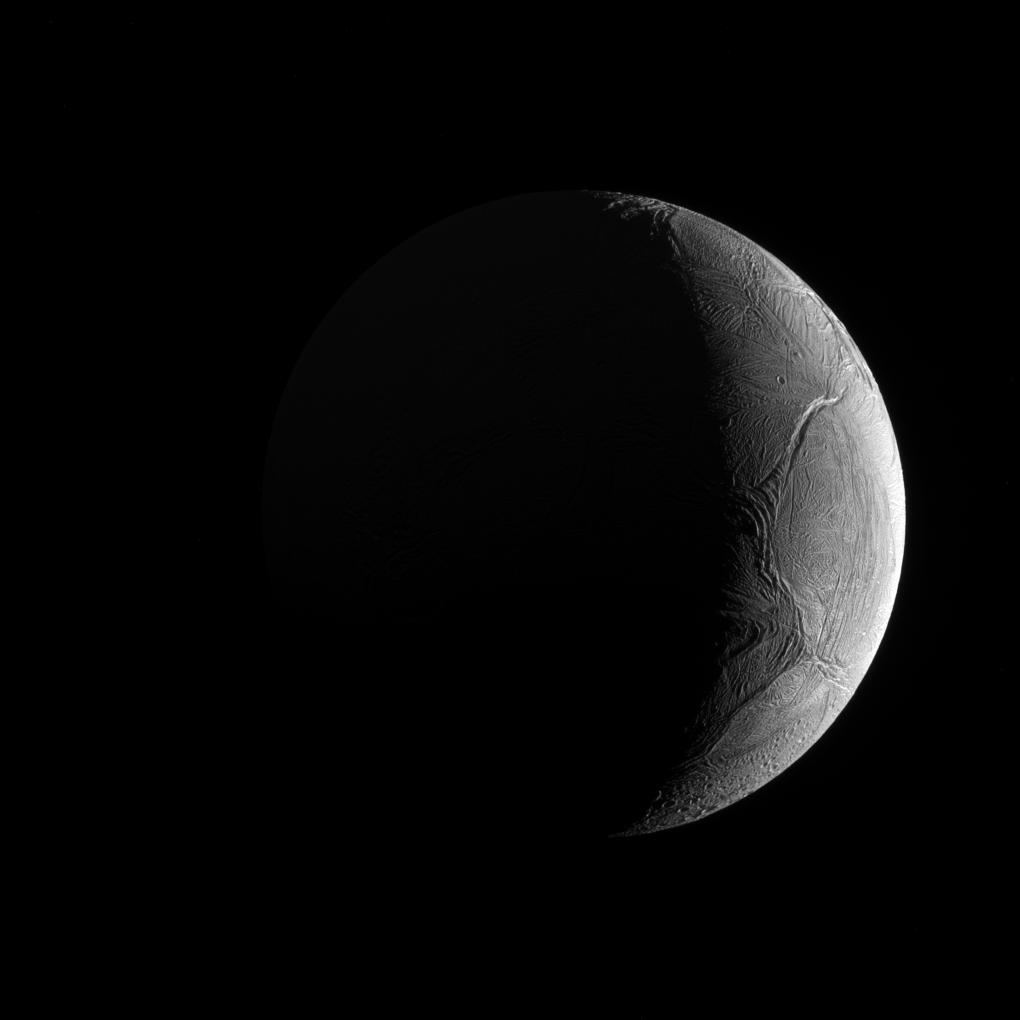
Why is Enceladus so white and reflective?
Its surface is coated in unusually clean water ice. Fine particles escaping in geyser-like plumes can fall back onto the moon, resurfacing terrain and covering older material with bright deposits. NASA describes Enceladus as one of the most reflective bodies in the solar system. Some regions remain older and cratered, while much of the south polar area shows a comparatively young, fractured appearance.
Reflecting sunlight is different from generating its own visible light. The moon is not a small sun, nor is the bright white surface evidence that it is warm enough for exposed liquid water lakes. Temperatures at the surface are extremely low, around minus 330°F (minus 201°C) in NASA’s overview, while liquid water exists much deeper below the crust.
Does Enceladus really have an ocean?
Yes, the evidence for a global subsurface ocean is strong. Cassini measurements of the moon’s tiny wobble, called libration, and gravity data indicated that the icy shell is separated from its rocky interior by a layer of liquid water. Plumes sampled by the spacecraft contain salts and other material consistent with contact between water and rock. This is not an ocean directly visible in the photographs; it lies beneath kilometers of ice.
NASA estimates that the ice shell may be as little as 1–5 kilometers thick near the south pole, with a rough global mean of 20–25 kilometers in some models. Those values remain model-based estimates, not a drilled measurement from the surface. The ocean is considered salty and likely in contact with the moon’s rocky core.
What are Enceladus’s tiger stripes?
The four prominent, roughly parallel south-polar fractures are informally called tiger stripes. Their names include Alexandria, Cairo, Baghdad and Damascus Sulci. Cassini observed that they are warmer than much of the surrounding ice, and that numerous jets of water vapor and tiny ice particles originate along them.
The second image below is a real Cassini close-up mosaic showing the Baghdad and Cairo fracture regions during the August 11, 2008 flyby. The folds and cracks are physical terrain—signs that the icy crust has experienced tectonic stresses. It is a different observing scene from the full-globe image above, and it does not pretend to show a cutaway into the hidden ocean.
How do the moon’s ice geysers work?
Saturn’s gravity flexes Enceladus slightly as it moves through its orbit. This process, known as tidal flexing, can help maintain heat inside the moon and influence stresses across the icy crust. In fractures connected to the ocean, water vapor and icy particles can escape upward, forming spectacular jets visible to Cassini against backlighting.
NASA reports that the plume material contributes to Saturn’s diffuse E ring. It is incorrect to say that Enceladus is an ordinary frozen rock with no active processes, but also misleading to claim that every plume is liquid water erupting directly as a massive waterfall into vacuum: expansion and cooling involve vapor, microscopic ice grains and changing physical conditions.
What did Cassini actually detect in the plume?
Cassini’s instruments measured several substances, including water vapor, molecular hydrogen, carbon dioxide, methane, ammonia and organic compounds. NASA’s account of the October 28, 2015 plume flythrough describes nearly 98% water vapor in one analyzed gas component, approximately 1% hydrogen and a mixture of other molecules. That result applies to those observations rather than defining an exact constant composition for every plume at every time.
Hydrogen is scientifically important because water-rock reactions at hydrothermal vents can produce chemical energy. On Earth, microbes near ocean-floor vents may use chemical energy without sunlight. NASA therefore considers an environment resembling the inner ocean of Enceladus potentially habitable. But organic compounds and hydrogen are not proof that anything is alive; they also form through abiotic chemistry.
Could life exist on Enceladus?
Astrobiologists examine three broad requirements: liquid water, usable chemical energy and biologically relevant chemistry. Enceladus appears to have all three, making it a strong target for future scientific exploration. Evidence for a global ocean, warm water-rock interactions and plume organics supports the idea of a potentially habitable environment.
However, no NASA mission has confirmed life on Enceladus. Cassini was not built with a comprehensive life-detection laboratory and its passes through the plumes had limited analytical capabilities. Future missions would need carefully designed instruments and measurements to distinguish biological evidence from natural nonliving chemical reactions. NASA makes this qualification explicit in its Ingredients for Life explanation.
What is hydrothermal activity below the ice?
Scientists infer that water interacting with a rocky seafloor at elevated temperature can produce minerals and dissolved gases, potentially creating hydrothermal environments. Cassini detected tiny silica-rich grains and hydrogen, which are consistent with hot water-rock reactions. Some models describe hydrothermal vent regions analogous in basic chemistry—not necessarily identical in biological ecology—to vents on Earth’s ocean floors.
See NASA’s Hydrothermal Activity science guide for mechanisms and evidence. The existence of hydrothermal conditions is scientifically exciting, but a hypothetical ecosystem is not a discovered ecosystem.
What happened to Cassini?
Cassini studied Saturn and its moons for more than a decade, revealing Enceladus’s geysers and hidden ocean. The mission ended with a deliberate entry into Saturn’s atmosphere in September 2017 to avoid contaminating potentially habitable moons with an uncontrolled spacecraft impact. The photos and measurements remain valuable, but any article claiming Cassini is still orbiting Saturn in 2026 is outdated.
For the entire mission and its major discoveries, see our Cassini mission guide. This article focuses on Enceladus itself—its size, science, ocean chemistry, south-polar terrain and habitability questions—not a duplicate general mission chronology.
Enceladus vs Europa: which moon is more likely to have life?
Both are compelling ocean worlds, but neither has confirmed organisms. Europa, a moon of Jupiter, has a deep suspected salty ocean beneath ice and shows signs of surface and interior interactions. Enceladus, a moon of Saturn, provides a particularly unusual advantage: it ejects material from its ocean into space, allowing instruments to sample that material without first landing and drilling through kilometers of ice.
There is no accepted single numerical ranking that proves which is more likely to harbor life. Each has different energy environments, uncertainties and mission-access opportunities. What we can say with confidence is that both are central to scientific discussions of habitability beyond Earth.
Enceladus frequently asked questions
What planet does Enceladus orbit?
Saturn. It is one of the planet’s many moons.
How big is Enceladus?
About 504 kilometers (313 miles) across.
Are the geysers evidence of life?
No. They are evidence of an active moon with a water-rich interior and organic chemistry, not definitive proof of biology.
Can you see Enceladus without a telescope?
No. Despite its high reflectivity, the moon is too small and distant for unaided-eye observation from Earth.
Is its ocean on the surface?
No. It lies beneath a thick icy shell.
Did Cassini land on Enceladus?
No. It flew past the moon and measured plume material using onboard instruments.
Does its plume create Saturn’s E ring?
Ice grains from the moon help maintain Saturn’s broad E ring, according to Cassini science results.
Are these pictures from 2026?
No. The authentic mission images date from 2008 and 2016; the labels make that clear.
NASA images and research sources
Our locally hosted photographs are official Cassini records PIA20522 (2016 Enceladus global view) and PIA11114 (2008 south polar fractures), courtesy NASA/JPL-Caltech/Space Science Institute. The science follows NASA’s Enceladus overview, Cassini Enceladus investigation and plume chemistry report. Images are real observations, not third-party watermarked photos or substituted generic ice textures, and NASA endorsement is not implied.