

What is the Dutch Defense?
The Dutch Defense is a chess opening for Black that begins 1. d4 f5. Black immediately uses the f-pawn to control the central e4 square and creates an unbalanced pawn structure. It is an ambitious response to White’s queen-pawn opening, but it also weakens some squares around Black’s king, so accurate development matters.
Unlike symmetrical 1. d4 d5 positions, the Dutch often leads to different plans for each side. Black may build a kingside initiative, while White aims to challenge the center and exploit dark-square weaknesses.
The first move and the opening position
1. d4 f5White’s d-pawn claims central space. Black’s f-pawn advances two squares to f5, controls e4 and signals a willingness to fight for the initiative. The move does not automatically attack the d4 pawn. Instead, it sets up a strategic battle over e4 and the center.
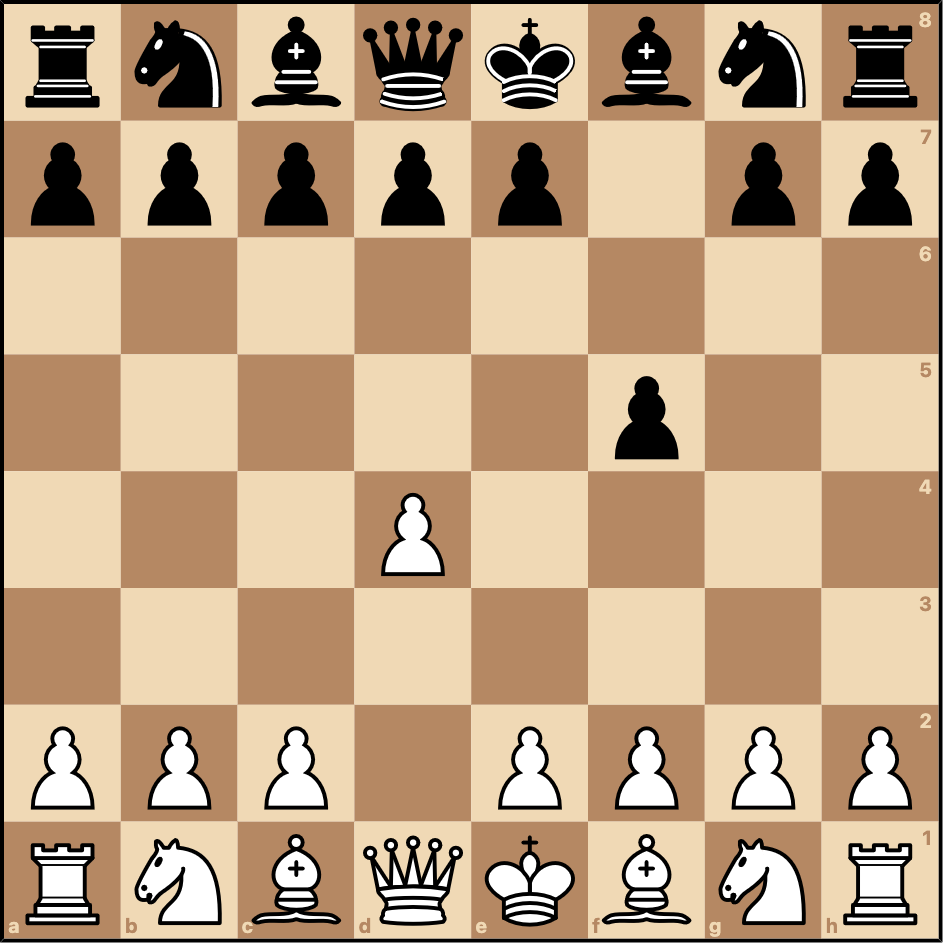
Three major Dutch Defense systems
| System | Typical Black setup | Strategic theme |
|---|---|---|
| Classical Dutch | …f5, …e6, …Nf6, …Be7 and often …d6 | Control e4 and seek kingside play |
| Stonewall Dutch | …f5, …e6, …d5 and …c6 | Strong e4 control and a fixed pawn chain, with dark-square tradeoffs |
| Leningrad Dutch | …f5, …g6, …Bg7 and …Nf6 | Fianchetto bishop, flexible central play and active kingside potential |
These are families of positions, not fixed move sequences. White’s choices can change whether Black’s preferred structure is practical.
How the Classical Dutch works
In Classical Dutch structures, Black often develops the knight to f6, the bishop to e7 and castles kingside. The e6 and d6 pawns may support a later central break with …e5. Black’s kingside pawns and pieces can generate pressure, but the king should be secured before launching an attack.
White commonly uses g3 and Bg2 to influence the center from a distance. White can also challenge the f5 pawn and look for opportunities to exploit the e6 square or open lines against Black’s king. Neither side should rush a pawn break without checking tactics.
Stonewall Dutch: strengths and weaknesses
The Stonewall typically includes Black pawns on f5, e6, d5 and c6. This structure gives strong control over e4 and can support a knight on e4. Black may develop the dark-squared bishop actively and aim pieces toward White’s king.
The tradeoff is that Black’s dark squares can become weak, particularly e5, and the light-squared bishop on c8 may struggle to find a good route. White often tries to exchange Black’s active bishop and establish a piece on e5. Understanding these squares is more useful than memorizing a tactical trap.
Leningrad Dutch: a different bishop setup
The Leningrad system usually puts Black’s dark-squared bishop on g7 behind a …g6 pawn. This creates long-diagonal pressure and leaves Black options for …d6 and …e5. Because the f-pawn has moved, however, Black must watch the king’s safety and the e6 square.
White may try to build a strong center with d4, c4 and Nc3, or use a fianchetto setup. Black should coordinate pieces before pushing more kingside pawns. A promising attacking position can become dangerous if the center opens while Black is underdeveloped.
White’s practical replies to 1…f5
White has several reasonable approaches. A conventional plan develops with g3, Bg2, Nf3 and c4, challenging the center and watching Black’s pawn breaks. More direct systems may include an early e4 attempt, but those require calculation and an understanding of the specific gambit.
White should not assume that …f5 is unsound simply because it weakens the king. The Dutch is a serious opening with established theory. Build development, maintain central flexibility and identify whether Black is heading for a Stonewall or Leningrad structure.
Dutch Defense versus King’s Indian Defense
Both openings can create dynamic play against 1. d4, but their starting ideas differ. The Dutch commits the f-pawn to f5 immediately, while the King’s Indian Defense usually begins with …Nf6 and …g6, delaying the central pawn decisions. In the Dutch, e4 control and the exposed f-file are immediate strategic factors.
The Dutch also differs from the Queen’s Gambit Declined, where Black typically supports a d5 pawn with …e6. Choosing an opening is partly a choice of pawn structure and the middlegame plans you want to learn.
Common beginner mistakes
- Ignoring the king’s weakened diagonal: The early f-pawn move creates tactical possibilities that must be monitored.
- Combining Stonewall and Leningrad plans at random: The bishop and pawn structures require different treatment.
- Playing …e5 before finishing development: An early pawn break may expose weaknesses.
- Forgetting the light-squared bishop: In Stonewall setups it can become restricted.
- Launching a pawn storm without central control: White may counter in the center while Black’s king is exposed.
A simple Dutch Defense study plan
- Learn why 1…f5 controls e4.
- Choose one setup: Classical, Stonewall or Leningrad.
- Identify the squares that your pawn structure weakens.
- Play training games at a time control that allows calculation.
- Review the first central pawn break in each game and whether it helped or hurt.
- Study how White uses g3, Bg2 and c4 against your system.
One coherent setup is more useful than memorizing many unrelated variations.
Dutch Defense FAQs
What is the first move of the Dutch Defense?
Black replies 1…f5 to White’s 1. d4.
Is the Dutch Defense aggressive?
It can be. The early f-pawn advance creates imbalance and opportunities for active play, but the position still requires careful development.
Is the Dutch good for beginners?
It can be a useful second opening to learn after basic development principles, especially if you enjoy strategic pawn structures.
What is the Stonewall Dutch?
A Dutch setup typically featuring Black pawns on f5, e6, d5 and c6, emphasizing e4 control.
What is the Leningrad Dutch?
A Dutch setup with …g6 and …Bg7, combining f5 control with a fianchetto bishop.
Final takeaway
The Dutch Defense is defined by 1. d4 f5. Learn the strategic differences between Classical, Stonewall and Leningrad setups, and watch the e4 and e5 squares. Sound development and king safety matter more than chasing an immediate attack. For help reading move sequences, consult our chess notation guide.

Other Articles

