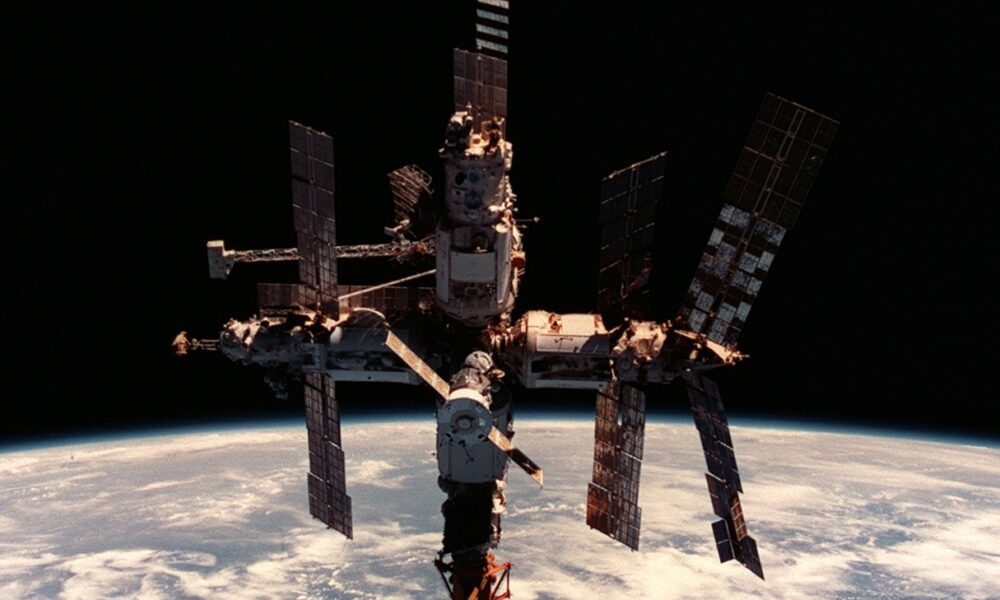

Quick answer: Mir was a Soviet-built, later Russian-operated modular space station in low Earth orbit from 1986 to 2001. Its core module launched on February 20, 1986, and additional research modules were added over the following decade. The station supported long-duration crews, international scientific experiments and NASA’s Shuttle–Mir partnership before being deliberately deorbited over the South Pacific on March 23, 2001. It was a crucial bridge between the single-module Salyut era and the International Space Station (ISS).
Mir space station: essential facts
| Question | Answer |
|---|---|
| What does Mir mean? | Russian for “peace” or “world,” depending on context |
| Core launched | February 20, 1986 |
| Operator | Soviet Union and, later, Russia |
| Orbit | Low Earth orbit, roughly 350–400 km in typical operations |
| Construction | Core module plus multiple science and equipment modules |
| Important international partnership | NASA Shuttle–Mir program in the 1990s |
| Final crew left | June 2000 |
| Controlled reentry | March 23, 2001, over the South Pacific Ocean |
| Famous challenges | 1997 fire and Progress cargo-ship collision |
NASA’s historical review of Mir’s final reentry and its Shuttle–Mir history document these dates and program events.
Why was Mir built?
Soviet planners already had experience operating Salyut space stations, but the earlier facilities were largely separate single-module laboratories. Mir introduced a more flexible idea: launch a core that could act as living quarters and command center, then connect specialist modules to docking ports as budgets, launch opportunities and research goals allowed.
That modular approach let the complex change over time. The first Mir crew arrived in March 1986; other elements followed in subsequent years. This architecture helped engineers learn how to maintain a large inhabited outpost in orbit, making it a direct predecessor to the much larger International Space Station.
What modules made up the Mir space station?
Mir did not appear fully assembled in one launch. Its final shape developed through a series of dockings and expansions.
| Element | Purpose |
|---|---|
| Core module (1986) | Primary living space, command systems, communications and life support |
| Kvant-1 (1987) | Astrophysics observations and supporting hardware |
| Kvant-2 (1989) | Environmental systems and facilities including an airlock for spacewalks |
| Kristall (1990) | Materials-science and other laboratory experiments |
| Spektr (1995) | Scientific experiments, including Earth observation and research facilities |
| Priroda (1996) | Earth observation and additional research instruments |
Mir’s large, multi-module appearance in 1998 photographs is therefore different from the relatively compact station that entered orbit in 1986. This is an important clue when identifying historical images: a fully assembled Mir photo cannot literally be a 1986 launch-day photograph.
How did astronauts and cosmonauts live on Mir?
Crews travelled mainly on Soyuz vehicles, while Progress cargo spacecraft delivered supplies and removed waste. Living aboard Mir meant maintaining life-support equipment, conducting research, exercising to counter the effects of microgravity and troubleshooting technical problems. The station contained workstations, sleeping spaces and exercise equipment, but personal space was limited.
Science and long stays
Work included space medicine, physiology, Earth observation, astronomy and studies of physical processes in microgravity. Long stays helped scientists understand how a human body adapts to extended spaceflight. NASA’s mission history records stays of more than a year, with Valeri Polyakov’s remarkable 437-day-plus single flight remaining a major endurance milestone.
Why a space station still needs regular deliveries
A station must continuously manage food, oxygen, water, spare parts and power. Solar panels generate electricity, but the crew cannot simply “grow” all vital consumables using sunlight. The need for resupply and repair is why visiting ships and safe docking systems are central to any long-duration orbital home.
What was the NASA Shuttle–Mir program?
During the 1990s, NASA and Russian space organizations used Mir as a place to practice the international operations later needed for the ISS. American Space Shuttles docked with Mir, carrying people and equipment. U.S. astronauts spent long periods aboard the Russian station and collaborated with Russian crewmates.
The first shuttle docking with Mir took place during STS-71 in June 1995, with Space Shuttle Atlantis. Later shuttle flights delivered supplies and returned U.S. astronauts from long-duration visits. Mir from NASA’s STS-91 mission in June 1998 is often used as the classic photograph of the station in its late configuration.
For a modern comparison to Earth-orbiting missions, see AVARIXO’s guide to tracking and viewing the International Space Station.
What went wrong aboard Mir in 1997?
Oxygen generator fire
In February 1997, a malfunctioning oxygen-generating device caused a fire and smoke aboard the station. Crew members responded with emergency equipment and managed the danger. The incident illustrated why life-support systems need multiple safeguards and well-rehearsed contingency procedures.
Progress collision with Spektr
In June 1997, a Progress cargo vehicle collided with Mir’s Spektr module during a docking experiment. The impact damaged the module and caused an air leak. The crew isolated the affected compartment to preserve the rest of the station’s atmosphere. The incident complicated science operations and station power management, but did not end the program immediately.
NASA’s detailed Mir historical account describes both emergencies and how the astronauts adapted. A sensational claim that Mir “exploded in 1997” is false.
Why was Mir deliberately brought down in 2001?
By 2001, the station was aging, costly to maintain and approaching the end of its planned operational usefulness. Engineers used a series of controlled maneuvers to lower the orbit, bringing Mir back into the atmosphere. Most of the spacecraft burned up; surviving fragments fell in a designated remote region of the South Pacific.
It was a planned reentry, not a spacecraft lost accidentally in a sudden crash. The date was March 23, 2001, and no crew was aboard. The ISS program was already underway, so retiring Mir did not stop human space station operations.
Mir versus the International Space Station
| Characteristic | Mir | ISS |
|---|---|---|
| First major module launched | 1986 | 1998 |
| Original program | Soviet/Russian | International partnership |
| Construction | Modules added over approximately a decade | Large international modular complex assembled over many missions |
| Research | Biology, medicine, materials and Earth observation | Broad international research in microgravity and technology |
| Final outcome | Deorbited in 2001 | Operational as of October 2026; future plans subject to partner decisions |
Mir showed that multi-year international cooperation in a confined orbital environment was possible even when old equipment required constant attention. The ISS combined these lessons with a much larger international design.
Frequently asked questions
Is Mir still in space?
No. It was deliberately deorbited on March 23, 2001.
Was Mir Russian or Soviet?
Its first modules launched under the Soviet Union. Russia continued operating the station following the Soviet Union’s collapse in 1991.
Did the Space Shuttle ever visit Mir?
Yes. U.S. shuttle crews made multiple visits and dockings in the 1990s.
Was Mir the first space station?
No. Soviet Salyut stations and the U.S. Skylab were earlier space stations. Mir became notable for its modular design and long operational life.
Did people die when Mir returned to Earth?
No crew was aboard during its controlled deorbit. NASA describes the reentry in an uninhabited Pacific area.
How is Mir pronounced?
Roughly “meer,” one syllable in English approximations.
Editorial check, October 2026. Primary sources: NASA Shuttle–Mir historical account and NASA on Mir’s final reentry.