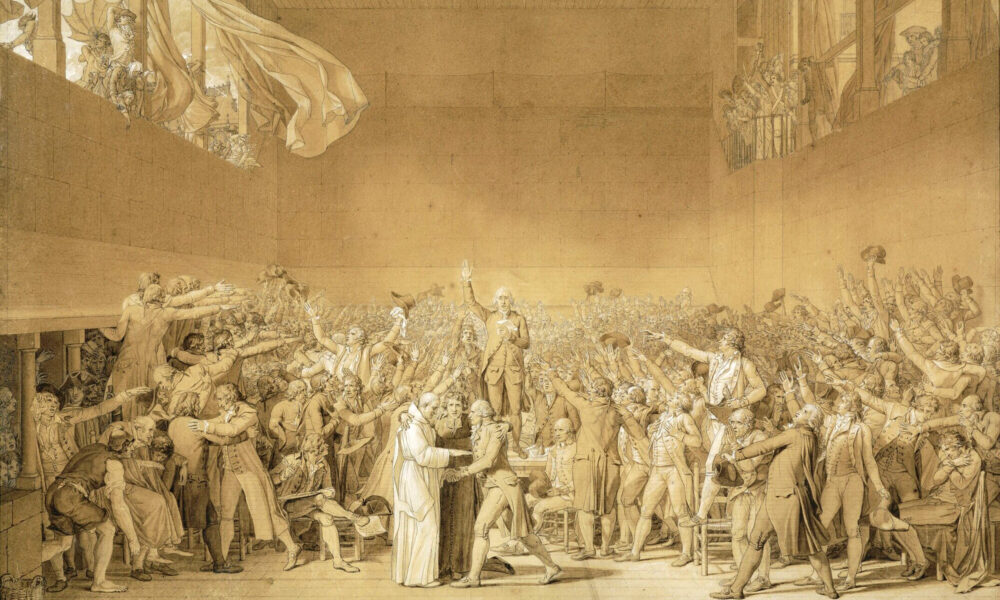

The Tennis Court Oath was a pledge taken on June 20, 1789, by members of France’s newly declared National Assembly in an indoor real-tennis court at Versailles. They promised not to disband until France had a constitution. The act transformed a political disagreement into a public claim that the nation’s representatives—not the king alone—could decide France’s constitutional future. It became one of the landmark early moments of the French Revolution.
Despite the name, this was not a tennis match, a modern sports rule or the signing of an already completed constitution. The date, location and political meaning are confirmed by the Palace of Versailles’ historical record and the French National Assembly’s history of 1789.
What was the Tennis Court Oath?
On Saturday, June 20, 1789, deputies meeting at Versailles found their usual meeting hall closed. They gathered in a nearby room used for jeu de paume, a precursor of modern tennis, and pledged to remain united as a National Assembly until a constitution for the kingdom had been established on solid foundations. The pledge was about political authority and representation, not about athletics.
Its immediate purpose was to prevent the deputies from being dispersed before they could carry out constitutional reform. Its larger historical meaning was the assertion that the representatives of the nation had the right to continue deliberating even without the monarch’s approval of their new political status.
When and where did the Tennis Court Oath happen?
Date: June 20, 1789. Place: the indoor Royal Tennis Court, or Salle du Jeu de Paume, near the Palace of Versailles, France. The hall was built in the 1680s and was a venue for real tennis, an older racket-and-ball game associated with royal and courtly recreation. It was not the kind of outdoor lawn-tennis venue familiar today.
The Royal Tennis Court can still be identified as a historic site in Versailles. The Palace’s official guide to the Royal Tennis Court explains how the room became a memorial to the 1789 event.
Why did the deputies take the oath?
1. France faced a political and financial crisis
King Louis XVI convened the Estates-General in May 1789 as the government struggled with severe financial problems and demands for reform. The assembly represented three traditional orders, or Estates: clergy, nobility and the Third Estate, which represented the commoners. The Third Estate represented most of the population but faced a voting structure that could allow the privileged orders to outvote it.
2. The Third Estate claimed to represent the nation
On June 17, 1789, deputies of the Third Estate, joined by some clergy, proclaimed themselves a National Assembly. That move challenged the assumption that the three orders should act as separate political bodies. The deputies argued that a legitimate legislature represented the nation as a whole.
3. Their usual meeting room was shut
Three days later, the deputies could not enter the hall where they normally met. The closure was interpreted as a threat to the assembly’s survival. Instead of abandoning their work, they gathered in the nearby real-tennis hall. The precise motivations behind every royal decision remain a matter for historians, but the official French parliamentary history explicitly records the closure and the deputies’ move to the Jeu de Paume room.
4. A common pledge kept the new assembly together
The oath committed the members to continue meeting wherever circumstances demanded until the kingdom had a constitution. That made their unity and constitutional objective visible to the public. A dispersed set of individual deputies had become a body determined to keep acting as a national legislature.
What did the Tennis Court Oath actually promise?
In plain language, the deputies pledged not to separate and to reconvene wherever necessary until France’s constitution was established. The statement did not immediately abolish monarchy or produce a final constitutional text that day. Its revolutionary significance lay in insisting that the assembly could not simply be shut down while its constitutional work remained unfinished.
The Palace of Versailles preserves the contemporary wording and historical context in its account of the oath. The National Assembly’s own historical timeline traces the declaration of the National Assembly on June 17, the oath on June 20 and the subsequent evolution into a constituent body.
Who took part in the Tennis Court Oath?
The participants were overwhelmingly deputies of the Third Estate, joined by some representatives of the clergy and other supporters of the assembly’s constitutional mission. The number is commonly described as more than 500 deputies; this is not a claim that every representative of all three Estates had joined. The Versailles restoration account uses the figure of over 500 for the gathering.
Jean-Sylvain Bailly presided over the assembly and read the oath. Jean-Joseph Mounier proposed the oath as a way to bind deputies together; representatives including Antoine Barnave and Isaac Le Chapelier helped draft it, according to Versailles’ historical account. Political thinkers such as Abbé Sieyès were important in the broader dispute over the nation’s representation, although that is not the same as saying Sieyès alone authored the oath.
What happened after June 20, 1789?
| Date | Event | Connection to the oath |
|---|---|---|
| May 5, 1789 | Estates-General meets at Versailles | Begins the institutional crisis over representation and voting. |
| June 17, 1789 | Third Estate deputies declare a National Assembly | Challenges separate voting by Estate and claims national legitimacy. |
| June 20, 1789 | Tennis Court Oath | Deputies pledge to continue until a constitution is established. |
| June 23, 1789 | Royal session and renewed political confrontation | Assembly members continue resisting demands to return to separate sessions. |
| June 27, 1789 | King orders remaining orders to join the assembly | The national assembly’s position is strengthened. |
| July 9, 1789 | National Constituent Assembly formally takes shape | Constitution-writing becomes an explicit institutional role. |
| July 14, 1789 | Storming of the Bastille | A distinct but pivotal later event in the accelerating Revolution. |
| August 1789 | Abolition of feudal privileges and Declaration of the Rights of Man and of the Citizen | Broader revolutionary reform proceeds after the oath. |
The timing is crucial: June 20 is the oath, not the Bastille. The Bastille was stormed on July 14, nearly a month later, and the two events should not be merged into one date in an assignment or timeline.
Why was the Tennis Court Oath important to the French Revolution?
Its importance has three layers. First, the oath helped the newly formed assembly resist dissolution and maintain solidarity. Second, it made constitutional government an explicit political demand. Third, it symbolized a transfer of legitimacy: national representation, rather than royal permission alone, was increasingly invoked as the basis of political power.
This is why historical accounts frequently call the oath an early founding moment of modern French representative politics. However, it did not complete the Revolution, guarantee equality immediately or make France a republic in June 1789. Constitutional struggles, protests, reform decrees and further conflicts followed over the coming years.
Was this a real tennis court?
Yes, but the word tennis needs historical context. The French jeu de paume was an early ball game played in dedicated enclosed courts, ancestral to the sport later known as real tennis. It was not a modern hard-court or grass-court tournament. The hall’s use as a political meeting place was improvised because it had sufficient indoor space for the deputies.
For a comparison with today’s game, AVARIXO’s modern tennis court dimensions guide describes the very different familiar singles and doubles court. The 1789 oath, by contrast, concerns the history of democracy and constitutional politics.
What does Jacques-Louis David’s Tennis Court Oath artwork show?
French artist Jacques-Louis David created a celebrated artistic treatment of the oath after the 1789 event. The large, ambitious project was left unfinished. The image used with this article is a reproduction of David’s historical depiction, now public domain; it is not a photograph or a literal contemporaneous record of each participant’s position.
The composition emphasizes the assembly’s collective commitment, gestures of agreement and the dramatic moment of political unity. As with any later historical artwork, it is valuable for understanding how the event was represented and remembered, but eyewitness records and the official historical chronology are stronger evidence for exact dates and proceedings.
Tennis Court Oath: cause, event, result and significance
| Question | Short answer |
|---|---|
| What caused it? | Conflict over political representation and the closure of the deputies’ regular assembly hall. |
| Who acted? | Deputies of the National Assembly, predominantly the Third Estate with some allies. |
| When was it? | June 20, 1789. |
| Where? | Royal Tennis Court, Versailles, France. |
| What did they promise? | To stay united and continue meeting until France had a constitution. |
| Immediate effect? | Reinforced the assembly’s resolve against attempts to disperse it. |
| Long-term significance? | Symbolized constitutional reform and the claim of national sovereignty. |
Frequently asked questions
What is the Tennis Court Oath in one sentence?
It was the June 20, 1789 pledge by France’s National Assembly members not to disband until the country had a constitution.
When was the Tennis Court Oath signed?
June 20, 1789, in the Salle du Jeu de Paume at Versailles.
Who led the Tennis Court Oath?
Jean-Sylvain Bailly presided at the meeting and read the oath; Jean-Joseph Mounier was instrumental in proposing the pledge.
Was the Tennis Court Oath the beginning of the French Revolution?
It was a major early milestone, but France’s crisis and the Estates-General had already begun. Historians often place it among the foundational political acts of the Revolution rather than treating it as the only starting point.
Did the Tennis Court Oath end the monarchy?
No. The oath demanded a constitution while the monarchy still existed. France’s political transformation continued through subsequent events and decisions.
Was the Tennis Court Oath about the sport of tennis?
No. It took its name from the room where deputies gathered. The event concerned constitutional government and national representation.
Was the Tennis Court Oath on June 20 or June 23?
June 20, 1789. June 23 was a later royal session and political confrontation. Confusing those two dates is a common timeline error.
Primary sources and image attribution
Historical details checked October 11, 2026 against the Palace of Versailles — Jeu de Paume Oath, 1789, the French National Assembly — History of the National Constituent Assembly, the Versailles Royal Tennis Court historical site, and Encyclopaedia Britannica — Tennis Court Oath.
Featured image: Jacques-Louis David, Le Serment du Jeu de paume, a historical artistic depiction of June 20, 1789. Public-domain artwork, Wikimedia Commons. Not a photograph of the event; image not altered by AVARIXO.


