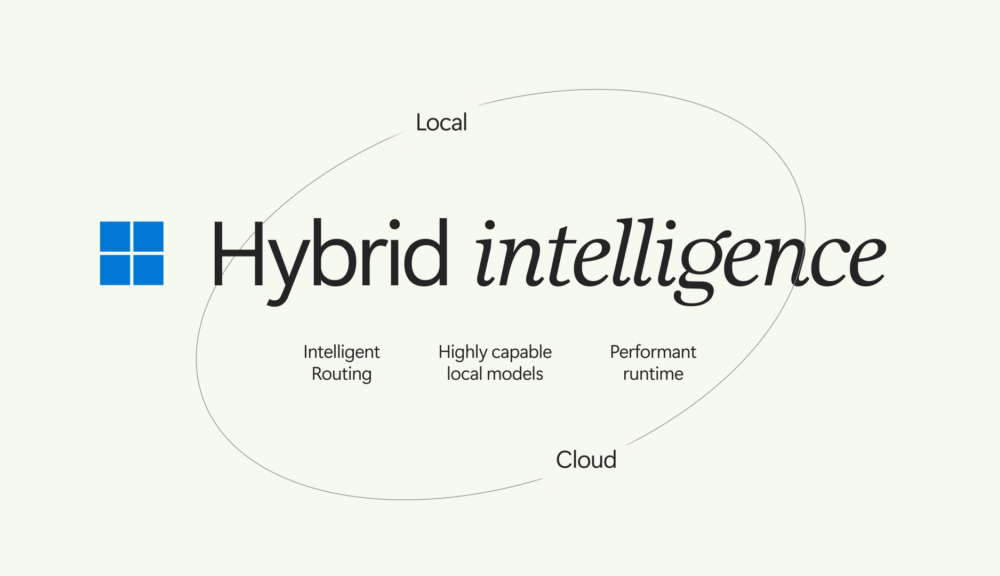

Quick answer: Microsoft is turning Windows into what it calls a “hybrid intelligence” platform, where AI work can run locally on a PC when that is faster, cheaper or more private and move to cloud models when more capability is needed. The October 7, 2026 announcement includes local context and actions for Copilot, local large models on new high-memory PCs, intelligent model routing, generally available Microsoft Execution Containers and broader support for agentic workloads.
What is Windows hybrid intelligence?
Hybrid intelligence is Microsoft’s term for combining local AI on a Windows PC with cloud AI instead of treating the two as separate worlds. The system can route a task to the place that makes the most sense based on capability, latency, cost, privacy and available hardware.
The strategy is broader than a single Copilot feature. Microsoft is presenting it as a Windows platform direction that includes local models, agent security, model routing, new PC hardware and developer tooling.
Copilot will use local context with permission
Microsoft says Copilot on supported Copilot+ PCs will gain access to three new classes of local capability over the coming months:
- Local context: with permission, Copilot can understand relevant files and recent activity on the PC.
- Local actions: Copilot can carry out Windows tasks such as organizing files, helping with diagnostics, troubleshooting and workflows.
- Local models: Copilot can use models running directly on the PC when local compute is the better choice.
The company emphasizes that these capabilities are permission-based and are intended to work with its new containment and identity controls.
Microsoft Execution Containers are now generally available
One of the more technical but important parts of the announcement is Microsoft Execution Containers, or MXC. Microsoft says MXC is now generally available on Windows 11.
MXC is designed to isolate agent activity and enforce policies over which files and networks an agent can access. The idea is that autonomous or semi-autonomous AI agents need stronger controls than a conventional application because they can use tools, write code and take actions across a system.
Microsoft says agents and developer tools supporting MXC include OpenAI Codex, GitHub Copilot, OpenClaw, Replit, LM Studio, NVIDIA OpenShell and Unsloth AI, with additional support planned from other vendors.
Large AI models are moving onto the PC
Microsoft is also using new hardware such as NVIDIA RTX Spark to bring much larger models into local Windows workflows. Its October 7 announcement highlights MAI Code 1.1 Flash, a coding model with 137 billion total parameters and 6.8 billion active parameters, compressed to 3-bit precision for local use while supporting a 256K context window.
The company also says upcoming local options include an NVIDIA Nemotron model with more than 70 billion parameters and DeepSeek V4 Flash, a 284-billion-parameter model, using aggressive quantization and high-memory systems to make them practical on local hardware.
That hardware push is visible in the newly announced Surface Laptop Ultra, which uses NVIDIA RTX Spark and can be configured with up to 128GB of unified memory.
GitHub HydraFusion adds local model routing
Microsoft says GitHub’s HydraFusion model-routing system is being extended to Windows so it can select between models in the cloud and models running on the local device. Experimental preview support is planned later in October for the GitHub Copilot app, GitHub Copilot CLI and Visual Studio Code.
This is one of the clearest examples of hybrid intelligence in practice: the user does not necessarily have to decide manually where every request runs. Routing logic can choose a model based on the task and resources available.
llama.cpp support is coming to Windows ML
Microsoft also announced llama.cpp support in Windows ML. That should make it easier for developers to experiment with open-source and open-weight models while using Windows’ GPU, NPU and CPU runtime stack.
For developers, this matters because llama.cpp has become a widely used way to run quantized models locally. Integrating it more directly with Windows ML reduces the gap between community model tooling and Microsoft’s native AI runtime.
Why Microsoft is pushing local AI now
Cloud inference can be powerful, but it has recurring costs, latency and data-transfer considerations. Microsoft argues that customers increasingly want to preserve access to frontier cloud models while moving suitable tasks to local hardware.
That can make sense for repetitive workloads, private local context, offline or low-latency interactions and tasks that do not require the largest available cloud model. The tradeoff is that local AI performance depends heavily on RAM, memory bandwidth, accelerator hardware and model compression.
Which PCs will support the new Copilot features?
Microsoft says Copilot features powered by hybrid intelligence are expected to begin rolling out on Copilot+ PCs over the coming months. More demanding local-model workloads require higher-end systems with much more memory and compute.
The company is therefore describing several tiers of hardware, from mainstream Copilot+ PCs to “builder” PCs based on platforms such as RTX Spark and larger deskside systems for heavier AI work.
What changes for ordinary Windows users?
The immediate impact will be gradual rather than a single Windows update that changes everything overnight. Search, Copilot and agent experiences are expected to gain more local context and actions over time. Most users will not suddenly begin running 100-billion-parameter models on a thin laptop.
The more important long-term shift is architectural: Microsoft wants Windows to decide more intelligently when work should happen on the PC and when it should use the cloud.
How this differs from today’s Copilot+ PC features
Current Copilot+ PCs already run many AI inferences locally for features such as imaging, search and video calls. Hybrid intelligence extends that concept into general-purpose agents and model routing rather than isolated device features.
Microsoft says Copilot+ PCs collectively run more than two trillion local inferences per month, and that over 40% of laptops being built for business are now Copilot+ PCs.
FAQ
Is Windows hybrid intelligence a new version of Windows?
No. It is Microsoft’s platform strategy for combining local and cloud AI capabilities across Windows, Copilot, developer tools and new hardware.
Will Copilot be able to access local files?
Microsoft says supported Copilot experiences will be able to use relevant local files and recent activity with the user’s permission.
What is MXC?
Microsoft Execution Containers are a containment system designed to control the files, networks and resources AI agents can access while running on Windows.
When will the new Copilot features roll out?
Microsoft says hybrid-intelligence-powered Copilot features are expected to begin rolling out to Copilot+ PCs over the coming months.

Other Articles