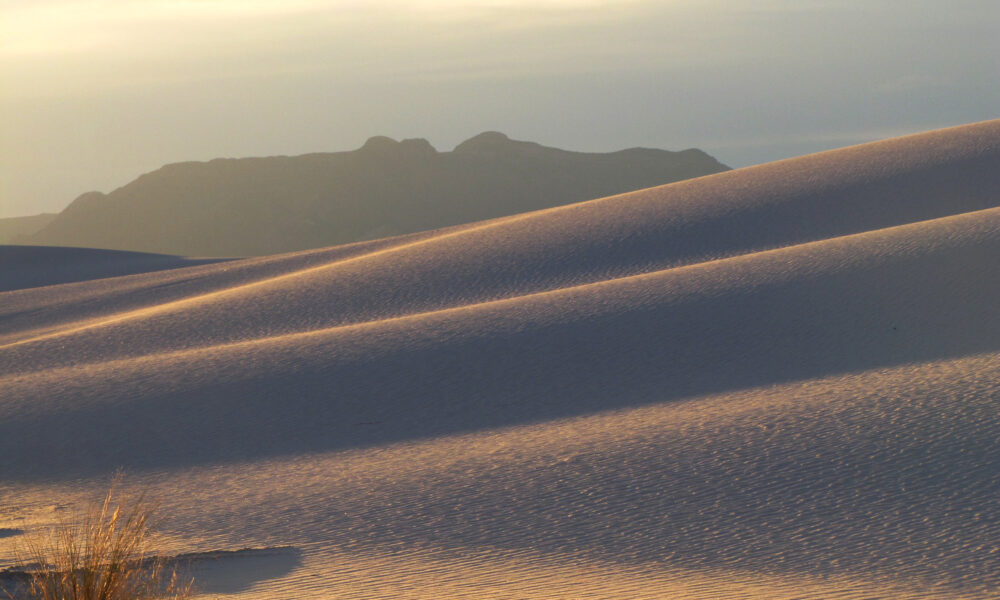

Quick answer (reviewed October 16, 2026): White Sands National Park is a field of brilliant white gypsum dunes in southern New Mexico, about 15 miles west of Alamogordo. You can drive the scenic Dunes Drive, hike marked routes, photograph the dunes and sled in designated areas. The standard private-vehicle entrance fee is $25, valid for seven consecutive days. The park normally opens at 7 a.m. and closes around sunset, but military testing can temporarily close its only road. Overnight camping inside the park is currently not permitted. Check the National Park Service current conditions before setting out.
Where is White Sands National Park?
White Sands lies in the Tularosa Basin of New Mexico, between desert mountain ranges. The park protects part of the world’s largest gypsum dunefield, which spans roughly 275 square miles. Its bright landscape is made of gypsum crystals that have been broken down and moved by wind, not snow and not a typical ocean beach. The official name is White Sands National Park; searches for “White Sand National Park” generally refer to the same place.
Use 19955 Highway 70 West, Alamogordo, NM 88310 for navigation. From Alamogordo, take US-70 west for approximately 15 miles. From Las Cruces, travel about 52 miles east on US-70. The NPS warns that typing only “white sands” into a navigation app can send drivers to nearby White Sands Missile Range instead of the national park. There is no public transit serving the park, and rideshares may not be available for the return journey. See the official directions for route details.
Hours and entrance fees in 2026
| Planning item | Official information | What to do |
|---|---|---|
| Park gates | Generally open at 7 a.m.; closing follows sunset and may vary seasonally | Check the NPS hours page for your visit date |
| Visitor center | Generally 9 a.m. to 5 p.m. | Ask rangers about weather and activities |
| Private vehicle entrance | $25, valid seven consecutive days | Keep your pass for reentry |
| Motorcycle entrance | $20, valid seven days | Confirm current pass details before arriving |
| On foot or bicycle, age 16+ | $15 per person, valid seven days | Children under 16 do not need this individual pass |
| Overnight camping | Closed within the park | Book lodging or camping outside the park |
Hours and fees can change. NPS lists closures on Thanksgiving Day and Christmas Day. Military activity and dangerous road conditions can cause additional temporary closures even when the usual operating schedule says open. Use the official operating-hours page and fee schedule rather than an old travel blog’s fixed seasonal timetable.
Best things to do at White Sands
1. Drive Dunes Drive and stop at the viewpoints
Dunes Drive is an eight-mile scenic road into the dunefield, forming a roughly 16-mile round trip from the visitor center. The NPS estimates about 45 minutes of driving without long stops. Plan more time to step onto the dunes, use picnic areas and take photographs. Sections are paved and others are hard-packed gypsum; sand drifts, wind and wet conditions can alter driving conditions. Ordinary passenger vehicles can generally use the road, but drive slowly and watch for visibility changes. See Dunes Drive road guidance.
2. Go sledding on the gypsum dunes
One of the park’s signature activities is sliding down dunes on a waxed plastic saucer. The NPS says saucers can be purchased or rented at the park gift shop, although availability is worth confirming. Choose a gentle slope with a broad, level stopping area and no plants, traffic, hard ground or other obstacles. Sit or lie with your feet facing downhill, never head-first or standing. Adults should supervise children.
Important restriction: Sledding is not permitted at the Interdune Boardwalk or the nearby protected dunes; use suitable areas elsewhere in the park. Even soft-looking sand can be hard at the base of a slope. Read the NPS sledding safety guidance first.
3. Choose a hike that fits your ability
| Trail | Approximate length | Best for |
|---|---|---|
| Interdune Boardwalk | 0.4 mile round trip | Short accessible walk, dune plants and desert wildlife |
| Dune Life Nature Trail | 1-mile loop | Families wanting a marked introduction to the dunes |
| Alkali Flat Trail | 5-mile loop | Experienced hikers prepared for deep sand, exposure and navigation |
The Interdune Boardwalk is the park’s wheelchair-accessible walking route. The Dune Life Nature Trail includes sandy climbs, while the Alkali Flat Trail is much harder than its name suggests: it traverses deep gypsum and typically takes three to five hours. Trails are marked with colored posts, but wind can hide or dislodge them. If you cannot see the next marker, turn around rather than continuing farther into the dunes. Carry ample water and sun protection even on apparently easy walks. Consult the NPS trail descriptions.
4. Photograph the dunes in lower-angle light
Late afternoon produces especially striking shadows over dune ripples. However, the park’s opening and closing times do not guarantee access at sunrise or long after sunset. Watch the clock and allow enough time to drive back out before the gate closes. Keep the sky, ridge lines and vegetation in the frame for a better sense of scale, and avoid trampling fragile interdune areas.
Can you camp at White Sands National Park in 2026?
No overnight stays are presently allowed inside White Sands National Park. NPS says its backcountry camping is closed while staff assess safety and environmental factors, with no reopening date announced. Older guides may still describe backcountry permits or a backcountry camping trail, but the presence of that trail does not mean overnight camping is available. For a stay, look for accommodations in Alamogordo or established campgrounds outside the national park and check those providers independently. The authoritative update is the NPS backcountry camping notice.
Missile testing, road closures and safety
The neighboring White Sands Missile Range conducts military testing. During tests, Dunes Drive may close for as long as about three hours, and US-70 may also be interrupted. Closures are not necessarily reflected in generic map apps or older travel articles. Read official planned closures and current conditions shortly before your trip, especially if driving from Las Cruces or passing through on a tight schedule.
Bring drinking water, a hat, sunglasses and sun protection. There is little shade in the dunefield, and walking up loose sand is more tiring than walking on a hard trail. Wind can erase footprints and obscure markers. Never rely on an assumption that you can simply follow your own tracks to the car. No fuel or electric-vehicle charging is provided at the park; the nearest services are in Alamogordo or Las Cruces.
Simple first-time itinerary: 2 to 4 hours
- Before departure: Confirm the day’s hours, missile-testing notices and the weather; fill your gas tank and carry water.
- First 20 minutes: Stop at the visitor center for ranger advice and an orientation to the gypsum dunes.
- Next 30 minutes: Walk the Interdune Boardwalk to observe plants, tracks and surrounding landscape.
- Next 60 to 90 minutes: Drive farther into the dunes, make a few photography stops and try a suitable sledding area if conditions are safe.
- Final 30 minutes: Enjoy the changing light, then allow time to return along Dunes Drive before closing.
This schedule is flexible. For a strenuous walk such as Alkali Flat, plan a separate hiking-focused visit instead of combining every activity in a short afternoon. If you are comparing distinctive U.S. national-park landscapes, our Haleakalā Crater hiking and sunrise guide explains another destination where timing, access and weather matter.
Frequently asked questions
Why is the sand white?
The dunes are made primarily of gypsum, a pale mineral deposited and concentrated within the Tularosa Basin. Wind shapes the grains into moving ridges and ripples. The official park site describes a gypsum dunefield covering roughly 275 square miles.
Is the park open all night?
No. It has controlled gate hours, and standard entry is not available 24 hours a day. Special ranger programs may operate at selected times; check the NPS calendar for tickets and eligibility.
Do you need a reservation to drive or hike?
Generally you need a valid entrance pass rather than a timed-entry reservation for normal daytime entry. Specific ranger-led programs can require reservations. Check the official park site before leaving.
Can visitors bring dogs?
Leashed pets are allowed on many walking routes under park restrictions. The NPS specifies a leash of no more than six feet on its Interdune Boardwalk information. Bring extra water and clean up after pets; protect their paws from hot surfaces.
Is White Sands worth visiting for one afternoon?
Yes, particularly if you focus on a scenic drive, a short walk and photography rather than a long hike. Two to four hours can offer a meaningful introduction, but closing times and missile-related road restrictions should decide your exact plan.
Information checked against the U.S. National Park Service on October 16, 2026. Fees, restrictions, access and reopening notices can change; verify the official links above for your travel date.

Other Articles
Jessica Meir: NASA Astronaut’s Spacewalks and 2026 Crew-12 Mission
