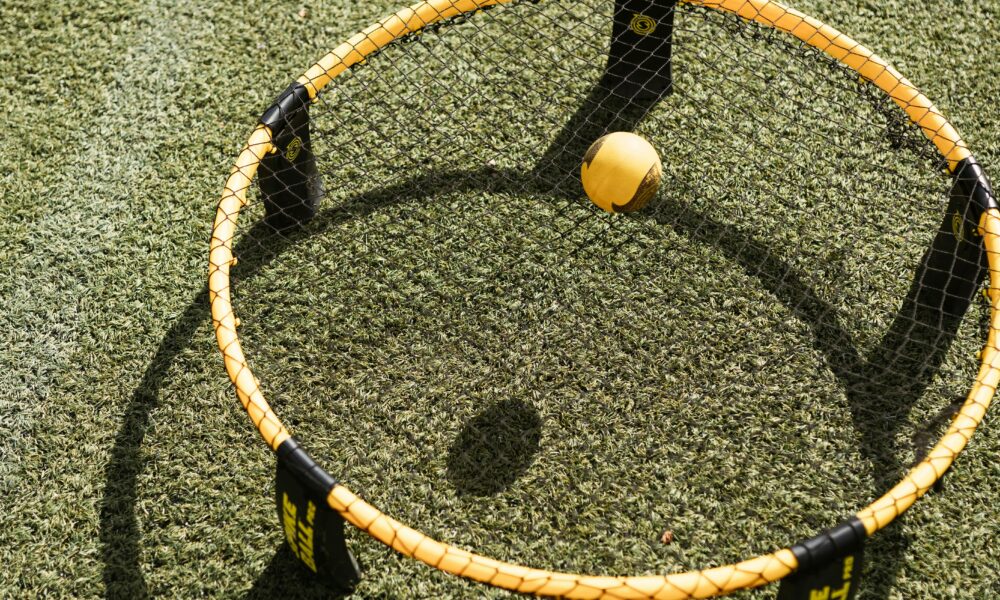

Spikeball rules, simply: Roundnet (often called Spikeball, after the popular equipment brand) is usually played by two teams of two around a low, circular net. One player serves the ball down onto the net so that it rebounds toward the opposing team. That team may touch it up to three times before hitting it onto the net again. Each rally scores one point; common recreational games go to 11, 15 or 21, with a two-point winning margin. The ball must be hit, not caught or carried.
2026 rules note: The International Roundnet Federation (IRF) published updated official rules on July 17, 2026. Local games using Spikeball’s simple beginner rules can differ from sanctioned tournament play. This guide distinguishes easy backyard rules from competitive details rather than treating all formats as identical.
Spikeball rules at a glance
| Topic | Quick answer |
|---|---|
| Other name | Roundnet |
| Players | Two teams of two in the usual format |
| Equipment | Round net, small ball, safe playing surface |
| Hits per team | Up to three before returning the ball to the net |
| Points | One after every rally (rally scoring) |
| Common game lengths | 11, 15 or 21 points; usually win by two |
| Serve | Toss and strike ball onto net toward designated receiver |
| Second serve | Ordinarily allowed after a first-service fault under the basic rules |
| Net rim | Direct rim contact is normally a fault or loss of rally, depending on context |
1. Set up the net and teams
Place the round net on level ground away from obstacles, breakable objects and people outside your game. Ensure all legs sit securely and the net tension is even, so the ball rebounds consistently. Two players face two opponents across the net for the initial serve; after a legal return, players normally move freely around all sides rather than remaining on a fixed half-court.
Agree on whether your match ends at 11, 15 or 21, and whether you are using the casual Spikeball guide or an organized event’s formal rules. If one teammate is new, play a short warm-up rally in which everyone alternates touches to learn the speed of the rebound.
2. How to serve in Spikeball
Pick the first server and receiver. The receiver should be designated before the serve, and the other players give enough room to react. Toss the ball into the air and strike it onto the net; a legal serve should rebound toward the receiving side without directly hitting the hard rim. In many standard instructions, the server gets one second attempt after a first fault, but two faulty serves award the point to the other team.
Spikeball’s published general instructions place everyone except the designated receiver at least 7 feet from the net before the serve. Informal beginners often start nearer by agreement. Official tournament rules have more detailed positioning and footwork requirements; check the event’s current IRF document rather than improvising a distance during a disputed point.
Common serve faults
- Hitting the rigid rim directly rather than making a clean net rebound.
- Delivering a serve that pockets or rebounds irregularly when the applicable service rules treat it as a fault.
- Tossing and then catching or dropping the ball instead of legally striking it.
- Standing or moving illegally under the competition’s serve-position requirements.
- Having someone other than the designated receiver try to receive the serve.
3. Return the ball in up to three touches
After a successful serve, the receiving team can take one, two or three touches and must then hit the ball onto the round net. The next team does the same. Think of the net as a rebound surface: the hit travels down onto it and springs out for the opposition.
Teammates must ordinarily alternate contacts; one player cannot simply hit the ball twice in a row. Competitive exceptions and special soft-touch rules can apply, but beginners should follow the simpler alternate-hits rule until everyone agrees otherwise. You may use different body parts for a clean hit, provided the ball is not caught, scooped, thrown or carried.
A correct three-touch rally
- Team A serves onto the net.
- Team B player 1 bumps the ball upward.
- Team B player 2 sets it higher.
- Team B player 1 strikes it onto the net.
- Team A has up to three touches to send it back.
There is no requirement to use all three touches: if the first receiving player can legally return the ball directly to the net, that may be enough.

4. When does the rally end, and who gets a point?
Roundnet uses rally scoring, so either team can score, not only the team that served. A rally ends when one side cannot complete a legal return: for example, the ball strikes the ground, the team uses too many touches, a player catches the ball, or a hit creates a disallowed net or rim contact. Depending on the applicable rules, contact with an opponent that prevents a play can produce a replay or a penalty rather than an automatic point.
Most friendly games are played to 11, 15 or 21, but the winning team must lead by two. A game to 15 is not finished at 15–14; play continues until 16–14 or another score with a two-point gap. Tournament directors may announce different match formats before play.
| Situation | Likely outcome under beginner rules |
|---|---|
| Return hits the floor before reaching net | Other team wins rally |
| Team touches ball four times | Other team wins rally |
| Player catches or throws ball | Other team wins rally |
| Server faults on both attempts | Receiving team gets point |
| Clean legal net return cannot be reached | Hitting team gets point |
| Both teams dispute whether opponent blocked play | Consult replay/hinder rule; replay by agreement if unresolved |
5. Rim, pocket and roll-up: what counts?
Rim: The hard plastic or metal edge of the set is different from the netting. A direct rim hit is generally illegal. Pocket: A ball can contact the net near the rim and take an unusual rebound; its legality depends on whether it happens on the serve or during an ordinary rally. Roll-up: A ball may land on netting and then roll toward or past the edge instead of contacting the rim directly. Avoid declaring every unusual bounce a foul: the current rules distinguish these scenarios.
Spikeball’s general published guide says pockets on non-service rallies can be legal, while a serve must rebound cleanly. Organized events may use more precise definitions, making the 2026 IRF official rules the authority for disputed tournament calls.
6. Backyard Spikeball vs tournament roundnet in 2026
| Issue | Friendly backyard version | Sanctioned event |
|---|---|---|
| Serve position | May be relaxed by agreement | Follow official positioning and receiver rules |
| Game length | Choose 11, 15 or 21 | Follow the published event format |
| Rim or pocket disputes | Replay unclear points by agreement | Apply IRF definitions and observer procedure |
| Interference | Pause and replay if people collide | Use official hinder and obstruction rules |
| Safety and boundaries | Play in a clear open area | Respect event field boundaries and any no-hit restrictions |
The IRF’s July 2026 revision is the starting point for competitive players. A 2023 or 2024 blog post may describe a different serve boundary or attack-zone convention; do not assume it is the current standard.
7. Who serves after winning a rally?
If the serving team wins, the service remains on that side for the next point, with the appropriate receivers/positions following the agreed rotation. If the receiving team wins, its next designated player serves according to the preset order. An easy way to prevent arguments is to decide the full four-player serve order before the game and write it down. More formal competition rotation and serve-receive rules should follow the event’s version of the IRF rules.
Common mistakes and quick fixes
- Standing too close on the serve: Learn the serve-position requirement before the first rally.
- Trying to hit the ball over the net: Unlike volleyball, the return must rebound off the horizontal net.
- Hitting twice consecutively: Practice bump–set–attack with alternating players.
- Touching the frame: Focus on hitting the tensioned net surface.
- Continuing after the ball hits the ground: The rally has ended.
- Forgetting to win by two: Set a clear end score and margin in advance.
Ten-minute beginner practice before playing
Spend two minutes checking the set and practicing a straight rebound. Have each partner work on gentle bump-and-set touches for three minutes. Next, serve slowly to a designated receiver for three minutes; only count clean rebounds. Finish with two minutes of rally practice, aiming for a legal two-touch return before trying fast attacks. Stop if anyone risks collision or falls on uneven terrain.
Frequently asked questions
Are Spikeball and roundnet the same sport?
Roundnet is the sport; Spikeball is a widely used brand and a common informal name for the game.
Can you score a point when you are not serving?
Yes. Roundnet normally uses rally scoring: each rally awards a point.
Is a pocket always illegal?
No. The treatment of unusual rebounds depends on whether the ball is being served, whether it contacts the rigid rim and which ruleset governs the game.
Do you have to use three touches?
No. Three is ordinarily the maximum, not a requirement.
Can you hit a Spikeball with your foot?
Clean contacts with body parts may be permitted under general roundnet rules; confirm exact playing conditions with the competition rules if taking part in a tournament.
What changed in the 2026 roundnet rules?
The IRF issued an updated official ruleset dated July 17, 2026. Tournament-specific service, zone and playing-surface questions should be resolved from that version rather than an older informal rule summary.
Want to compare another net sport’s rally and serving mechanics? Read our published volleyball serve techniques guide; the sports have different rebound surfaces and service rules, despite sharing teamwork and ball-control skills.


